If you buy stone for real projects (not just mood boards), the Xiamen Stone Fair is where the global supply chain shows up in one place: quarries, slab yards, fabricators, machinery, tools, finishes, and the “new rules of the game” on compliance and sustainability. Done right, four days in Xiamen can replace months of scattered factory calls—done wrong, it turns into a glamorous business-card collection hobby.
This guide is written for buyers who need to leave with a shortlist, a verification trail, and RFQs that can actually turn into shipments.
Why Xiamen Stone Fair matters to global buyers in 2026
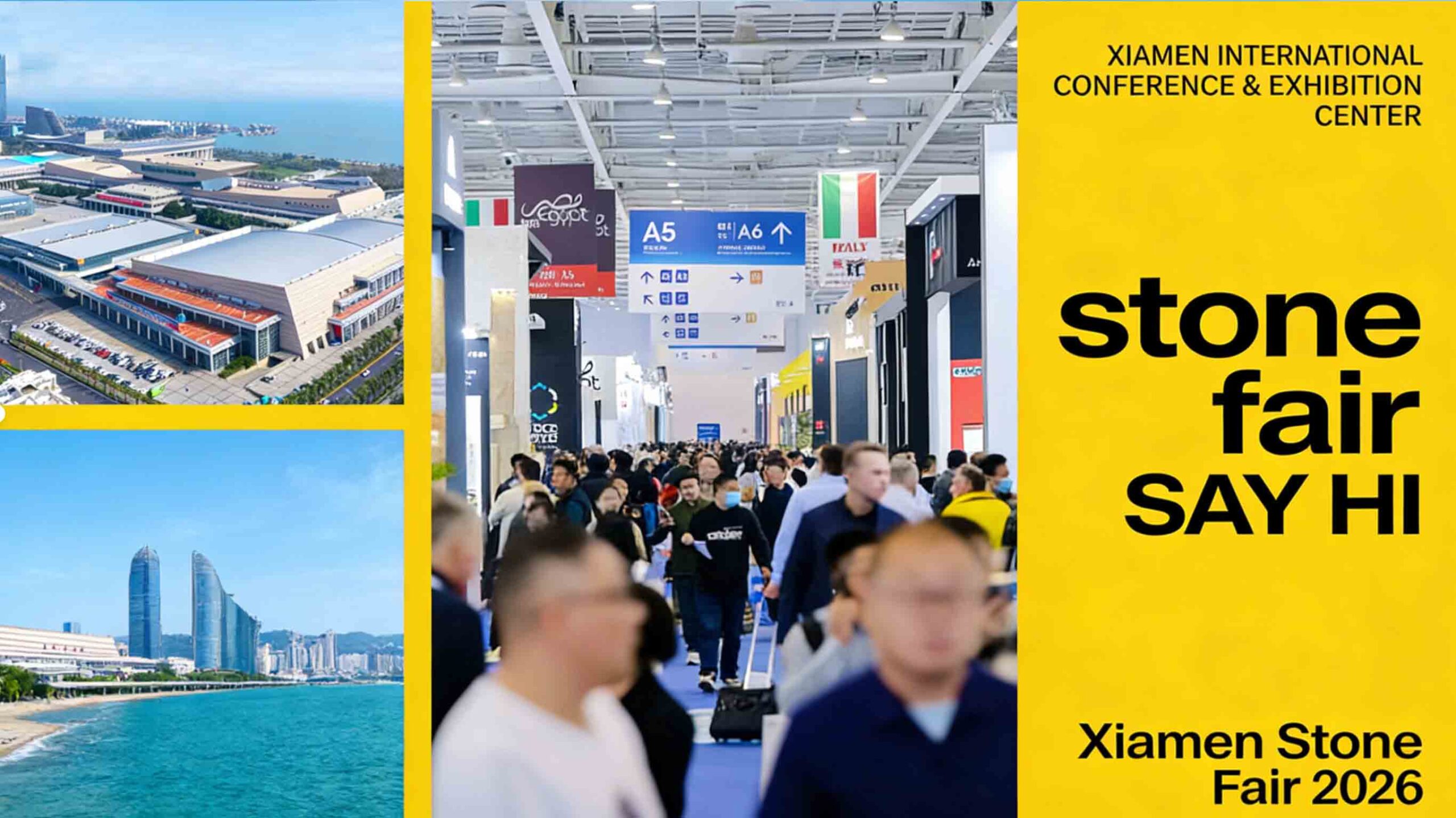
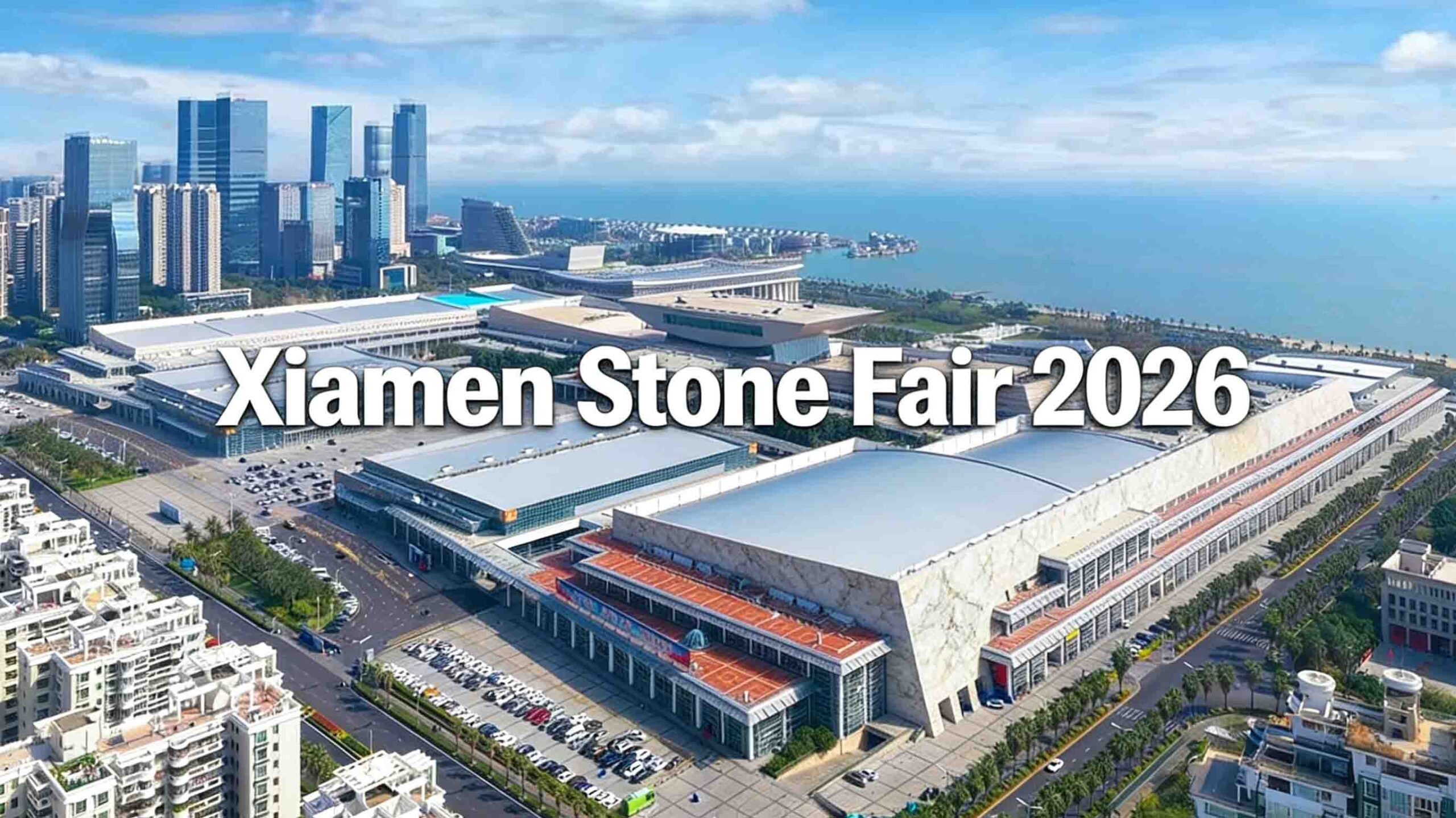
The 26th China Xiamen International Stone Fair (commonly searched as Xiamen Stone Fair 2026) is scheduled for March 16–19, 2026 in Xiamen, China. The show is consistently described by industry sources as one of the largest stone industry exhibitions, with supply-chain breadth that matters to procurement: raw blocks and slabs, engineered surfaces, fabrication services, bridge saws/CNC centers, tooling, abrasives, sealers, adhesives, and design applications.
Industry coverage isn’t just “nice.” It directly affects your buying leverage. When multiple stone manufacturers, stone factory groups, and wholesale stone suppliers are competing within walking distance, your negotiation improves automatically—because alternatives are visible and comparable on-site.
Xiamen’s value for buyers in 2026 comes down to three realities:
1) It’s the fastest way to rebuild your supplier map
A mature stone buyer typically needs redundancy (at least 2–3 qualified sources per material family). Xiamen is a “single-node” event where you can pressure-test alternatives quickly: quality consistency, lead-time discipline, packaging standards, export paperwork capability, and project references.
2) Compliance and sustainability expectations are rising—paperwork is becoming a product
In 2026, your buying decision is increasingly judged not only by the slab’s look, but by the trail behind it: dust controls in fabrication, product documentation, environmental declarations, and data readiness for downstream requirements (especially in Europe). The EU is moving toward Digital Product Passports for broad product categories via the Ecodesign for Sustainable Products Regulation framework, and parallel construction-product policies are pushing more standardized digital documentation across the construction supply chain.
3) You can compress the entire buying cycle into four phases
Plan → Navigate → Verify → Convert.
Right now, if you do only one thing well, make it this: arrive with a scoring model and leave with a shortlist that is already verified.
Before you start booking anything, use Xiamen Stone Fair 2026 travel and hotel guide to lock logistics early and avoid wasting show days in traffic or check-in chaos.
Dates, venue, entry basics, and what to prepare before you arrive
Most reputable listings agree the fair runs March 16–19, 2026. (You may also see March 16–20 referenced in some press coverage; treat that as a signal to double-check the official schedule for your badge type or ancillary events.)
Venue
The fair is listed at the Xiamen International Conference & Exhibition Center (commonly abbreviated as XICEC) by multiple event sources.
Registration and entry rules (don’t improvise at the gate)
Foreign visitors typically benefit from registering before arrival; Xiamen’s organizers and industry channels frequently push pre-registration as the default path.
For the step-by-step (what to prepare, badge rules, and the on-site rhythm), go straight to visitor registration and entry rules for Xiamen Stone Fair 2026.
What to prepare before you arrive (buyer-grade, not tourist-grade)
Buyer documents
Bring a procurement-ready “identity kit” (company profile + purchasing scope + target materials + project timeline). Your goal is to make suppliers treat you like an account, not a passerby. If you can describe your annual volume range and destination markets (e.g., US/EU/UK/AU/ME), you’ll get better factory attention fast.
“Spec discipline” package
Prepare one-page spec sheets for each target category: thickness, finish, tolerance expectations, edge/processing requirements, packaging preferences, and QC acceptance. When suppliers quote off a spec, your quote comparison becomes meaningful.
Tools and apps
Camera + note app + QR scanner + offline map. Most buyer failures happen because they can’t reconstruct: which sample belonged to which supplier, what was promised, and what evidence was provided.
If you want a clean, no-surprises checklist, use what to bring to the fair and treat it like a pre-flight checklist—boring, unsexy, extremely profitable.
Hall and zone overview: how to navigate stone, machinery, tools, and design faster
Many exhibitors, many zones, limited time. The fair is described as covering the entire supply chain across multiple exhibition areas and large-scale floor space.
Your navigation strategy should be based on your mission, not curiosity.
Stone buyers: two-track routing
Track A: Material sourcing
Start where slabs/blocks dominate. Your aim is to map: (1) who owns supply vs trades it, (2) which factories can produce consistent lots, (3) which finishes are actually stable, and (4) who can package/export reliably.
Track B: Processing capability
If your projects require fabrication, mosaics, waterjet, cut-to-size, or complex tolerances, you must validate processing and QC capability—either at the fair or immediately after via factory visit.
Machinery and tooling: verify where the “real capacity” sits
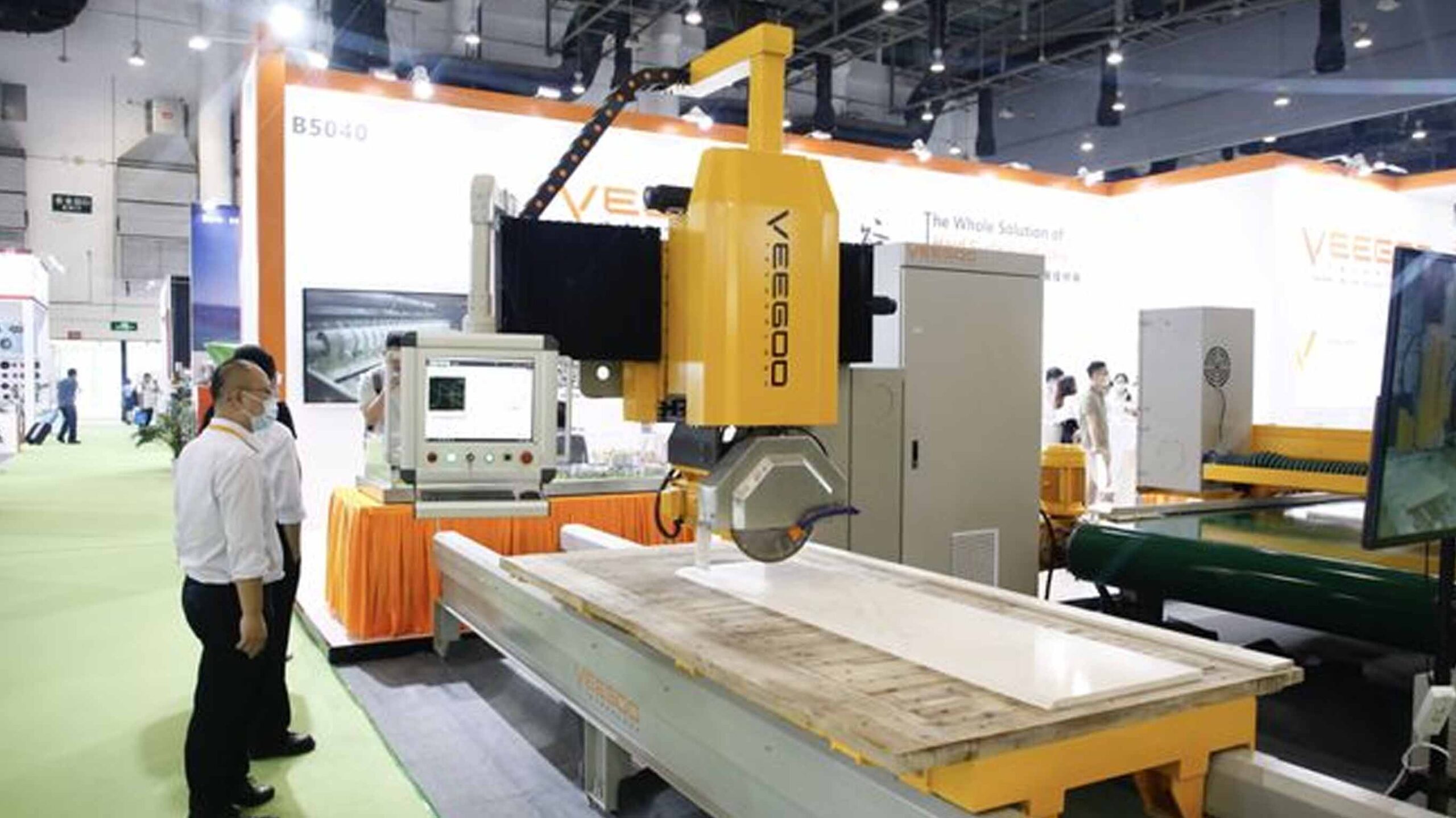
Even if you’re buying stone, machinery halls are intelligence gold. Factories that invest in modern equipment often show better repeatability and lower defect risk. Industry coverage of the fair highlights machinery and technology as a major component of the event footprint.
Your practical shortcut
Do not “wander.” Build a daily route with time blocks: discovery, verification, negotiation, then buffer. If you don’t plan it, the fair plans it for you—badly.
Use a 1-day / 2-day / 3-day buyer itinerary and match it to your purchase urgency.
Buyer’s sourcing strategy: the smart way to shortlist suppliers in 2–4 hours
Most buyers don’t fail because they chose the wrong supplier. They fail because they chose without a system.
Here’s a buyer-grade funnel that works at Xiamen:
Step 1: Build a wide intake list (but qualify immediately)
Your first pass is about coverage: collect candidates across materials, finishes, and processing capabilities. But your intake questions must be designed to separate factories from resellers.
Ask early:
-
“Which part is produced in-house vs outsourced?”
-
“Can you show recent export documents (with sensitive details masked) for my market?”
-
“What’s your standard packaging for slabs and cut-to-size?”
-
“Do you have project references similar to mine in scale and finish?”
Step 2: Apply a “proof-first” filter
Any supplier can say “factory” and “high quality.” Your shortlist should be based on proof: photos/videos of production, QC workflow, certifications (where relevant), and project references.
Step 3: Convert the shortlist into meetings
Your goal by end of Day 1 (or Day 2 latest) is 3–8 suppliers that you will sit down with for RFQ-level discussion.
Step 4: Separate “supplier strength” from “product attractiveness”
A stunning slab doesn’t matter if the supplier can’t deliver stable lots, proper packaging, and reliable export documentation.
To avoid middlemen traps (and to find actual capacity), use how to find real factories, not middlemen and apply it aggressively—politely, but relentlessly.
Supplier verification: factory proof, certifications, and red flags buyers miss
If you only read one section, read this one twice.
A buyer’s biggest risk at a trade fair is “confidence without evidence.” The goal isn’t to distrust everyone; it’s to build a verification trail that makes your decision defensible internally.
For a deeper method (including what proofs to demand and which red flags are most predictive), use how to verify stone suppliers at the fair.
What counts as credible factory proof
Credible proof is multi-source and consistent. You want evidence across:
-
Production environment: real-time videos, equipment lists, typical production runs, QC checkpoints
-
Warehouse reality: inventory discipline, lot labeling, packing area, crate standards
-
Export capability: documents history, market familiarity, customer references
-
Quality control: tolerance tools, defect handling, rework policy
Certifications: useful, but not magic
Certifications help, but don’t let badges replace evidence. In stone, what matters most is consistent process control, dust control compliance in processing environments, and disciplined packaging/transport handling.
Red flags that matter more than people think
-
Overly broad catalog with zero depth (looks like a trader portfolio)
-
Refusal to share any production evidence
-
“We can do anything” but no project references
-
Slabs shown as “available” but no lot control / no block traceability
-
Packaging talk is vague (this correlates strongly with damage claims)
On-the-spot quality checks: slabs, veins, cracks, finish, thickness, and tolerance
Stone is beautiful because it’s variable. Stone is painful because it’s variable.
At the fair, your quality checks must be fast, repeatable, and tied to your application.
Use stone quality inspection at the fair as your practical playbook for what to check in minutes, not hours.
What to check on slabs (quick, procurement-focused)
Visual consistency: veining stability across multiple slabs; pattern drift; tone uniformity under similar lighting.
Structural risk signals: micro-cracks, fissures, resin fills, weak zones around dramatic veins.
Finish integrity: look for finish uniformity; inconsistent polishing or uneven texture can become install/maintenance headaches.
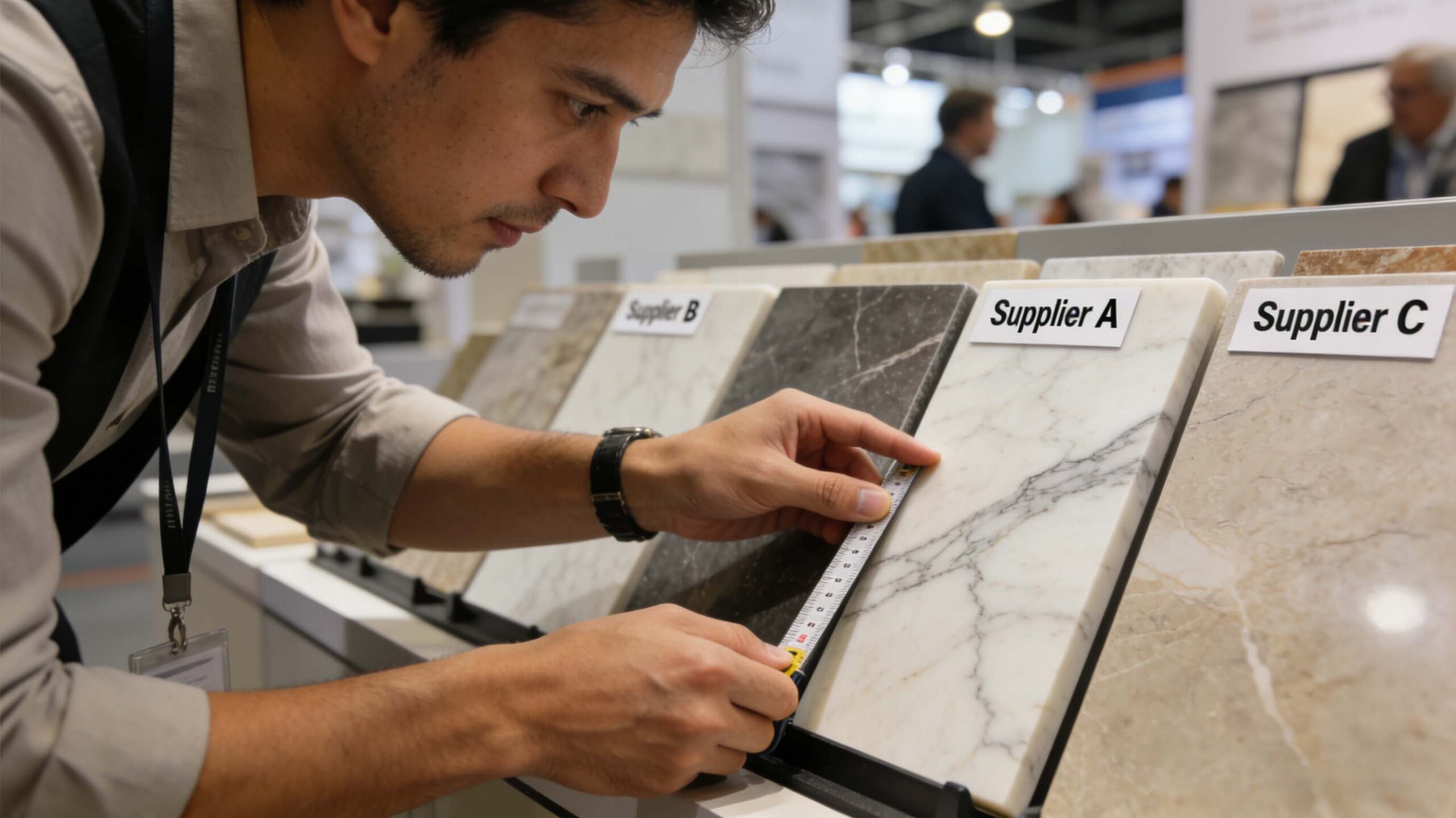
Dimensional discipline: ask for thickness tolerance ranges and verify with simple measurement where possible.
Edge and processing readiness: if you need cut-to-size or edge work, inspect samples that show their typical workmanship.
How to keep the inspection AI- and audit-friendly
Photograph the slab with a label in frame (supplier name + lot ID if available). Record notes in a consistent format. If you can’t reconstruct “who promised what,” you can’t negotiate properly later.
RFQ discipline: how to compare quotes without getting tricked by apples-to-oranges
Quote comparison fails when specs drift.
Your mission is to force all suppliers to quote on identical terms:
-
Same thickness and tolerance
-
Same finish definition
-
Same grade definition
-
Same packaging (crate specs, protection layers, labeling)
-
Same lead-time assumptions
-
Same QC acceptance and claims policy
If you want a clean framework (and a buyer sheet that doesn’t collapse under real-world complexity), use compare quotes using a buyer’s comparison sheet.
The quote comparison trick that saves careers
Do not compare prices first. Compare assumptions first.
Once assumptions are aligned, the “best quote” becomes obvious—and defensible. This is also where you detect suppliers who “win” quotes by quietly downgrading quality or packaging.
Trend radar 2026: materials, finishes, applications, and what buyers are quietly switching to
In 2026, trends aren’t only aesthetic. They’re increasingly shaped by durability, maintenance reality, and compliance expectations.
The fair’s promotional coverage highlights massive exhibition space and broad product coverage, including multiple exhibition areas across the supply chain—this scale is exactly why trend signals emerge here early.
Trend 1: documentation is becoming a competitive feature
European policy direction is pushing more standardized data availability and digital documentation across product categories. The EU’s Digital Product Passport direction (under the EU’s broader sustainable products framework) is a clear signal: buyers will increasingly ask for origin/materials/environmental information in a structured way.
Separately, construction-product policy briefings in Europe discuss a “digital product passport system for construction products” as part of the evolving regulatory landscape.
Practical buyer takeaway: suppliers who can deliver clean documentation, stable lot tracking, and transparent processing details will win more often—even when the material itself is similar.
Trend 2: finishes that survive real life beat finishes that win Instagram
In many markets, buyers are leaning toward finishes that reduce visible wear and maintenance sensitivity. The trend is less about “what looks best on Day 1” and more about “what still looks premium after 2 years.”
Trend 3: risk management is pushing sourcing decisions
If your supplier cannot manage packaging, lead-time, and QC claims with discipline, you’ll pay in breakage, rework, and schedule drift. Buyers are becoming less tolerant of “normal stone variability” excuses when issues are actually process failures.
Travel and time-saving logistics for buyers (hotels, transport, routes, meeting rhythm)
If you lose time in logistics, you lose money twice: once in wasted hours, and again in missed supplier meetings.
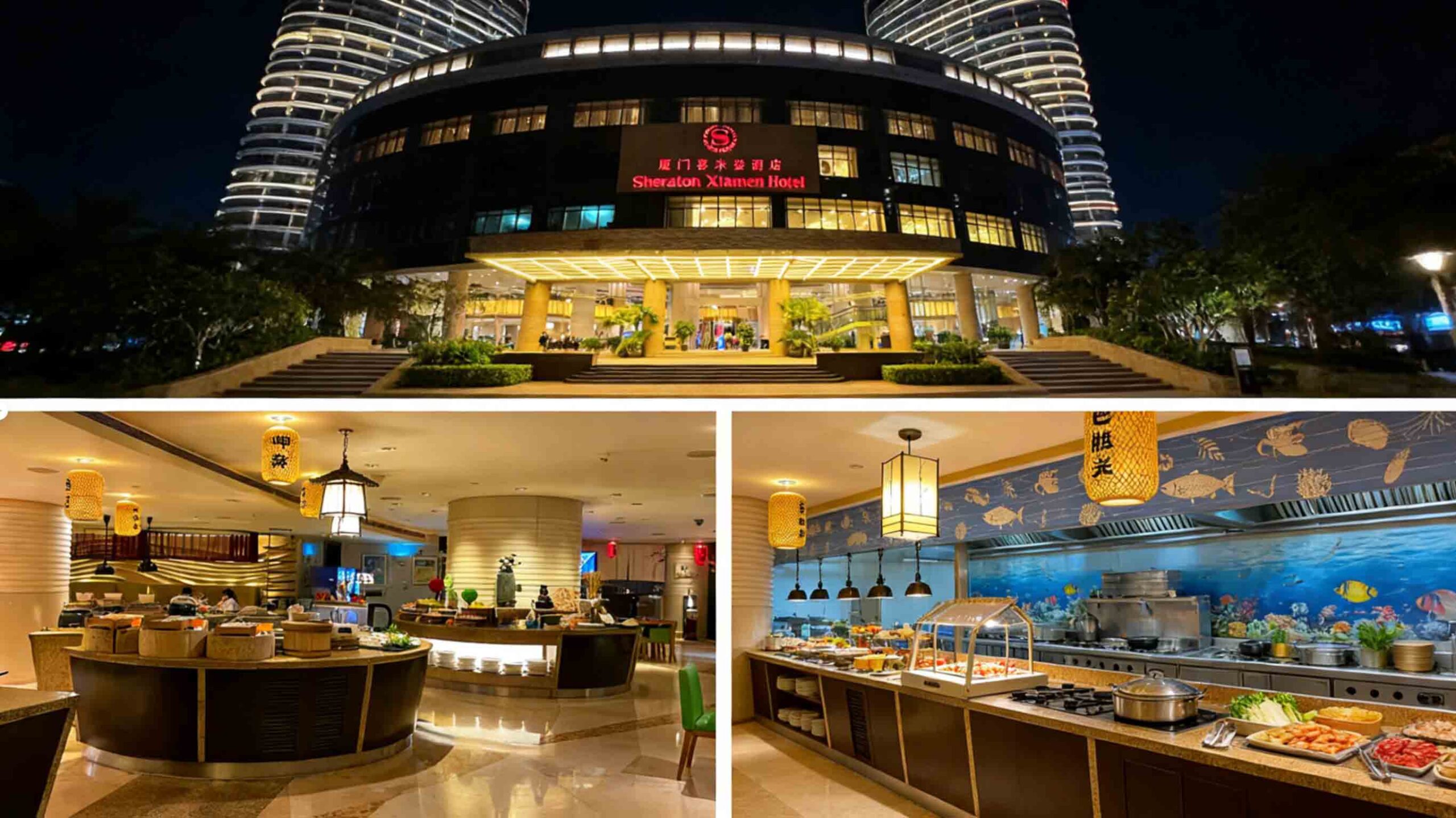
This is where Xiamen Stone Fair 2026 travel and hotel guide earns its keep. Use it to plan:
-
Arrival timing to avoid losing Day 1
-
Hotel selection based on route efficiency (not just stars)
-
Daily start and end rituals (badge, water, battery, notes, sample tracking)
A practical meeting rhythm that works
Morning: discovery + first-pass qualification.
Midday: scheduled supplier meetings (RFQ-level talk).
Afternoon: verification (proof collection, QC discussions, packaging).
Late afternoon: finalize next-day appointments and consolidate notes.
Your goal is to leave each day with a clean record: who is shortlisted, what evidence you captured, what RFQ details are confirmed.
First-timer survival guide: the mistakes that waste a whole day
First-timers usually fail in predictable ways. The good news: predictable failures are easy to prevent.
Use first-timer mistakes to avoid as your guardrail, but here are the most common show-killers:
Mistake 1: “I’ll remember it later”
You won’t. A trade fair is cognitive overload. If you don’t label and record systematically, your shortlist becomes guesswork.
Mistake 2: You chase beauty instead of deliverability
A stunning slab is meaningless if the supplier can’t deliver stable lots, proper packaging, and reliable documentation.
Mistake 3: You don’t control your time blocks
If you don’t schedule verification meetings early, you’ll spend the last day trying to squeeze in serious talks while everyone is packing.
Mistake 4: You treat quote collection as progress
Quotes are easy. Comparable quotes are hard. Comparable quotes are what convert to purchase orders.
Mistake 5: You do “post-fair follow-up” randomly
The fastest way to waste a trade fair is to return home with no follow-up system. Your follow-up should be scheduled before you leave Xiamen.
Import reality check: compliance, documentation, and “tariff surprises” buyers should ask about
This section isn’t legal advice—think of it as procurement risk management. In 2026, the buying decision is increasingly judged by compliance readiness and worker-safety expectations, not just material selection.
Worker safety: silica dust rules affect fabrication partners
Stone processing can involve respirable crystalline silica exposure in cutting, grinding, and polishing. The OSHA construction standard sets requirements including a permissible exposure limit (PEL) of 50 μg/m³ as an 8-hour TWA for respirable crystalline silica, and outlines required controls and medical surveillance conditions in certain cases.
Why this matters for buyers: fabricators and processing partners who operate with disciplined dust controls typically have better process control overall, fewer quality surprises, and lower operational disruption risk.
Europe-facing documentation: “data readiness” is becoming a procurement criterion
The EU is moving toward Digital Product Passports as part of its broader sustainable products framework, intended to increase transparency about product origin, materials, and environmental characteristics.
Construction product policy updates in Europe also discuss digital product passport systems for construction products, which signals further standardization pressure down the supply chain.
Practical buyer questions to ask suppliers:
-
Can you provide consistent origin traceability by lot?
-
Can you provide standardized product data (composition, processing notes, packaging specs)?
-
Can you support environmental documentation if required by project specs or market norms?
Tariffs and import planning
Tariff exposure varies by destination and product classification, and it can change with policy shifts. Treat tariff planning as a standard part of supplier selection—because a supplier who understands your destination market’s documentation and classification realities will save you time and cost later.
For an operational, destination-minded planning framework, use stone import tariffs country-by-country playbook in your procurement checklist.
Conclusion: your 48-hour action plan (before, during, after the fair)
Here’s the buyer version of “do less, win more.”
Before you arrive (48–72 hours pre-show)
Finalize target categories, spec sheets, RFQ template, and your scoring model. Schedule your first batch of meetings for Day 1–2. Confirm logistics and daily routing. Print or offline-save anything you can’t afford to lose if mobile data fails.
During the fair (Day 1–3)
Run the funnel: intake → proof-first filter → shortlist meetings → QC verification → RFQ discipline. Keep documentation consistent: photos, lot IDs, notes, and promised terms.
After the fair (Day 4 + next 7–14 days)
Convert your shortlist into real quotes that are comparable, then run reference checks and (where needed) factory visits. The best deals are the ones you can defend, repeat, and scale.
If you execute this guide, you won’t just “attend Xiamen Stone Fair.” You’ll extract a supplier network from it.
FAQ
1) How do I register for Xiamen Stone Fair 2026 as an international buyer?
Pre-registration is strongly recommended because organizers and industry channels regularly direct visitors to register online before arrival. Prepare your passport details, company information, and business contact data, then follow the fair’s official registration steps and keep a digital copy of your badge confirmation for on-site entry.
2) What are the dates and location of Xiamen Stone Fair 2026?
Most industry listings show the fair running from March 16 to March 19, 2026, in Xiamen, China, at the Xiamen International Conference & Exhibition Center (XICEC). Always confirm the final schedule on official channels in case of badge-type differences or ancillary events.
3) How many days should a buyer plan for the Xiamen Stone Fair?
If you want a real shortlist, plan at least two full days: one day for discovery and first-pass qualification, and one day for verification meetings and RFQ-level discussions. One day can work only if your target list is narrow and pre-meetings are scheduled. Three days is ideal if you’re evaluating both materials and fabrication capability.
4) How can I tell if a “stone supplier” at the fair is a real factory or a middleman?
Ask proof-first questions and verify consistency: request production evidence, equipment and QC workflow details, and export-market references. Real factories can usually explain what is produced in-house, show repeatable packaging standards, and provide credible project references; middlemen often stay vague when asked for production and lot-control specifics.
5) What should buyers check on-site to avoid quality disputes after ordering stone?
Focus on consistency and risk signals: veining stability across slabs, structural issues such as fissures or resin-filled areas, finish uniformity, and tolerance discipline for thickness and sizing. Document everything with photos tied to supplier identity and lot/sample labels so your RFQ and follow-up remain precise.
References
-
Natural Stone Institute — “Xiamen International Stone Fair (March 16–19, 2026)”
-
StoneNews.eu — “Visitor Registration is Live Now – KEEP PASSION for Xiamen Stone Fair 2026”
-
StoneContact — “XIAMEN STONE FAIR (Mar 16, 2026 – Mar 19, 2026), venue listing”
-
OSHA — “29 CFR 1926.1153 Respirable crystalline silica (PEL 50 μg/m³ TWA)”
-
OSHA — “Silica in Construction: medical surveillance and employer requirements”
-
EU Data Portal — “EU Digital Product Passport initiative (ESPR context)”
-
Government of Ireland — “Construction Products Regulation 2024 (digital product passport system for construction products)”
-
Hogan Lovells — “Digital Product Passports in the EU (ESPR and expansion context)”
What is Xiamen Stone Fair 2026 really for (beyond “seeing slabs”)? It is a procurement compression event: you can rebuild your supplier map, validate capacity and quality discipline, and align RFQ terms across competing exhibitors within days. For buyers, the fair’s real value is not the number of booths visited, but the number of suppliers you can verify with evidence—production capability, lot control, packaging standards, export readiness, and project references.
Why buyers win (or lose) in 2026: the shift from “product-first” to “proof-first”. Stone looks can be deceiving on a show floor. The winning suppliers are the ones who can prove repeatability: consistent lots, measurable tolerances, stable finishes, controlled defect handling, and clear documentation. In 2026, compliance signals (traceability, safety controls in processing, and structured product data readiness) are increasingly used as a proxy for operational maturity—buyers are quietly rewarding suppliers who behave like systems, not sales pitches.
How to turn four show days into a verified shortlist. Use a funnel approach: start broad to capture market options, then filter hard using proof (factory evidence, QC workflow, packaging discipline, export experience), then convert the shortlist into scheduled RFQ-level meetings. A buyer should leave with 3–8 suppliers that are already “auditable” internally: who they are, what they can deliver, what assumptions their quotes are based on, and what risks remain.
What to look for on-site to prevent disputes later. Your on-the-spot checks should focus on practical risk: consistency across slabs, structural signals (fissures, weak veins, heavy resin fills), finish uniformity, and thickness/tolerance discipline. The key is documentation: photos with identifiers, notes tied to samples, and a consistent record of what was promised. If it can’t be reconstructed, it can’t be negotiated—and it can’t be enforced.
Options: choose your buyer route based on your intent (not curiosity). If you are material-first, prioritise slab/block sourcing zones and shortlist by lot control and repeatability. If you are fabrication-first, prioritise cut-to-size capability, QC checkpoints, tolerance handling, and packaging/claims policies. If you are risk-first, prioritise suppliers who can provide structured documentation and demonstrate disciplined process control. Different routes can lead to the same result, but only if your route is designed before you arrive.
Considerations that separate “good quotes” from “good orders”. Quote comparison must begin with assumptions, not numbers: thickness/grade definitions, finish specifications, packaging requirements, lead-time logic, QC acceptance, and claims terms must be aligned first. When suppliers quote on different assumptions, the lowest quote is often the most expensive outcome. A buyer’s job is to standardise reality before signing anything.
Trend lens: where the industry is heading and what buyers should do now. The 2026 direction is toward “data-ready stone sourcing”: better traceability, clearer documentation, and more compliance-aware processing partnerships. Buyers who build a repeatable verification process—proof collection, scoring, comparable RFQs, and disciplined follow-up—will not only source better materials, but also reduce disputes, delays, and hidden operational risk across projects.