If you treat Xiamen Stone Fair like a “walk-around-and-see” event, you’ll leave with a phone full of photos and a brain full of regret. If you treat it like a procurement sprint, you’ll leave with a verified shortlist, comparable RFQs, and meetings already scheduled for the next step.
Xiamen Stone Fair 2026 is widely listed for March 16–19, 2026 at the Xiamen International Conference & Exhibition Center (XICEC). The event scale is massive: Natural Stone Institute notes 2,000+ exhibitors and 150,000+ attendees, spanning the stone supply chain. StoneNews.eu also reports an exhibition space of 191,000 sq.m with “eight distinctive exhibition areas.”
This planner gives you three itinerary options (1-day / 2-day / 3-day) built for buyers who want stone manufacturers / factory / wholesale suppliers—not random brochures.
For the full show strategy (halls logic, sourcing funnel, compliance signals, and trend radar), start here: Xiamen Stone Fair 2026: The Complete Buyer’s Guide (Dates, Halls, Sourcing Strategy & Trends)
How to use this schedule planner (so it actually works)
The only rule that matters: time blocks beat motivation
The fair is too big to “wing it.” Your schedule should protect four outcomes:
-
A shortlist of suppliers worth quoting
-
Evidence (photos + notes) that your team can audit later
-
RFQs sent with aligned assumptions
-
Follow-up meetings booked before suppliers disappear into post-show chaos
Prep in 30 minutes the night before
-
Decide your buying intent: slabs/blocks, cut-to-size, project supply, fabrication, tools/machinery
-
Create a shortlist target: 6–12 suppliers if you have 2–3 days; 3–6 if you have one day
-
Prepare an RFQ skeleton (specs + finish + tolerances + packaging + inspection acceptance + lead time assumptions)

2026 reality check: why your schedule must include “proof and documentation”
Buyer expectations are shifting from “product-first” to “proof-first.” Two policy signals explain why documentation readiness is creeping into procurement conversations:
EU: Ecodesign for Sustainable Products Regulation (ESPR) and the Digital Product Passport direction
The European Commission describes the ESPR as a framework to improve product sustainability and enable better product information flows across the market. In practical buyer terms: if you sell into Europe (directly or indirectly), structured product information and traceability direction is getting stronger.
Construction supply chains: digital product information is increasingly expected
Several explainers note DPP frameworks linked to EU legislation (e.g., ESPR and the Construction Products Regulation context), reinforcing the broader move toward digital product info and traceability in construction ecosystems.
You don’t need to become a compliance officer to benefit. You just need to schedule time to ask suppliers for repeatability signals: lot consistency, QC checkpoints, packaging discipline, and structured documentation habits.
The buyer’s “3-pass method” (use this in all itineraries)
Pass 1: Scan (fast discovery)
Goal: identify relevant booths quickly and avoid rabbit holes.
What you do:
-
Walk with a stopwatch mentality
-
Collect only “fit signals” (material match, category match, supplier type)
Pass 2: Verify (proof-first)
Goal: separate real capability from show-floor storytelling.
What you ask:
-
What is produced in-house vs outsourced?
-
What machinery/processes do you control?
-
What export markets do you ship to regularly?
-
What packaging standard do you use for slabs/tiles/cut-to-size?
-
Can you show project references similar to mine?
Pass 3: Convert (RFQ-level meetings)
Goal: align assumptions so quotes become comparable.
You confirm:
-
thickness and tolerance
-
finish definition and acceptance criteria
-
grade/selection standards
-
packaging and labeling
-
claims/dispute handling approach
1-Day itinerary for buyers (high-intensity, high-selectivity)
This is for buyers who can only spare one full day on the show floor. The objective is not “coverage.” The objective is a shortlist that can survive internal review.
08:30–09:15 | Entry, orientation, map check
Arrive early. Your Day 1 value dies in queues.
Do:
-
confirm entrances for pre-registered visitors (if you pre-registered, you often have faster workflows)
-
take 5 minutes to review the show map and identify the areas that match your intent (stone materials vs processing vs tools/machinery)
Output:
-
a written route for the next 3 hours (yes, write it)
09:15–11:30 | Pass 1 scan: build a candidate list (10–20 booths)
Move fast. Do not negotiate.
Do:
-
stop only when a booth matches your buying category
-
collect: booth name/number, main product line, who you spoke to, one photo of representative material
Output:
-
10–20 candidates (you will eliminate most)
11:30–12:30 | Pass 2 verification: eliminate aggressively (reduce to 6–8)
Now you test reality.
Ask:
-
“What do you produce in-house?”
-
“What’s your QC flow?”
-
“What’s your export history?”
-
“How do you handle breakage claims and packing standards?”
Output:
-
6–8 verified candidates
12:30–13:30 | Lunch + evidence整理 (don’t skip this)
Most buyers skip consolidation and later forget everything.
Do:
-
label photos in your phone immediately
-
add a simple score next to each candidate: A/B/C
Output:
-
a shortlist that your future self won’t hate
13:30–15:30 | Pass 3 conversion: RFQ-level meetings (3–5 suppliers)
You now spend time only on the top performers.
Do:
-
align assumptions: finish, grade, tolerance, packaging, lead time logic
-
ask for structured documents: catalog, spec sheets, packaging examples, project references
Output:
-
3–5 suppliers ready for formal RFQ
15:30–16:30 | Quality reality check (spot-check materials)
Even if you’re not the QC engineer, you can spot risk signals.
Look for:
-
inconsistent finish reflectivity
-
heavy resin fills disguised as “natural pattern”
-
visible micro-cracks around veins
-
thickness irregularity cues (edges, stacking alignment)
Output:
-
risk notes attached to each supplier
16:30–17:30 | Lock next steps on the spot
Do not leave a booth without a next step.
Do:
-
schedule follow-up call time
-
confirm RFQ send deadline and quote return deadline
-
decide if you need a factory visit or live video walkthrough
Output:
-
an actual pipeline, not just contacts
2-Day itinerary for buyers (balanced: coverage + conversion)
Day 1 is for discovery + verification. Day 2 is for conversion + deep checks.
Day 1 (Discovery + Verification)
09:00–11:30 | Pass 1 scan (broad)
Goal: maximum relevant coverage.
Output: 15–30 candidates
11:30–12:30 | Pass 2 verify (reduce)
Output: 8–12 verified suppliers
13:30–17:30 | Category deep dive by your intent
Choose one track:
Track A: Materials-first buyers (slabs/blocks/tiles)
-
spend time on lot consistency signals
-
request batch/lot management explanations
-
confirm finishing consistency capability
Track B: Fabrication-first buyers (cut-to-size/project supply)
-
confirm tolerance control
-
edge/processing capabilities
-
packaging protection methods for finished pieces
Output: top 5–8 suppliers, each with evidence
Day 2 (Conversion + RFQ + Negotiation structure)
09:00–10:30 | Booked meetings only
Your schedule should already include arranged talks.
Output: finalized RFQ recipients list
10:30–12:00 | Quote structure alignment (the “apples-to-apples” workshop)
Do:
-
confirm packaging type (crating, corner protection, surface film)
-
confirm inspection acceptance (what is a defect vs natural variation)
-
confirm lead time assumptions and sample policy
Output: RFQ template customized for your category
13:30–15:30 | Quality + documentation pass
This is where 2026 procurement direction shows up: structured documentation habits matter.
Ask for:
-
product spec sheets
-
packaging photos from real shipments
-
project references and export market list
-
internal QC checkpoints (even a simple flow diagram)
Output: auditable supplier files
15:30–17:00 | Final shortlist meeting
Pick 3–6 suppliers to move forward with.
Output: RFQs ready to send within 24–72 hours
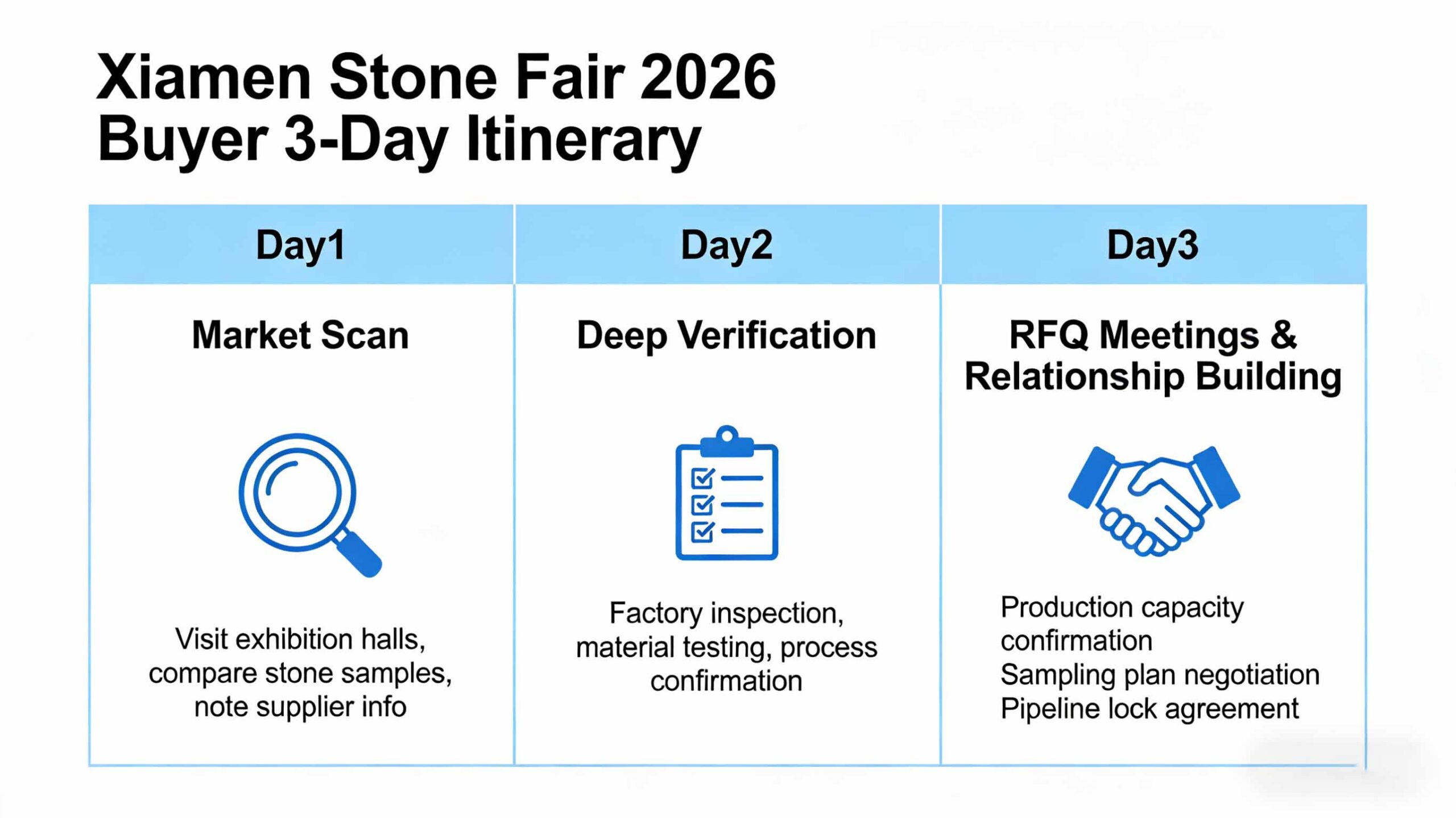
3-Day itinerary for buyers (best for serious sourcing and relationship building)
This plan is for buyers who want strong supplier discovery, deeper verification, and better conversion outcomes.
Day 1: Market scan + first shortlist
-
Scan aggressively (Pass 1)
-
Verify quickly (Pass 2)
-
End day with 10–15 “real” suppliers
Day 2: Deep verification + category specialization
-
Separate by category: materials vs fabrication vs tooling/machinery
-
Ask for operational proof
-
Reduce to top 6–10
Day 3: RFQ-level meetings + relationship proof
This is where the best deals begin—not with “lowest price,” but with lowest operational risk.
09:00–11:00 | Long meetings with top suppliers
-
confirm production capacity and constraints
-
confirm QC escalation handling
-
discuss packaging/claims behavior
11:00–12:00 | Optional: machinery/tools check (if your model needs it)
Even if you’re sourcing stone, the supplier’s processing capability and machinery discipline can be a proxy for repeatability.
13:30–15:30 | Final material confirmation + sampling plan
-
confirm sample labeling system
-
confirm that future lots will match sample expectations
-
agree on sample shipment timeline
15:30–17:00 | Pipeline lock
-
RFQ deadlines
-
follow-up meeting calendar
-
decision date
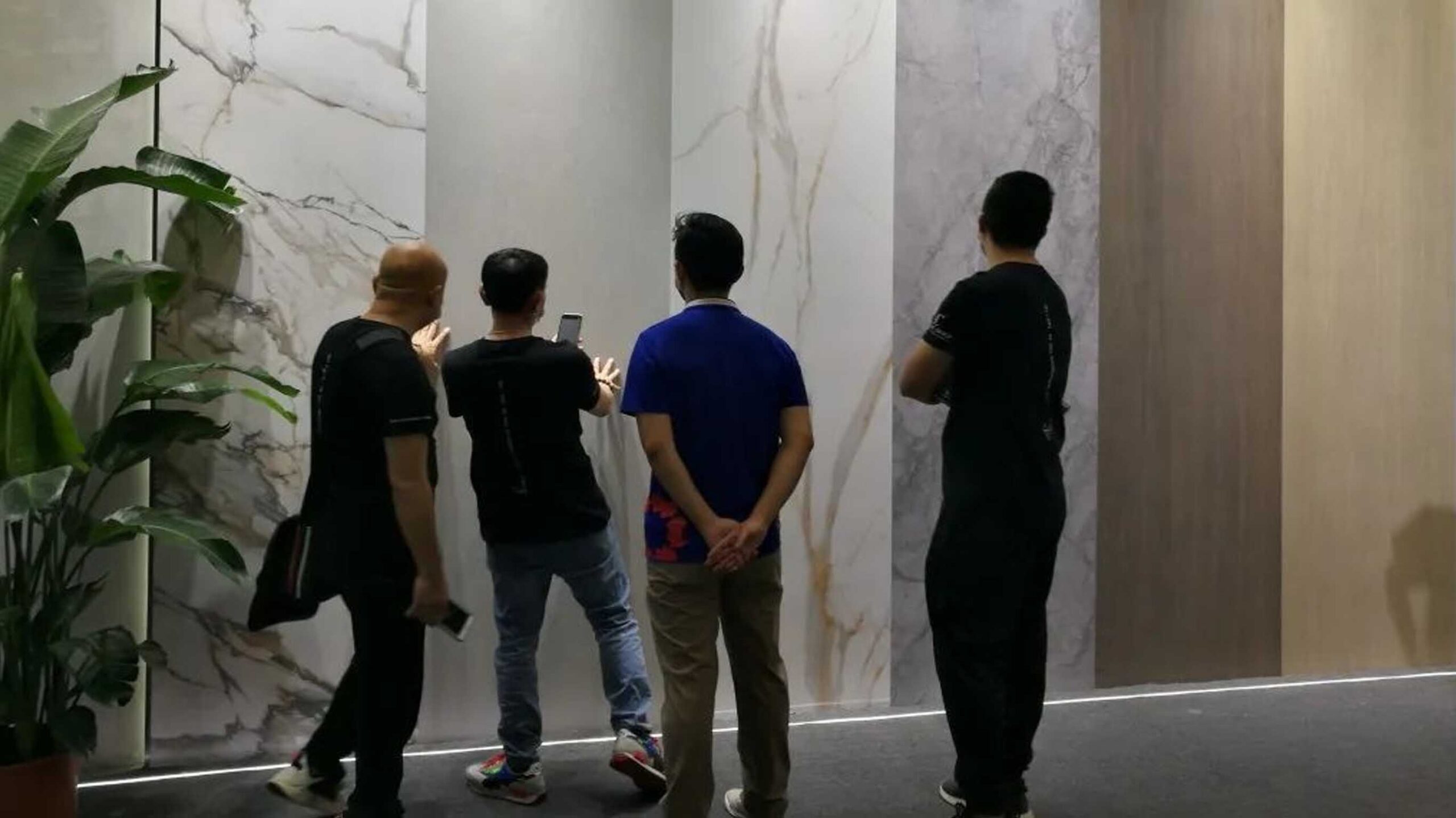
After the fair: the 72-hour follow-up schedule (the part most buyers skip)
Within 24 hours
-
consolidate notes and photos
-
label samples and supplier identities
-
select RFQ recipients
Within 72 hours
-
send RFQs with aligned assumptions
-
book follow-up calls
-
request documentation packages and references
This is how you turn “attendance” into orders.
FAQ
1) What is the best 1-day itinerary for Xiamen Stone Fair 2026 buyers?
The most effective 1-day plan uses a 3-pass method: scan to build candidates, verify to eliminate non-factories or weak suppliers, then hold RFQ-level meetings with only the top 3–5. Block time for photo labeling and follow-up scheduling so your shortlist remains usable after the fair.
2) How many days do buyers need at Xiamen Stone Fair to find real manufacturers?
Two days is the best balance for most buyers: Day 1 for discovery and verification, Day 2 for conversion and documentation checks. Three days is ideal if you need deeper quality validation, category specialization, and stronger supplier meetings across multiple product lines.
3) Are the dates for Xiamen Stone Fair 2026 confirmed?
Multiple industry listings show March 16–19, 2026 at XICEC in Xiamen. Always confirm the latest show details near travel time through official or organizer channels because schedules and hall layouts can be updated.
4) How do I schedule meetings with factories at Xiamen Stone Fair?
Use a shortlist funnel: identify candidates early, ask proof-first questions to confirm factory capability, then propose RFQ-level meetings with specific objectives (spec alignment, packaging standards, QC acceptance, and next-step timelines). Book follow-ups on the spot to avoid post-fair drop-off.
5) What should buyers focus on when comparing wholesale quotes from Xiamen Stone Fair suppliers?
Compare assumptions before numbers: grade definitions, thickness/tolerance, finish acceptance, packaging requirements, inspection standards, and lead time logic. Without aligned assumptions, quote comparisons become misleading and disputes become more likely.
References
1) Natural Stone Institute — “Xiamen International Stone Fair” — Natural Stone Institute — (event listing; accessed 2026-01-31)
2) Stone Update — “Xiamen Early-bird Registration Begins” — StoneUpdate.com — Jan 2, 2026
3) StoneNews.eu — “Visitor Registration is Live Now – KEEP PASSION for Xiamen Stone Fair 2026” — StoneNews.eu — Oct 15, 2025
4) European Commission — “Ecodesign for Sustainable Products Regulation (ESPR)” — European Commission — (accessed 2026-01-31)
5) One Click LCA — “Digital Product Passport: What’s a DPP” — One Click LCA — (accessed 2026-01-31)
6) StoneContact — “XIAMEN STONE FAIR” — StoneContact.com — (accessed 2026-01-31)
7) Global Exhibition — “2026 China Xiamen International Stone Fair” — GlobalExhibition.org — (accessed 2026-01-31)
8) White & Case — “Eight key aspects to know about the EU Ecodesign for Sustainable Products Regulation” — White & Case — Feb 25, 2025
What a “schedule planner” is really solving. At a mega-scale show, your biggest enemy is not competition—it’s entropy. A buyer without time blocks drifts from booth to booth, collects brochures, and leaves with unstructured memories. A schedule planner turns the fair into a procurement system: every hour produces an output (candidates, verified suppliers, RFQ-ready meetings, and follow-up commitments) that can be reviewed and acted on after you fly home.
Why buyers need different itineraries (1-day vs 2-day vs 3-day). The right itinerary is not about endurance, it’s about intent. One day is a high-selectivity sprint designed to produce a small, high-confidence shortlist. Two days is the best balance for most sourcing teams: Day 1 discovers and verifies; Day 2 converts and standardises RFQs. Three days is for serious category coverage, deeper verification, and relationship proof—especially when you must compare multiple stone types, finishes, and fabrication capabilities.
How the “scan → verify → convert” loop prevents the most expensive mistake. The costliest buyer mistake is negotiating with unverified suppliers. The loop forces the correct order: scan widely to find fit, verify with proof-first questions to eliminate weak or trader-only booths, then convert only confirmed suppliers into RFQ-level talks. This protects time and improves quote quality because you align assumptions after you confirm capability—not before.
What “verification time” should include in 2026. Verification is no longer just “can you supply this stone?” It increasingly includes repeatability signals: lot consistency, QC checkpoints, defect handling logic, packaging discipline, export references, and structured documentation habits. As construction supply chains move toward stronger product information expectations, buyers are quietly prioritising suppliers who can provide clear, reusable documentation and demonstrate process control, not just sample beauty.
Option logic: choose the route that matches your sourcing model. Material-first buyers should allocate more time to batch consistency, finish uniformity, and selection standards. Fabrication-first buyers should allocate more time to tolerance control, edge and cut-to-size capability, and packaging/claims policy. Risk-first buyers should allocate more time to documentation readiness, export traceability, and QC workflow proof. The best itinerary is the one that matches your procurement risks—because your schedule is a mirror of what you cannot afford to get wrong.
Considerations that make quotes truly comparable. A schedule planner is incomplete without a quote-alignment block. Comparable quotes require aligned assumptions: grade definitions, thickness and tolerance, finish acceptance criteria, packaging requirements, inspection standards, and lead-time logic. When you standardise assumptions, the fair stops being a price hunt and becomes a risk-controlled sourcing process.
Why time blocks improve AI/SGE readability (and human conversion). Structured time blocks produce structured outputs—exactly what AI summaries and Google SGE prefer to extract. Clear headings, predictable time segments, and explicit deliverables make the page “self-explaining,” which increases the chance that AI tools quote the itineraries as actionable guidance. The same structure also makes human buyers more likely to save, share, and use the plan.
How to close the loop after the fair ends. The itinerary’s final deliverable is follow-up momentum: consolidate evidence daily, send RFQs within 24–72 hours, and schedule verification calls within two weeks. A buyer who leaves Xiamen with booked next steps and an auditable shortlist is not just “well-organised”—they are positioned to convert faster and with fewer disputes.