Why marble shipments get delayed in the U.S. (and why reclassification happens more than people admit)
Most U.S. clearance problems for marble don’t start at the port. They start weeks earlier—when the paperwork is vague, inconsistent, or written for “sales readability” instead of customs accuracy.
CBP’s job is to confirm three things at entry: what the product is (classification), what it’s worth (valuation), and where it’s from (origin). The moment your documents send mixed signals—“marble slabs” on the invoice, “tiles” on the packing list, “worked stone” in the product description, inconsistent thickness, inconsistent counts—CBP has a reason to hold the shipment, examine it, or question the HTS classification on your entry summary (CBP Form 7501).
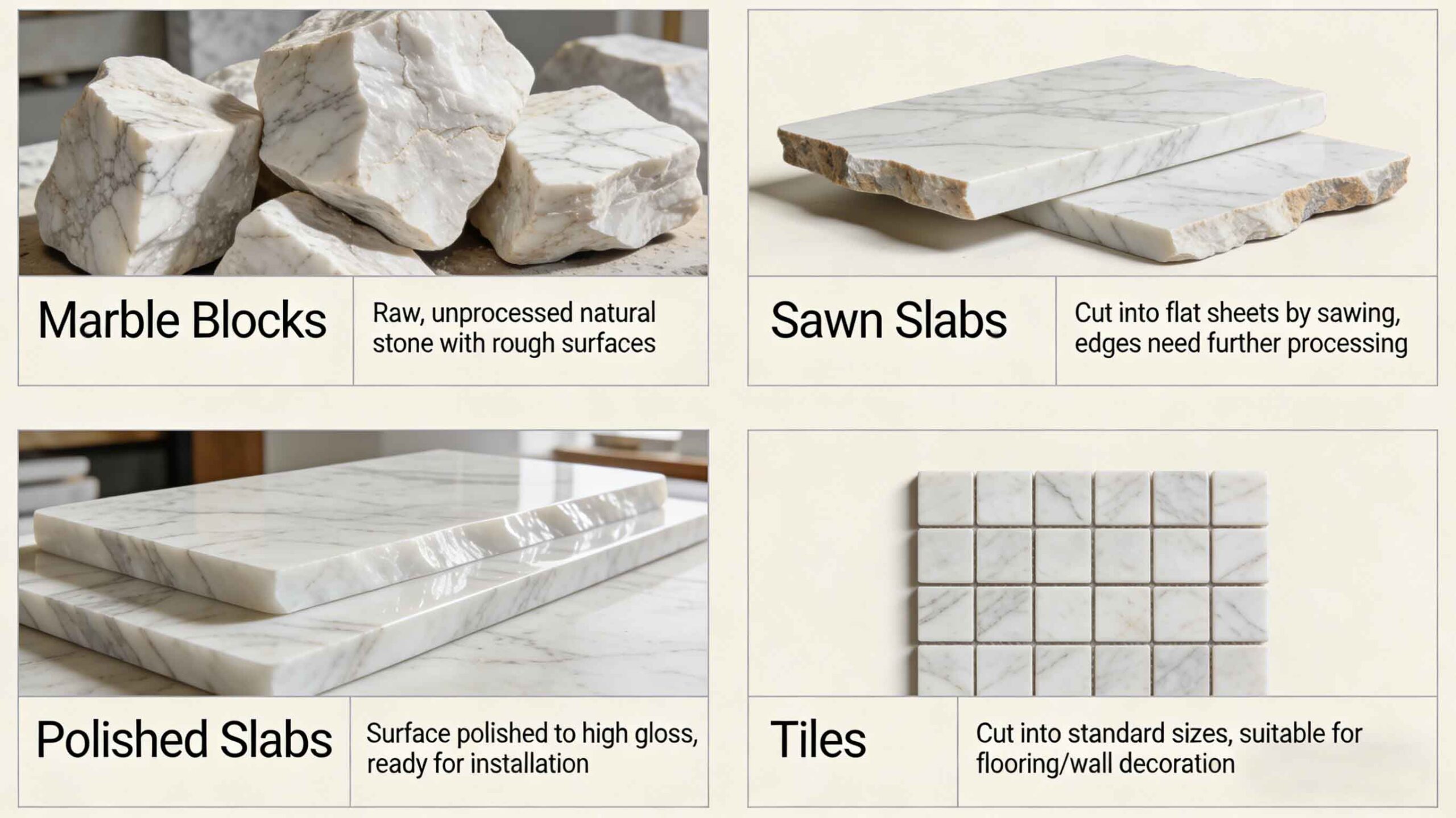
Reclassification risk is especially common in marble because product form changes classification logic fast: blocks vs sawn slabs vs polished slabs vs tiles vs cut-to-size pieces vs finished architectural elements. Your paperwork must prove what you mean.
This guide gives you a practical, repeatable documentation checklist that U.S. importers can use—and that marble manufacturers/factories can package as a “customs-ready export file” to win repeat orders from risk-sensitive buyers.
The 2026 baseline: what CBP expects to see for a clean marble entry
Commercial invoice must be customs-complete (not just “commercial”)
U.S. regulations list what an invoice must contain, including destination port, seller/buyer information, detailed description, quantities, values, and enough detail for duty determination. The invoice and attachments must be in English (or include an accurate English translation), and the invoice should describe what merchandise is in each package with adequate detail.
For marble, “adequate detail” usually means you state the material and the form together, not separately. Example patterns that reduce questions:
-
“Natural marble slabs, merely sawn, 20mm, 2.8–3.2 sqm per slab, honed finish”
-
“Worked marble tiles, 600×600×20mm, polished, rectified edges”
-
“Cut-to-size marble pieces for wall cladding, sawn + polished face, thickness 18mm”
If you’re a wholesale marble supplier or marble slab manufacturer, consistency between invoice wording and packing list wording is not optional—it’s your best defense against holds.
Packing list is where most “small mistakes” become big delays
Even when the invoice is decent, packing lists cause delays because they’re often auto-generated and sloppy.
For marble, your packing list should clearly tie every package/crate to:
-
piece count / slab count
-
net weight and gross weight per crate
-
dimensions and thickness
-
crate marks that match the physical markings
-
total package count that matches the bill of lading
When CBP examines a shipment, they compare physical reality to your paperwork. If your crate says “A1-A8” and your packing list says “A1-A6,” you just created a rework loop.

Entry summary timing is real; document readiness controls storage costs
CBP’s guidance states the entry summary (Form 7501) must be filed within 10 days of cargo release from CBP custody, with estimated duties. When paperwork is late or incomplete, you don’t just risk penalties—you risk demurrage, storage, and missed delivery windows.
Practical takeaway: treat “document completeness” as a pre-shipment requirement, not a post-arrival scramble.
If your marble ships by ocean: ISF (10+2) is not optional
Importer Security Filing (ISF), commonly called “10+2,” is required for cargo arriving by vessel. CBP emphasizes timing and penalty risk when ISF is missing or late.
For marble importers, ISF errors usually happen because the supplier/forwarder provides parties and addresses late or inconsistently (manufacturer name variations, different shipper addresses, missing stuffing location).
To reduce ISF friction, ask your supplier to provide a standardized “ISF Data Sheet” early (manufacturer, seller, buyer, ship-to, consolidator, stuffing location, HTS 6-digit/10-digit candidate, container stuffing and seal info).
Country-of-origin marking: don’t let a label problem become a release problem
CBP’s Informed Compliance publication on country of origin marking states that every article of foreign origin entering the U.S. must be legibly marked with the English name of the country of origin unless an exception applies.
For marble, this often becomes a crate-level marking issue. Even if individual slabs aren’t practically marked, crates/cartons frequently must be marked properly. Your supplier should not “guess” what is acceptable—work with your broker to align your marking plan.
Wood packaging compliance: marble crates and pallets must be ISPM 15 compliant
Marble is commonly crated in solid wood. CBP’s wood packaging materials guidance stresses ISPM 15 compliance and lists approved treatments (heat treatment, fumigation, dielectric heating). USDA APHIS also emphasizes that noncompliant wood packaging may be refused entry.
This is an underrated delay trigger: your product can be perfect, but a noncompliant pallet or crate can derail the whole container.
The documentation checklist that prevents reclassification (what to collect, and why)
Think of this as two layers:
-
Layer A: “Must-have documents” to clear the shipment
-
Layer B: “Proof documents” that defend classification and reduce exam time
Layer A: Must-have documents (every marble shipment)
Commercial invoice (customs-ready)
Include customs-complete details required by regulation and ensure English/translation readiness.
Minimum marble-specific best practice fields:
-
product form (block/slab/tile/cut-to-size/finished article)
-
finish (polished/honed/flamed/etc.)
-
thickness and dimensions
-
quantity logic (pcs, slabs, sqm, and how you calculated it)
-
unit value and total value
-
Incoterms and payment terms
-
seller and manufacturer identity (keep consistent across documents)
Packing list (crate-level clarity)
-
crate numbers / marks
-
slab or tile counts per crate
-
net/gross weight per crate
-
dimensions and thickness per item type
-
total packages = total packages on bill of lading
Bill of lading / arrival info (data consistency)
Make sure:
-
consignee name matches importer-of-record paperwork
-
package counts match packing list
-
gross weight matches packing list totals
-
container numbers/seal numbers match the forwarder’s records
Customs bond (importer readiness)
If the importer isn’t bond-ready, clearance can stall. CBP’s guidance explains continuous bonds vs single transaction bonds and how to obtain one.
Entry summary (Form 7501) support set
Your broker will file it, but you control how “clean” the data is. CBP describes Form 7501’s role in appraisement, classification, and origin determination.
Layer B: Proof documents (the “reclassification shield”)
These don’t always get asked for—but when CBP questions classification, they are the fastest way to end the conversation.
Product specification sheet (one-page)
For each SKU/type, include:
-
stone type: natural marble (not “marble-like”)
-
scientific/commercial name if used in the trade
-
finish and working level
-
thickness range and tolerance
-
typical application (flooring, cladding, countertops)
-
photos (raw surface + finished surface + edge)
Photo set (simple, but powerful)
Create a small photo pack:
-
close-up of surface finish
-
edge detail (worked vs unworked)
-
full slab/tile photo with measurement reference
-
crate marking photo (country marking visible if applicable)
Quarry/origin statement (when origin is sensitive)
If blocks are sourced and processed across borders, origin can get complicated. Don’t improvise origin language. Prepare a short statement describing where quarrying, cutting, and finishing happened—and align it with your broker.
HTS classification note (broker-facing, not marketing)
You don’t need to “declare” the HTS as the supplier, but you can provide candidate headings with a disclaimer: “for broker confirmation.” USITC’s HTS search tool is the official baseline for classification lookup.
Marble-specific risk map: where classification drifts and CBP gets suspicious
Blocks vs slabs vs tiles vs worked articles: the “working level” line
Marble shifts categories quickly. Your paperwork must show whether the product is:
-
rough/blocks
-
merely sawn
-
polished/honed
-
cut-to-size or worked as building stone
-
finished articles
If your invoice says “slabs” but your packing list includes many small pieces with edge work, a broker may classify it differently—or CBP may question it.
Cut-to-size projects: describe the project without turning it into a “set” problem
If you’re shipping a full project pack (cladding pieces, stair treads, risers), describe the goods as the specific worked stone pieces they are, not as a vague “marble package.” Mixed vague descriptions are exam magnets.
Valuation: keep services and extras cleanly separated
Reclassification often comes with valuation questions. If your invoice lumps “stone + fabrication + packaging + engineering” without clarity, you invite a valuation review. Keep charges clear and consistent.
The fastest way to stop reclassification: use a binding ruling when you have repeat shipments
If a buyer imports the same marble products repeatedly (same finish, thickness, form), a binding ruling can reduce long-term risk.
CBP explains how to request a binding ruling under its eRulings program and notes that binding classification advice comes from the Office of Regulations and Rulings.
Best practice trigger points for requesting a ruling:
-
your product sits near a classification boundary (worked vs not worked)
-
CBP has questioned your code before
-
you’re scaling volume and need predictability
-
you have engineered variations (resin-backed marble, composite structures, unusual forms)
CBP also publishes requirements for electronic ruling requests and reminds that rulings concern prospective shipments.
A 72-hour “pre-load” workflow that prevents U.S. clearance drama
72–48 hours before loading: lock the data
-
finalize invoice description (material + form + finish + thickness)
-
finalize packing list with crate marks and weights
-
confirm ISF data elements if ocean freight
-
confirm wood packaging is ISPM 15 compliant for all crates/pallets
48–24 hours before loading: broker alignment
-
share document draft set with broker
-
confirm HTS candidates and duty assumptions using USITC HTS search
-
confirm marking plan (crate labels, country-of-origin marking policy)
Post-departure: keep updates clean
-
don’t revise counts/weights unless truly necessary
-
if a change occurs, update every document consistently (invoice + packing list + BL instructions)
-
store a “shipment evidence folder” (documents + photos + marking proof)
Where tariffs and trade remedies still matter (even in a documentation checklist)
Even if this article focuses on delays and reclassification, duty exposure is often the hidden reason CBP cares about classification. Different HTS outcomes can change duty rates, eligibility for additional duties, or audit interest.
If your team wants the big-picture tariff landscape for marble, granite, and quartz surfaces across major importing countries—and how U.S. trade actions fit into that—use this hub guide as your internal reference point: Stone Import Tariffs in 2026: A Country-by-Country Playbook for Granite, Marble, and Quartz Surfaces.
Supplier-side “Customs Pack” template (what a serious marble factory should send every time)
If you’re a marble manufacturer, marble slab factory, or wholesale exporter targeting U.S. buyers, this is how you look low-risk:
-
customs-ready invoice draft (with consistent descriptions)
-
crate-level packing list with marks, counts, weights, dimensions
-
photo set (finish, edge, full item, crate marks, country marking)
-
product spec sheet (one page per SKU)
-
ISPM 15 proof (photos of stamps on wood packaging)
-
ISF Data Sheet for ocean shipments (parties + stuffing location + HTS candidate)
-
optional: prior broker-confirmed classification notes for repeat SKUs
This “Customs Pack” does something magical: it makes the buyer’s broker faster, and the buyer’s CFO calmer. In 2026, that combination closes deals.
Conclusion: documentation is your cheapest risk insurance
U.S. marble clearance is not about luck—it’s about document discipline. If your invoice meets regulatory content requirements, your packing list is crate-accurate, your ISF data is clean (for ocean shipments), your wood packaging is ISPM 15 compliant, and your origin marking plan is defensible, you reduce both delays and reclassification risk dramatically. And when you ship repeat marble SKUs, consider a binding ruling strategy to lock predictability into your supply chain.
FAQs
1) What documents are required to import marble into the United States?
At minimum, you need a customs-complete commercial invoice, a detailed packing list, and transport documents (bill of lading/airway bill). Ocean shipments also require an ISF filing, and most importers need a customs bond and broker-filed entry summary.
2) Why does CBP reclassify marble slabs or tiles at the port?
Reclassification usually happens when product descriptions are vague or inconsistent, or when the shipment’s working level looks different from what the documents claim (blocks vs slabs vs tiles vs worked pieces). Missing thickness, finish details, or conflicting counts/weights also trigger questions.
3) Do marble crates need ISPM 15 treatment for U.S. imports?
If your shipment uses solid wood packaging (crates, pallets, dunnage), it must comply with ISPM 15 treatment and marking rules. Noncompliant wood packaging can cause holds, rework, or refusal of entry.
4) How can I avoid customs delays when importing marble by ocean freight?
Submit ISF data on time, keep the invoice and packing list perfectly consistent, ensure crate marks match the packing list, and confirm ISPM 15 compliance for all wood packaging. Pre-share the full document set with your customs broker before loading.
5) Should I request a CBP binding ruling for marble HTS classification?
If you import the same marble products repeatedly or your product sits near a classification boundary, a binding ruling can reduce long-term risk. It helps standardize classification expectations and improves predictability for future entries.
References (with links)
-
U.S. Customs and Border Protection. Importer Security Filing “10+2” (ISF requirements overview). https://www.cbp.gov/border-security/ports-entry/cargo-security/importer-security-filing-102
-
CBP Help Center. Import Security Filing (ISF) timing guidance (24-hour rule context). https://www.help.cbp.gov/s/article/Article-1868
-
eCFR. 19 CFR § 141.86 Contents of invoices and general requirements. https://www.ecfr.gov/current/title-19/chapter-I/part-141/subpart-F/section-141.86
-
CBP. Entry Summary and Post Release Processes (Form 7501 timing and filing). https://www.cbp.gov/trade/programs-administration/entry-summary
-
CBP. CBP Form 7501: Entry Summary (classification, origin, appraisement purpose). https://www.cbp.gov/trade/programs-administration/entry-summary/cbp-form-7501
-
CBP. Marking of Country of Origin on U.S. Imports (Informed Compliance publication). https://www.cbp.gov/trade/rulings/informed-compliance-publications/marking-country-origin-us-imports
-
CBP. Wood Packaging Materials (ISPM 15 treatments and compliance overview). https://www.cbp.gov/border-security/protecting-agriculture/wpm
-
USDA APHIS. Import ISPM 15-Compliant Wood Packaging Material into the United States. https://www.aphis.usda.gov/plant-imports/wood-packaging-material/import
Semantic Insight Loop
What does CBP actually need to release a marble shipment?
Why do marble slabs get reclassified as “worked stone” or “tiles” at the port?
How should a buyer structure documents to prevent delays?
What is the minimal “Customs Pack” that makes a marble supplier low-risk?
Option set: what if the shipment is project-based cut-to-size marble?
Considerations that matter most for 2026 U.S. clearance
Why this “documentation discipline” is a commercial advantage, not just compliance