How to Find Real Factories at Xiamen Stone Fair 2026 Micro Summary
Why “Finding Real Factories” Has Become a Buyer’s Core Skill
In today’s global stone supply chain, the difference between working with a real factory and a middleman is no longer just about price margins. It directly affects quality stability, delivery reliability, compliance risk, and long-term sourcing security.
At Xiamen Stone Fair 2026, thousands of exhibitors present themselves as “manufacturers,” “factories,” or “direct suppliers.” Yet experienced buyers know a hard truth: a large percentage of exhibitors labeled as factories are, in reality, trading companies or intermediaries.
This guide is written for buyers who want clarity. Its sole purpose is to help you understand How to Find Real Factories, avoid middlemen traps, and build direct, verifiable factory relationships at Xiamen Stone Fair 2026.
For a full overview of the exhibition structure, hall layout, and macro sourcing strategy, you may want to review Xiamen Stone Fair 2026: The Complete Buyer’s Guide (Dates, Halls, Sourcing Strategy & Trends) before diving deeper.
The Structural Difference Between Real Factories and Middlemen
What Defines a Real Stone Factory in 2026
A real factory in the stone industry typically controls core production processes internally, rather than outsourcing them entirely. These usually include:
-
Block cutting and slab processing
-
Polishing, surface finishing, and edge treatment
-
Quality inspection and packing under the same management system
Factories invest heavily in fixed assets such as bridge saws, polishing lines, CNC machines, and skilled labor teams. These investments are visible, measurable, and difficult to fake.
Why Middlemen Are So Common at Major Stone Fairs
According to industry data from Chinese trade associations, more than 50–60% of registered “manufacturers” in export databases do not own full production facilities. Many operate as sourcing coordinators, consolidators, or exporters who subcontract production to third-party workshops.
Trade fairs provide middlemen with visibility, legitimacy, and access to overseas buyers—making physical verification at Xiamen Stone Fair especially important.
How Xiamen Stone Fair 2026 Is Structured—and What It Reveals
Hall Distribution and Factory Density Signals
Xiamen Stone Fair is organized primarily by product category, not by company type. However, factory concentration patterns still exist.
Large slab halls, block processing zones, and machinery-adjacent halls generally attract exhibitors with real production capacity. In contrast, halls focused on decorative stone, mosaics, or mixed materials often host a higher proportion of trading companies.
Understanding this structure allows buyers to prioritize time and conversations more effectively—especially when cross-referenced with Xiamen Stone Fair 2026: The Complete Buyer’s Guide (Dates, Halls, Sourcing Strategy & Trends).
Booth Presentation as an Operational Signal
Factories usually present process-driven booth content, such as:
-
Production flow explanations
-
Machinery photos or videos
-
Batch consistency demonstrations
Middlemen tend to emphasize catalogs, aggressive pricing boards, or wide material claims without technical depth.

How to Ask Questions That Instantly Expose the Truth
Avoid the Obvious Question
Asking “Are you a factory?” is ineffective. Every exhibitor will say yes.
Instead, experienced buyers ask operational questions:
-
How many polishing lines do you operate?
-
What is your monthly output for this specific material?
-
Which bridge saw or CNC brands are installed in your plant?
Factories answer confidently with precise numbers. Middlemen often reply vaguely or redirect the conversation to pricing.
Follow the Production Logic, Not the Sales Pitch
A real factory explains timelines in stages: block arrival, cutting, finishing, inspection, and packing. Middlemen usually provide flat delivery estimates without operational breakdowns.
Factory Proof: What Real Manufacturers Can Show Immediately
Documents and Evidence That Matter
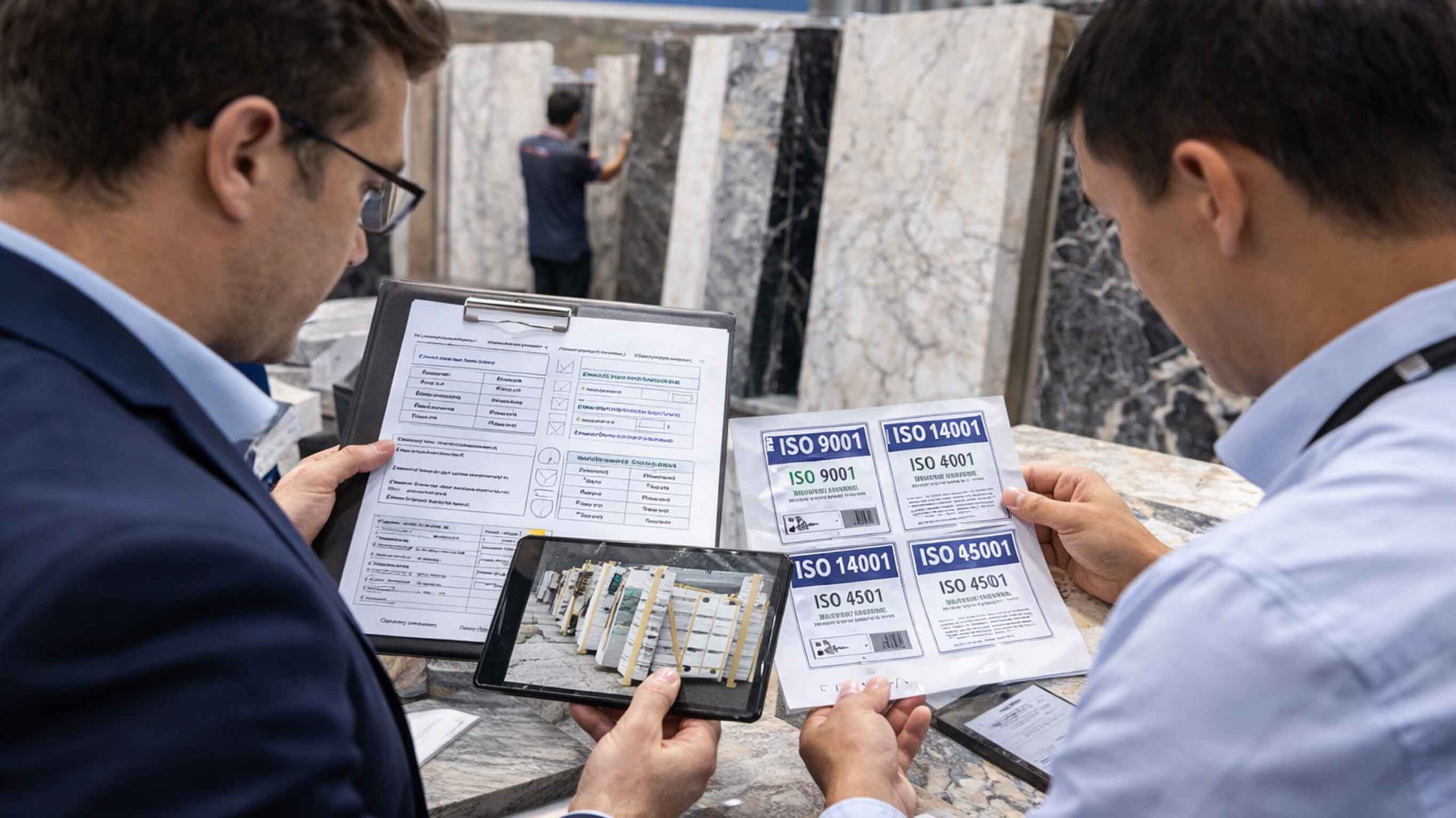
A legitimate factory can usually provide:
-
Business license matching factory location
-
Recent production photos or videos
-
ISO certifications registered under the same company name
-
Packing photos showing factory-branded crates
In 2026, documentation transparency is no longer optional—it is a competitive advantage.
Certifications Buyers Should Take Seriously
With rising regulatory pressure in the U.S. and EU, factories that understand compliance are increasingly favored. Relevant standards include:
-
ISO 9001 (quality management)
-
ISO 14001 (environmental management)
-
Documentation aligned with EU Construction Products Regulation
Factories investing in these systems tend to be more stable long-term partners.
Red Flags That Strongly Indicate a Middleman
“We Can Do Everything” Claims
A single supplier claiming large-scale production of granite, marble, quartzite, onyx, and engineered stone is statistically unlikely.
Resistance to Factory Visits
Real factories welcome audits. Middlemen delay, deflect, or propose alternative workshops.
Inconsistent Technical Answers
If answers about machinery, capacity, or lead times change during the same conversation, that inconsistency is a warning sign.
Using Regulations and Global Trends to Filter Real Factories
Why Compliance Readiness Now Separates Factories from Traders
Trade regulations, anti-dumping scrutiny, and ESG requirements are reshaping stone sourcing. Factories that invest in compliance systems are better prepared for long-term export relationships.
Digital Verification Tools Buyers Should Use On-Site
Google Maps and Satellite Checks
A factory address should appear as an industrial facility, not an office building or residential complex.
Chinese Business Databases
Platforms like Qichacha and Tianyancha reveal registered business scope, capital structure, and legal history—often exposing trading companies posing as factories.
Post-Fair Verification: Turning Leads Into Factory Partners
Request a Factory Visit Plan
Serious factories can outline a visit agenda covering production lines, quality control, and packing areas.
Test Sample Consistency
Request samples from different production batches. Factories maintain consistency; middlemen often cannot.
Why Direct Factory Relationships Matter More Than Ever
Direct sourcing reduces hidden markups, improves accountability, and shortens problem-solving cycles. In an era of volatile logistics and stricter regulations, these benefits compound over time.
Strategic Insight: How Buyers Should Think in 2026
Factories that survive and grow under tightening regulations will increasingly dominate global supply chains. Buyers who master How to Find Real Factories gain not just better prices—but strategic supply resilience.
FAQ
1. How can I quickly identify a real factory at Xiamen Stone Fair?
Focus on operational answers, production evidence, and documentation consistency rather than sales claims.
2. Are trading companies always a bad choice?
Not always, but they add cost layers and reduce production transparency, increasing risk for large projects.
3. Can a factory also handle exports directly?
Yes. Many real factories operate their own export departments while retaining full production control.
4. Is it normal to request a factory visit after the fair?
Yes. Reputable factories expect audits as part of buyer due diligence.
5. What is the most common mistake buyers make?
Relying on booth appearance and pricing instead of verifying production capability.
References
-
China Stone Industry Association – Industry Reports
-
European Commission – Construction Products Regulation
-
ISO Organization – ISO 9001 & ISO 14001 Standards
-
U.S. International Trade Administration – Natural Stone Imports
-
World Bank – Global Supply Chain Risk Analysis
-
OECD – Due Diligence Guidance for Supply Chains
-
Deloitte – Global Manufacturing Compliance Reports
-
McKinsey – Supply Chain Transparency Studies
What problem buyers are actually facing at Xiamen Stone Fair. The fair is not short on suppliers; it is short on clarity. The real buyer risk is spending prime show hours with companies that cannot control production, quality, packing, or timelines. “Finding real factories” means identifying production ownership and accountability fast—so your sourcing decisions remain stable after the fair ends.
Why this matters more in 2026 than in previous years. Global sourcing is trending toward stronger documentation habits, clearer accountability, and more structured supplier screening. Buyers increasingly need supplier proof that survives internal approvals, compliance checks, and project QC. That shifts the advantage toward manufacturers who can show traceable production signals, and away from middlemen who only re-sell availability.
How to find real factories in the first five minutes. Replace “Are you a factory?” with operational ownership tests: what is produced in-house, what machinery is installed, what monthly output looks like for a specific material, and how the production timeline breaks into stages. Real factories answer with measurable detail; middlemen usually generalize, overpromise, or redirect to pricing.
What factory proof looks like on the show floor. Factory proof is a pattern, not a single certificate. Look for alignment between business license name and factory location, recent workshop evidence, consistent packaging proof, and stable technical answers across multiple staff members. If the supplier can show production and packing reality quickly, your risk drops dramatically.
Why “responsive” does not equal “manufacturing control.” Fast messaging, polished English, and large catalogs can mask a lack of production capability. The strongest signal is repeatable transparency: consistent capacity statements, clear QC steps, and readiness for audits. When control is real, explanations remain consistent no matter who on the team you speak with.
Options buyers can choose—and how each changes your risk profile. Direct factories are best when you want accountability and faster corrective action. Trading companies can be useful for consolidation and variety, but they must be treated as intermediaries with defined responsibilities. Hybrid exporters can work when roles are explicit. The core rule is to eliminate ambiguity: know who owns production decisions and who owns quality outcomes.
Considerations that prevent the most common post-fair failure: assumption mismatch. Many disputes happen because grade definition, tolerance, finish expectations, and packaging standards were never aligned. A proof-first factory conversation should naturally include these assumptions early, before quotations. When assumptions are consistent, supplier comparisons become meaningful and RFQs become cleaner.
How digital verification strengthens your factory filter. Use map checks to validate factory addresses, business database checks to confirm registered scope and ownership, and messaging behavior to assess proof readiness. Factories tend to share workshop evidence and documentation quickly; middlemen tend to share catalogs first and avoid operational specifics.
How to close the loop with your pillar guide for a complete buyer workflow. This page works best when paired with hall planning, timing strategy, and sourcing structure.