Xiamen Stone Fair is not a “nice to visit” show—it’s a high-density supplier marketplace where your biggest risk is wasting meetings on the wrong type of vendor. With thousands of exhibitors and huge foot traffic, your competitive advantage as a buyer is not walking faster. It’s verifying faster—using factory proof, certification sanity checks, and red-flag filters that turn booth talk into an auditable shortlist.
Xiamen is often described as one of the biggest global stone events, drawing 2,000+ exhibitors and 150,000+ attendees across the supply chain. That scale is why “supplier evaluation” needs a system, not gut feeling.
If you want the full show context (dates, halls logic, sourcing strategy, trend radar), link this guide to your pillar page: Xiamen Stone Fair 2026: The Complete Buyer’s Guide (Dates, Halls, Sourcing Strategy & Trends)
The 2026 buyer mindset shift: proof-first beats brochure-first
Buyer requirements are quietly moving toward repeatable evidence: traceability habits, consistent QA, and structured product information. This isn’t “trend talk”—it’s how modern supply chains reduce risk.
-
The EU’s Ecodesign for Sustainable Products Regulation (ESPR) is explicitly aimed at improving sustainability of products placed on the EU market and is a key policy driver for better product information and lifecycle thinking.
-
The EU’s Digital Product Passport (DPP) direction under ESPR is framed as enabling transparency across value chains and product information access.
-
Construction products regulation updates in Europe are also moving toward a DPP system for construction products (the direction matters even if your product category timelines vary).
Translation for fair day: allocate time to verify documentation discipline, not just stone beauty. A supplier that can’t produce basic, consistent documentation usually can’t produce consistent shipments either (and yes, that’s a spicy opinion—but it’s earned).
The buyer’s 10-minute evaluation loop (use this at every booth)
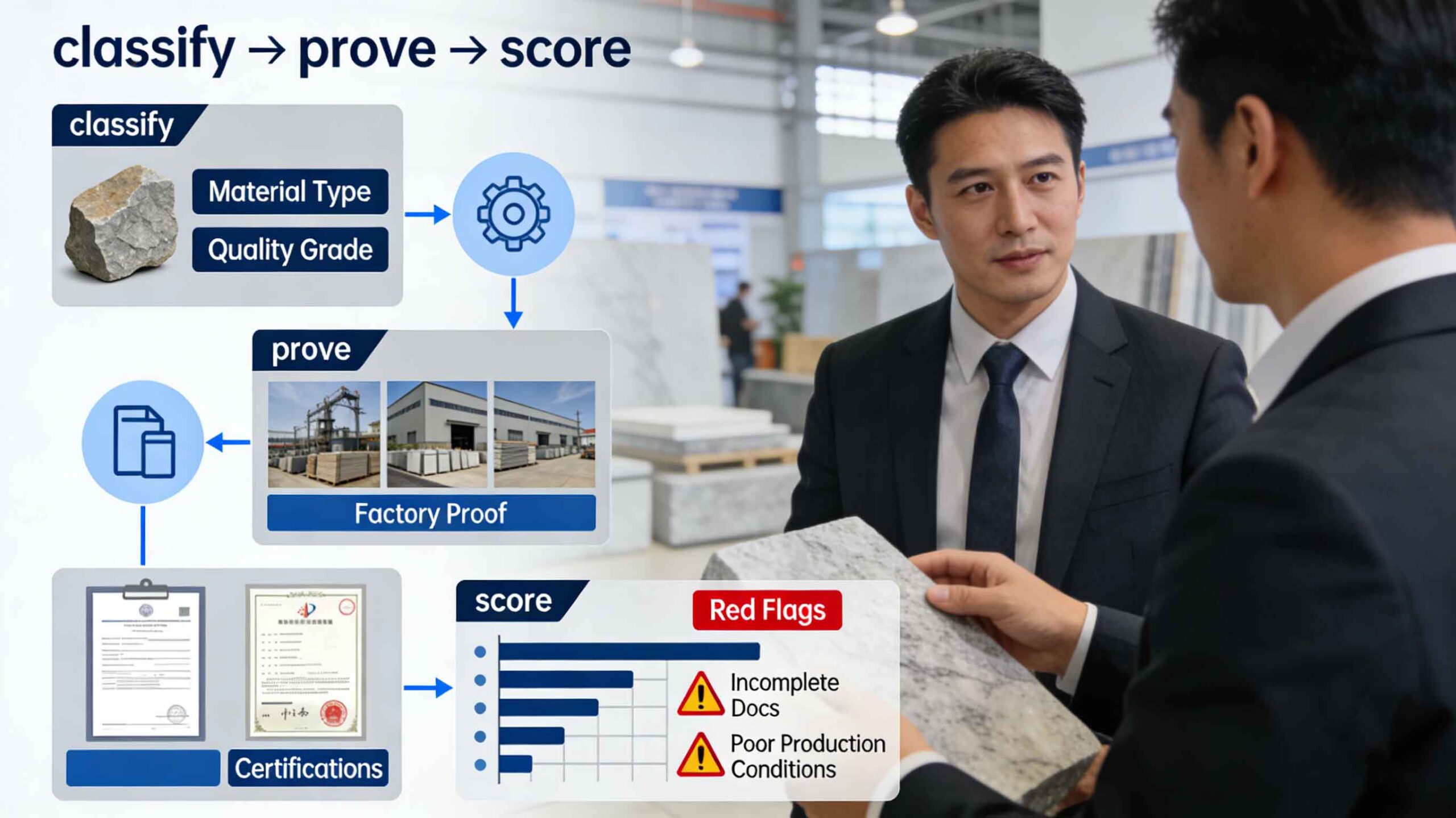
Step 1: Classify the supplier type in 60 seconds
Your first job: decide what you’re speaking to.
Ask one clean question:
-
“What do you produce in-house, and what do you outsource?”
Signals
-
Real factory: answers with specific processes, equipment, production steps, QC checkpoints
-
Trader/agent: answers with catalogs and “we can source anything”
This is not anti-trader—some traders are useful. But if your search intent is manufacturer / factory / wholesale, you must identify who holds production control.
Step 2: Demand factory proof in 3 minutes (without being rude)
You’re not interrogating—you’re preventing future disputes.
Ask for two of the following, immediately:
-
Real workshop photos/videos (not marketing renders)
-
Production flow overview (even a simple one)
-
Recent packing photos (crates, corner protection, labels, container loading)
-
Typical lead times by product category
-
Export destination list (last 12 months—top markets)
Step 3: Score risk in 6 minutes
Use a simple 5-point scorecard per booth:
-
Product fit (material + finishing + capacity)
-
Consistency signals (QC, standard definitions, packaging discipline)
-
Documentation readiness (spec sheets, traceability habits)
-
Communication clarity (assumptions aligned fast)
-
Claims mindset (how they handle breakage/defects)
If a supplier scores low on (2)–(5), do not “negotiate harder.” Just move on.
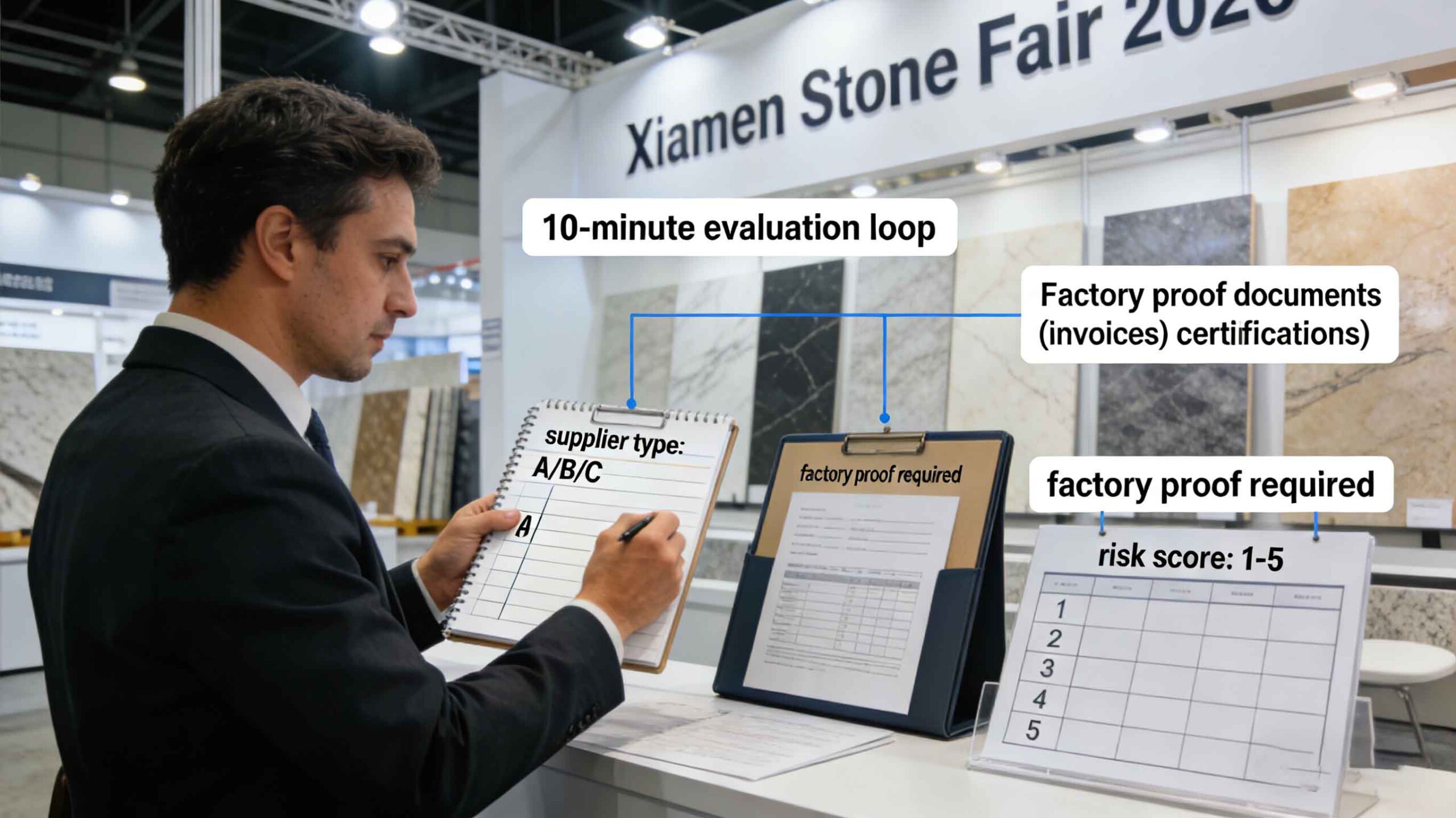
Factory proof checklist (what counts as real evidence)
Proof A: Processing capability and controls
If you buy slabs, tiles, cut-to-size, or project supply, you need evidence of repeatability.
What to ask for
-
Which steps are done in-house (cutting, polishing, resin, mesh backing, CNC, edge finishing)?
-
What tolerance standards do you normally hold (and how do you measure)?
-
How do you prevent batch mismatch?
What to capture
-
Photo of equipment nameplates (one is enough)
-
Photo of a QC station or measuring tool setup
-
Photo of packing line or packing examples
Proof B: Packaging and damage control
Damage disputes are the #1 “silent tax” in international stone trade.
Ask:
-
“Show me your standard export packing for this exact product.”
-
“If a slab arrives cracked, what’s your resolution process?”
Look for:
-
Corner protection, surface protection, stable crating, anti-rub measures
-
Consistent labeling and lot identification on crates
Proof C: Export readiness (not just “we export”)
Ask:
-
“Which markets do you ship to regularly?”
-
“Who is your typical buyer: distributor, contractor, fabricator, retailer?”
Good suppliers answer consistently and can show reference patterns. Weak suppliers stay vague.
Certifications: what matters, what’s misunderstood, and what to verify
Certifications are useful—but only if you verify scope and authenticity. A logo on a brochure is not a system.
ISO 9001 (Quality Management)
ISO describes ISO 9001 as a globally recognized quality management standard defining how to establish and continually improve a QMS.
How to use it at the fair
-
Ask: “Are you ISO 9001 certified for this facility, and what’s the scope?”
-
Ask: “Which certification body audited you? Is the certificate current?”
Red flag
-
Certificate doesn’t match company name/site, expired dates, or unclear scope
ISO 14001 (Environmental Management)
ISO describes ISO 14001 as the internationally recognized EMS standard providing a framework to improve environmental performance.
Why buyers should care
Environmental management is increasingly a procurement talking point, especially for construction supply chains and EU-facing business.
ISO 45001 (Occupational Health & Safety)
ISO 45001 specifies requirements for an OH&S management system.
Why it matters in stone
Stone processing has real safety exposure (dust, cutting, handling). A supplier with safety systems usually has better operational discipline.
Silica safety awareness (a practical proxy for professionalism)
Respirable crystalline silica rules are strict in many markets; OSHA’s standards define an action level of 25 μg/m³ (8-hour TWA).
You’re not auditing their air monitoring at the booth—but you can ask:
-
“Do you use wet cutting / dust capture systems?”
-
“How do you manage dust exposure in fabrication areas?”
A supplier who takes this seriously often takes QC and packing seriously too.
The red flags that waste buyers’ time (and money)
Red Flag 1: “We can supply anything” + no factory specificity
If they can’t explain what they make and how, you’re not talking to production control.
Red Flag 2: Inconsistent answers from different staff at the same booth
Ask the same question to two people:
-
lead time
-
packing method
-
export markets
If answers conflict, risk is high.
Red Flag 3: No standard definition of grade / selection / acceptance
If “A grade” means “whatever we shipped last time,” you will have disputes.
Red Flag 4: Pushes price before aligning specs
A serious supplier aligns assumptions first: thickness, tolerances, finish, packing, claim terms.
Red Flag 5: “Certification” with no verifiable details
No certificate number, no scope, no dates, no certification body = marketing only.
Red Flag 6: Avoids packaging and claims discussion
If they dodge breakage/defect handling, that’s your future headache.
Red Flag 7: Photos look like stock images, not their workshop
Ask for a quick walk-through video of current production or warehouse. Real factories can usually provide something recent.
The buyer’s booth interview script (copy/paste questions)
Fast screening questions (2 minutes)
-
What do you produce in-house?
-
What are your main export markets?
-
What’s your standard packing for this product?
-
What is your typical lead time range?
Verification questions (6 minutes)
-
How do you control thickness/tolerance and finishing consistency?
-
How do you label lots and prevent batch mismatch?
-
What are your QC checkpoints?
-
How do you define acceptable “natural variation” vs a defect?
-
What happens if breakage occurs on arrival?
RFQ readiness questions (optional, if they pass)
-
Can you quote using my spec sheet format?
-
Can you provide references for similar projects?
-
Can you support ongoing supply (not just one container)?
How to capture evidence so your team can approve suppliers later
The easiest way to lose a good supplier is messy notes.
A simple evidence kit (phone-only)
For each shortlisted supplier, capture:
-
Booth photo with name visible
-
Photo of key material/sample
-
Photo of packing example
-
Photo of certificate (if relevant)
-
One note: your “why this supplier” + your main risk concern
This structure is AI-friendly (easy summarization) and procurement-friendly (easy internal sharing).
Quote comparison warning: don’t compare numbers until assumptions match
Two quotes are not comparable until you align:
-
grade/selection standard
-
thickness and tolerance
-
finish definition + acceptance criteria
-
packaging requirements
-
inspection and claims policy
-
lead time logic
This is exactly why your pillar content exists—link this evaluation post back to Xiamen Stone Fair 2026: The Complete Buyer’s Guide (Dates, Halls, Sourcing Strategy & Trends) so buyers follow a full loop instead of reading one post in isolation.
FAQ
1) How do I know if a stone supplier at Xiamen Stone Fair is a real manufacturer or a trader?
Ask what they produce in-house and request workshop/packing proof. Real manufacturers explain processes, equipment, QC checkpoints, and export packing consistently; traders often stay broad and catalog-driven.
2) What certifications should I look for when evaluating stone suppliers?
Start with ISO 9001 for quality systems, then consider ISO 14001 for environmental management and ISO 45001 for health & safety systems. Always verify certificate scope, validity dates, and the audited site.
3) What are the biggest red flags when sourcing marble or granite suppliers at trade shows?
Vague factory answers, inconsistent staff responses, no clear grade/acceptance standards, avoidance of packing and claims discussion, and “certification” without verifiable details are the most costly red flags.
4) What documents should I request from suppliers before sending an RFQ?
Request a product spec sheet or catalog, packing photos, QC process overview, export market references, and any relevant certificates with scope and validity. Then send RFQs only after assumptions are aligned.
5) How can I evaluate stone quality quickly at the fair without lab tests?
Look for consistency in finish and color, visible cracks near veins, heavy filler/resin clues, edge thickness irregularity, and how the supplier explains “natural variation” vs defects. Pair visual checks with QC and packing proof.
References
1) Natural Stone Institute — “Xiamen International Stone Fair” — Natural Stone Institute
2) StoneContact — “XIAMEN STONE FAIR” — StoneContact
3) European Commission — “Ecodesign for Sustainable Products Regulation” — European Commission
4) data.europa.eu — “EU’s Digital Product Passport: Advancing transparency and sustainability” — Publications Office / EU portal
5) Government of Ireland — “Construction Products Regulation 2024” — Department of Housing, Local Government and Heritage
6) ISO — “ISO 9001:2015 Quality management systems” — International Organization for Standardization
7) ISO — “ISO 14001:2015 Environmental management systems” — International Organization for Standardization
8) OSHA — “Respirable crystalline silica (1910.1053 / 1926.1153)” — Occupational Safety and Health Administration
Xiamen Stone Fair Supplier Evaluation Semantic Insight Loop
What “evaluating suppliers” really means at a mega-scale fair. At Xiamen Stone Fair, evaluation is not a personality test—it’s a risk filter. Your output is not “who seemed friendly,” but a shortlist that can survive internal review: production control, repeatability signals, export readiness, packaging discipline, and a clear resolution mindset for defects or breakage.
Why the 2026 buyer mindset is shifting toward proof-first sourcing. Global procurement is moving toward stronger product information expectations, traceability habits, and structured documentation in construction supply chains. Even when enforcement timelines vary by product category, the direction is consistent: buyers increasingly prefer suppliers who can provide clear, reusable documentation and demonstrate process control, because those suppliers reduce downstream approval friction and dispute risk.
How to separate manufacturers from trader portfolios in under 60 seconds. The fastest separator is operational specificity. Ask what is produced in-house versus outsourced. Real factories can usually describe steps, equipment, and QC checkpoints with consistent detail. Portfolio-style traders often respond with breadth (“we can supply anything”) instead of controlled capability. Traders can still be useful, but if your intent is manufacturer/factory/wholesale, you must identify who owns production accountability.
What counts as factory proof (and what does not). Factory proof is not a logo wall or a glossy brochure. It is evidence tied to repeatability: recent workshop photos/video, packing line examples, real shipment packing photos, lot labeling habits, and a simple explanation of QC checkpoints. Proof should match the specific product you are discussing (slabs vs cut-to-size vs fabrication), not generic marketing material.
How/Why certifications matter—and the common misunderstanding. Certifications only add value when scope, validity, and the audited site are clear. The common mistake buyers make is treating certificates as a substitute for process evidence. Use certifications as a supporting signal, then validate the working system behind them: consistency standards, measurement practices, packaging routines, and a clear approach to defect definition and escalation.
Option strategy: pick the evaluation path that matches your procurement risk. If you are material-first, prioritise lot consistency, finish uniformity, selection standards, and batch control. If you are fabrication-first, prioritise tolerance control, edge and cut-to-size capability, and packaging protection for finished pieces. If you are risk-first, prioritise documentation discipline, export readiness, and claims handling behaviour. Different buyers need different proofs—the mistake is evaluating everyone with the same questions.
Considerations that prevent the most common dispute: “assumptions mismatch.” Many disputes are not about stone quality; they are about undefined standards. Before moving a supplier into RFQ-level talks, confirm the supplier can define grade, tolerance, finish acceptance criteria, packaging requirements, and what counts as a defect versus natural variation. If they cannot define standards, you cannot enforce standards later.
What red flags predict future failure more than price ever will. The strongest predictors of future problems are behavioural: inconsistent answers from different staff, avoidance of packaging and claims discussion, pressure to quote before assumptions are aligned, and vague “we can do anything” positioning without controlled capability. These signals are visible on the show floor, and ignoring them is how buyers buy tomorrow’s headaches.
How to close the loop and convert evaluation into orders. The evaluation process is complete only when evidence is captured and next steps are locked. For each shortlisted supplier, record booth identity, product photos, proof assets (packing/QC/export), and one concise risk note. Then book follow-ups and send RFQs within 24–72 hours while context is fresh. A buyer who leaves Xiamen with evidence and scheduled next steps will convert faster and with fewer disputes.