Stone Quality Inspection at the Fair Micro Summary
Why Stone Quality Inspection at Trade Fairs Is a High-Risk Moment
For many international buyers, a stone trade fair is the first and sometimes only opportunity to physically inspect materials before committing to samples, deposits, or even container-level orders. Unlike factory visits, fair inspections are fast, noisy, and full of visual distractions—polished lighting, selective slab displays, and carefully chosen samples.
This is why Stone Quality Inspection at the fair requires a different mindset than warehouse or quarry inspections. You are not validating production consistency yet—you are identifying risk signals, material truth, and supplier honesty in minutes, not hours.
Buyers who rely only on color, price, or verbal assurances often discover problems later: inconsistent veins across batches, hidden resin repairs, out-of-tolerance thickness, or finishes that do not match the quotation. A fast but structured inspection method can eliminate most of these risks on-site.
This guide explains how to check slabs, veins, cracks, surface finish, and dimensional tolerance quickly, using techniques aligned with international standards and current regulatory expectations—especially when sourcing from manufacturers, factories, and wholesale suppliers at major stone fairs.

What “Stone Quality Inspection” Really Means at a Trade Fair
Inspection at the Fair Is Not Factory QC
At a trade fair, you are not performing ISO-level quality control. Instead, you are answering five critical questions:
-
Is the stone structurally sound or cosmetically disguised?
-
Are the veins and patterns naturally consistent or selectively presented?
-
Has the slab been repaired, reinforced, or resined beyond acceptable limits?
-
Does the finish match what the supplier claims they can reproduce in volume?
-
Are thickness and tolerances realistic for fabrication, transport, and installation?
A proper Stone Quality Inspection at the fair filters suppliers before sampling, not after.
How to Inspect Stone Slabs Fast Without Tools
Step 1: Observe the Slab From Distance First
Before touching anything, step back 2–3 meters.
Look for:
-
Uneven reflection across the slab surface
-
Color banding that looks artificially “blended”
-
Repeated patterns that suggest slab selection rather than random pull
Experienced inspectors always start with distance. Many resin-filled or heavily patched slabs only reveal inconsistencies when viewed as a whole.
How to Evaluate Veins and Pattern Continuity
Natural Veins vs Engineered Presentation
Stone veins should show organic continuity, not abrupt starts and stops.
Check:
-
Do veins travel across the slab edge-to-edge?
-
Are there sudden color shifts inside the same vein?
-
Do multiple slabs on display show similar vein logic?
Suppliers often display only the “hero slabs.” Ask to see two or three slabs from the same block if available. If they refuse or divert, treat that as a signal.
For bookmatched slabs, verify:
-
True mirror continuity
-
No mirrored resin patches
-
Symmetry without artificial color enhancement
How to Detect Cracks, Fissures, and Resin Repairs
Cracks vs Natural Fissures: Know the Difference
-
Fissures follow the stone’s geological structure and usually feel shallow
-
Cracks often cut across grain direction and may be resin-filled
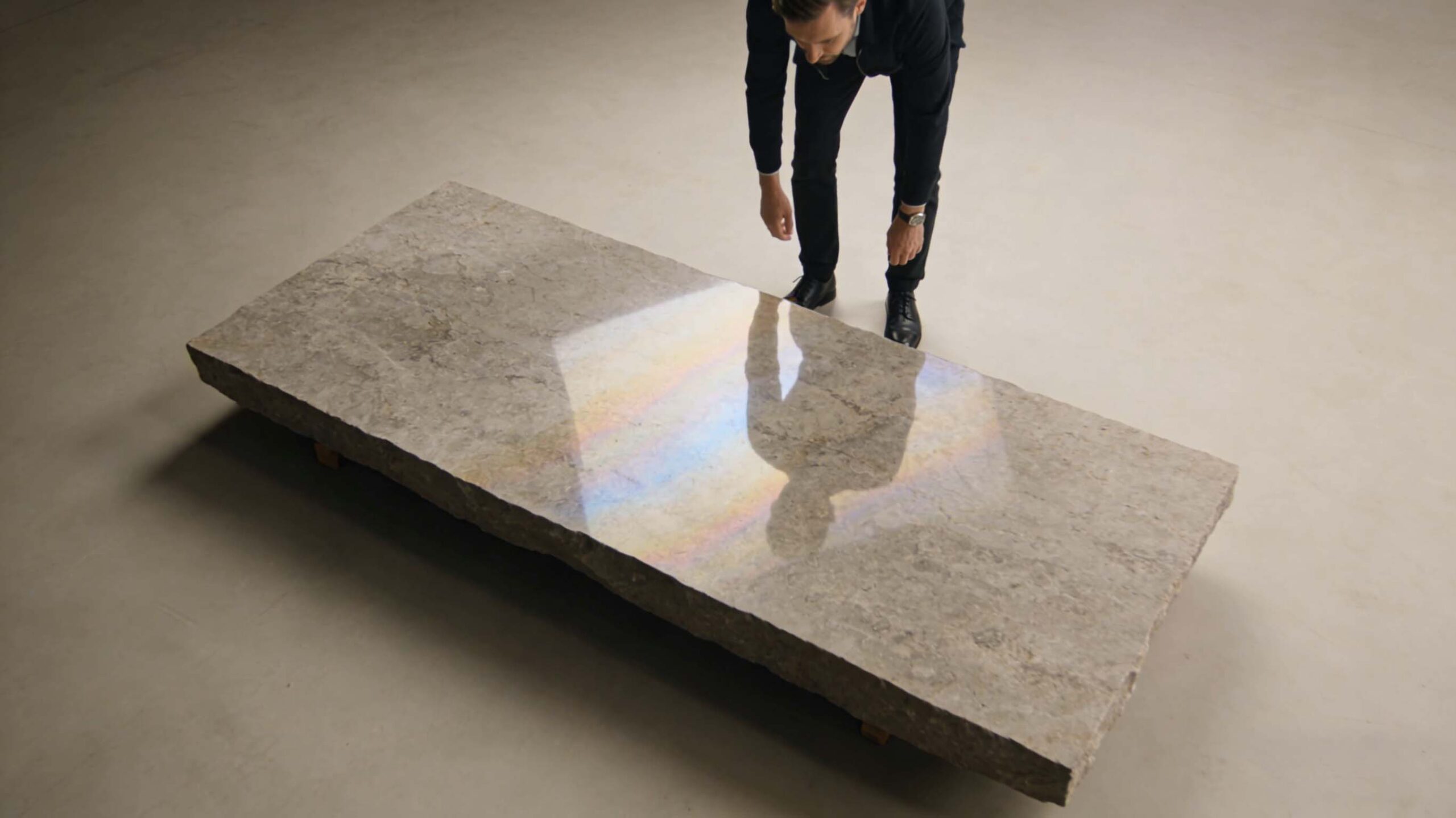
Run your fingernail lightly across suspicious lines:
-
Smooth + glossy = likely resin
-
Rough or uneven = natural fissure or open crack
Use Light, Not Pressure
Tilt the slab under strong lighting:
-
Resin repairs reflect light differently
-
Filled cracks often appear darker at certain angles
Ask directly:
-
Is this slab reinforced with mesh?
-
Has resin been applied for structural reasons or cosmetic reasons?
Honest manufacturers will answer clearly. Middlemen often avoid specifics.
Surface Finish Inspection: What You See vs What You’ll Receive
Polished Finish
Check:
-
Uniform gloss level across the slab
-
No dull “clouding” near veins or repairs
-
Edge polish consistency (not just the face)
Uneven gloss often indicates rushed polishing or soft minerals reacting differently—an issue that worsens in bulk production.
Honed, Leathered, and Brushed Finishes
For non-polished finishes:
-
Touch matters more than sight
-
Texture should feel consistent across the surface
-
No sticky or waxy residue (a red flag for temporary enhancement)
Ask whether the finish is achieved mechanically or chemically. This affects durability and repeatability.
Thickness and Dimensional Tolerance: The Most Ignored Risk
Why Thickness Tolerance Matters More Than Buyers Think
A slab listed as “20 mm” may vary between 18–22 mm if tolerance control is weak.
At the fair:
-
Check slab edges visually for waviness
-
Compare two slabs side by side
-
Ask for stated tolerance range (±1 mm, ±2 mm, etc.)
Poor tolerance causes:
-
Installation delays
-
Extra adhesive use
-
Fabrication rework
-
Rejection at site
Professional factories know their tolerance limits. Traders often do not.
Fast Checklist for On-the-Spot Stone Quality Inspection
Use this mental checklist:
-
Overall slab integrity (distance view)
-
Vein continuity and natural logic
-
Presence and honesty of repairs
-
Finish consistency and method
-
Thickness realism and tolerance disclosure
If a supplier passes all five, they are worth sampling. If not, walk away—no matter how attractive the price.
Regulatory and Compliance Context Buyers Should Know
Why Compliance Is Becoming Part of Quality
Increasingly, stone quality is tied to:
-
Construction material regulations
-
Fire safety and surface treatment standards
-
Environmental and worker safety disclosures
In the EU and North America, buyers are under pressure to document material origin, processing methods, and chemical treatments. This makes transparent inspection conversations at the fair more important than ever.
Suppliers who understand compliance usually understand quality. Those who dismiss it often cut corners elsewhere.
Linking Inspection to Sourcing Strategy
A fair inspection should not exist in isolation. It must connect to:
-
Supplier qualification
-
Quotation comparison
-
Sampling strategy
-
Factory audit planning
If you are attending Xiamen Stone Fair, a broader sourcing context is essential. For a full overview of halls, supplier types, and sourcing strategy, see this complete buyer reference:xiamen stone fair 2026 the complete buyers guide dates halls sourcing strategy trends

Common Buyer Mistakes During Stone Quality Inspection
-
Trusting lighting instead of surface behavior
-
Ignoring slab edges
-
Confusing resin gloss with polish quality
-
Failing to ask about tolerance
-
Assuming display slabs equal shipment quality
Avoiding these mistakes saves months—not days.
Conclusion: Inspect Fast, Decide Slow
A trade fair inspection is about eliminating bad options, not confirming perfect ones. When you apply a structured Stone Quality Inspection approach—focused on slabs, veins, cracks, finish, and tolerance—you dramatically reduce downstream risk.
The best buyers don’t rush decisions. They rush filtering.
FAQ: Stone Quality Inspection at Trade Fairs
1. How can I tell if a stone slab has hidden cracks at a trade fair?
Look for irregular reflection under angled light and run a fingernail across suspect lines. Smooth glossy lines usually indicate resin-filled cracks rather than natural fissures.
2. Is resin treatment always a bad sign in stone slabs?
No. Structural resin reinforcement is common and acceptable, but excessive cosmetic resin to hide defects is a quality risk. Transparency from the supplier is key.
3. What thickness tolerance should I accept when buying stone slabs?
Professional factories usually control within ±1 mm to ±2 mm. Anything looser increases installation and fabrication risk.
4. Can I rely on displayed slabs to judge bulk order quality?
Displayed slabs are often selected. Always ask about block origin, batch consistency, and whether similar slabs are available beyond the display.
5. Which stone finish is hardest to inspect at a trade fair?
Leathered and brushed finishes are hardest because texture can mask repairs. Touch and angled lighting are essential for these finishes.
References
-
ASTM International. Standard Guide for Selection of Dimension Stone. ASTM C97/C97M.
-
Natural Stone Institute. Dimension Stone Design Manual.
-
EN Standards Committee. EN 1469 Natural Stone Products – Slabs.
-
Marble Institute of America. Stone Inspection and Fabrication Guidelines.
-
European Commission. Construction Products Regulation (CPR).
-
U.S. Geological Survey. Natural Stone Resource Characteristics.
-
Building Stone Magazine. Common Stone Defects and How to Identify Them.
-
World Stone Federation. Best Practices in Stone Processing and Inspection.
A Fast On-Site Method to Verify Slab Quality Without Getting Fooled by Display Lighting
What buyers are really trying to confirm at a fair. Trade fair inspection is not factory QC. Your goal is to identify risk signals fast: whether the slab is structurally sound, whether patterns will remain consistent across batches, whether repairs are transparent and acceptable, whether the finish is repeatable, and whether thickness tolerance is controlled well enough for fabrication and installation.
Why inspection mistakes are more expensive in 2026. Display slabs are increasingly curated, lighting is designed to flatter surfaces, and cosmetic repairs can look “normal” at first glance. At the same time, procurement is moving toward stronger accountability and documentation habits. That means the cost of missing a crack, a heavy resin repair, or poor tolerance control is no longer just aesthetic—it can become a dispute, a delay, or a rejection later in the supply chain.
How to inspect slabs fast in the most reliable order. Start with distance viewing to catch uneven reflection and whole-slab inconsistencies, then move to angled-light checks for resin repairs and clouding, then edge checks for waviness and thickness realism. This order prevents the most common trap: zooming into a beautiful area and missing the slab’s overall truth.
What “vein checking” actually means for buyers. Vein continuity is a batch question, not a single-slab question. Ask to see multiple slabs from the same block or similar batch. Natural veins usually show organic continuity; abrupt starts, mirrored patching, or inconsistent color inside the same vein often indicate selective display or heavy treatment. Your sheet should record whether the supplier can show “more than the hero slab.”
What cracks and fissures look like when suppliers are being honest. Natural fissures usually follow geological structure and remain shallow; structural cracks often cross grain direction and may be filled. Under angled light, resin-filled lines reflect differently. If a supplier can explain the repair method, reinforcement, and acceptability limits clearly, that transparency itself is a quality signal.
Options buyers should choose based on application, not preference. Polished slabs prioritize reflection uniformity and edge polish discipline; honed surfaces require consistent abrasion results; leathered/brushed finishes demand touch checks because texture can hide repairs. Your inspection method should adapt to finish type, because the “same” defect can behave differently under different finishes.
Considerations that prevent post-fair disputes. Thickness tolerance is the quiet deal-breaker. Slabs labeled 20 mm can vary enough to create fabrication rework and installation delays. Ask for tolerance range, document it, and compare slabs side by side. If tolerance answers are vague, treat the quote as higher risk regardless of the slab’s beauty.
How to connect inspection to the complete sourcing workflow. Fair inspection is strongest when it plugs into your broader hall strategy, supplier verification, and follow-up system. Add a contextual internal link so readers can plan halls and supplier types before inspecting: Internal Link: Xiamen Stone Fair 2026: The Complete Buyer’s Guide (Dates, Halls, Sourcing Strategy & Trends) → /xiamen-stone-fair-2026-the-complete-buyers-guide-dates-halls-sourcing-strategy-trends/