What to Bring to Xiamen Stone Fair Micro Summary
Why “What You Bring” Determines What You Gain
Xiamen Stone Fair is not a sightseeing event—it is one of the world’s most concentrated sourcing environments for stone manufacturers, factories, machinery suppliers, and wholesale exporters. Every year, buyers walk the same halls, meet the same categories of suppliers, and see similar materials. Yet the outcomes differ drastically.
The difference is not luck. It is preparation.
What you bring to Xiamen Stone Fair—documents, tools, apps, and decision frameworks—directly determines whether you leave with a business card stack or with verified suppliers, clear quotations, and a shortlist ready for RFQs.
This guide focuses on practical packing logic for buyers, not generic travel advice. It is written for importers, contractors, distributors, architects, and procurement teams who want to evaluate real factories, avoid time waste, and convert fair visits into real orders.
(For the full fair overview, halls, sourcing strategy, and market trends, see Xiamen Stone Fair 2026: The Complete Buyer’s Guide (Dates, Halls, Sourcing Strategy & Trends).)
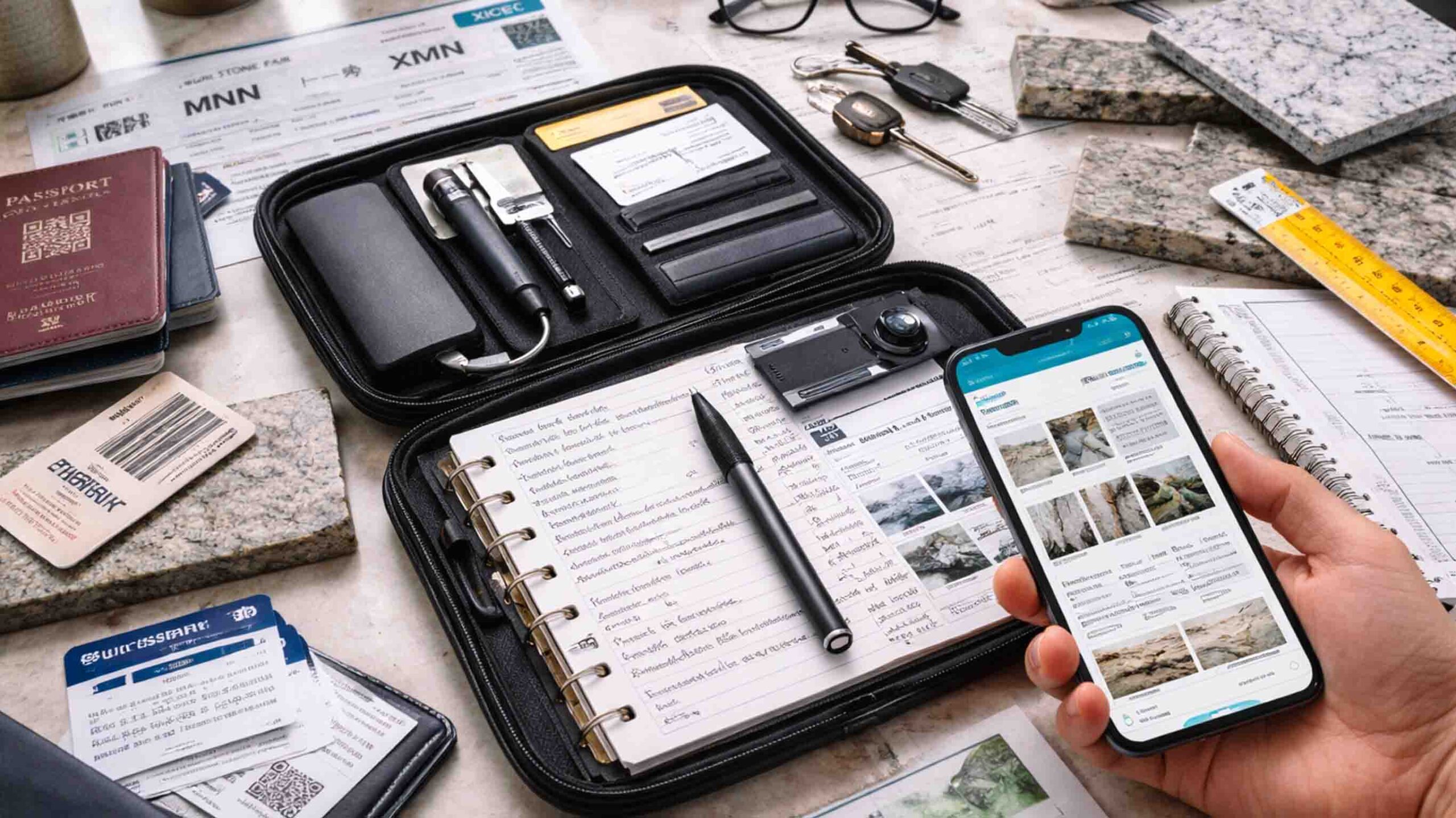
Category 1: Essential Documents Buyers Must Carry
Passport, Visa, and Entry Proof (Physical + Digital)
Your passport and visa are obvious—but buyers often overlook how they carry them.
Best practice is redundancy:
-
Physical passport and visa
-
High-resolution scans stored offline
-
Cloud backup accessible without local SIM dependency
During fair week, hotels, local authorities, and even some suppliers may request verification. Having instant access avoids friction.
Business Cards Still Matter (But Only If Used Correctly)
Despite digital tools, business cards remain relevant in China—especially with factory owners and senior sales managers.
Bring cards that clearly state:
-
Your role (Buyer, Procurement Manager, Distributor)
-
Company name (not just a brand alias)
-
Email + WhatsApp/WeChat ID
Avoid generic “Sales” or unclear titles. At a fair like Xiamen, positioning affects how seriously suppliers engage.
Company Introduction (1–2 Pages, Buyer-Focused)
This is one of the most underused tools.
A short company introduction helps suppliers immediately understand:
-
Your market (retail, project, wholesale, OEM)
-
Typical order volume
-
Target materials or finishes
It reduces irrelevant pitches and accelerates meaningful conversations.
Category 2: Supplier Evaluation & Verification Materials
Pre-Printed Supplier Evaluation Checklist
At Xiamen Stone Fair, you may speak with dozens of suppliers per day. Memory fails quickly.
Bring a simple evaluation checklist covering:
-
In-house production scope
-
Factory location
-
Export experience
-
Certifications
-
QC and packaging standards
This transforms casual conversations into structured comparisons.
(For deeper evaluation logic, see How to Evaluate Stone Suppliers at Xiamen Stone Fair: Factory Proof, Certifications & Red Flags.)
Sample Acceptance & Quality Criteria Notes
Natural stone disputes often start with undefined expectations.
Prepare written notes on:
-
Acceptable color variation
-
Vein tolerance
-
Thickness tolerance
-
Surface finish standards
When you ask suppliers these questions consistently, you instantly separate experienced manufacturers from sales-only traders.

Category 3: Tools That Save Time on the Show Floor
Smartphone With Adequate Storage and Battery Capacity
Stone fairs are visually dense. Photos are your real records.
Before departure:
-
Clear storage
-
Enable high-resolution camera mode
-
Carry a power bank (20,000 mAh recommended)
Label photos immediately after meetings. Unlabeled slab photos lose value within hours.
Portable Measuring Tools
A compact tape measure or digital caliper allows you to:
-
Verify slab thickness
-
Check cut-to-size samples
-
Validate claims quickly
Suppliers who resist measurement are revealing more than words ever could.
Notebook for Decision-Level Notes
Digital notes are efficient, but handwritten notes still excel for:
-
Quick supplier scoring
-
Red-flag observations
-
Negotiation context
Short notes written immediately after meetings preserve decision clarity.
Category 4: Apps You Actually Need in Xiamen
WeChat (Non-Negotiable)
WeChat is not optional in China.
It is used for:
-
Supplier follow-up
-
Sending catalogs and certificates
-
Sharing factory videos
-
Scheduling post-fair meetings
Set it up before arrival. Verification inside China can be difficult.
Translation Apps (Offline Enabled)
While many suppliers speak English, technical discussions often benefit from translation support.
Recommended:
-
Google Translate (offline packs)
-
DeepL (for written follow-ups)
Do not rely on live connectivity alone.
Ride-Hailing and Maps
Install:
-
DiDi (ride-hailing)
-
Apple Maps or Google Maps (with offline maps)
These save significant time moving between hotels, the exhibition center, and supplier dinners.
(For route planning and hotel logic, see Xiamen Stone Fair 2026 Travel Guide: Flights, Hotels, Transport & Time-Saving Routes.)
Category 5: Digital Files You Should Prepare Before Flying
RFQ Templates (Editable)
Prepare RFQ templates that include:
-
Material name
-
Size and thickness
-
Finish
-
Quantity
-
Packaging requirements
-
Destination port
When you send RFQs within 48–72 hours after the fair, response quality improves dramatically.
Certification Reference List
Know what certificates matter in your market:
-
ISO standards
-
Environmental compliance
-
Safety or labor standards
Bring a reference list so you can ask precise questions instead of generic ones.
Category 6: Packing Strategy for Fair Week Efficiency
Clothing With Purpose
Xiamen Stone Fair requires walking, standing, and rapid meetings.
Bring:
-
Comfortable business-casual shoes
-
Light layers (halls vary in temperature)
-
Minimal accessories
Discomfort reduces focus, which reduces decision quality.
Lightweight Bag for Documents and Tools
Choose a bag that:
-
Fits documents without folding
-
Holds power banks and chargers
-
Is easy to open during meetings
Avoid overpacking. Speed matters more than style.

Category 7: What Not to Bring (And Why)
Avoid:
-
Heavy catalogs (collect digital versions instead)
-
Excessive samples
-
Non-essential electronics
Your goal is information capture, not material transport.
Category 8: How Packing Strategy Affects Sourcing Outcomes
Well-prepared buyers:
-
Ask better questions
-
Detect inconsistencies faster
-
Send cleaner RFQs
-
Convert suppliers more efficiently
Poor preparation leads to:
-
Vague follow-ups
-
Misaligned quotations
-
Disputes months later
Packing is not logistics—it is sourcing strategy.
Connecting This Guide to the Bigger Picture
This article is one part of a complete buyer system.
For dates, hall layouts, sourcing strategy, and industry trends, return to the pillar guide:
Xiamen Stone Fair 2026: The Complete Buyer’s Guide (Dates, Halls, Sourcing Strategy & Trends)
Frequently Asked Questions
1. What documents should I bring to Xiamen Stone Fair as a buyer?
Bring your passport, visa, business cards, and a short company introduction. Digital backups of all documents are strongly recommended.
2. Do I need to prepare RFQs before attending Xiamen Stone Fair?
Yes. Having RFQ templates allows you to follow up within days, which significantly improves supplier response quality.
3. Is WeChat necessary for attending Xiamen Stone Fair?
Yes. Most suppliers use WeChat for communication, document sharing, and post-fair follow-up.
4. What tools help evaluate stone suppliers faster at the fair?
A smartphone with good camera, a measuring tool, a notebook, and a structured evaluation checklist are the most effective tools.
5. Should I bring stone samples back from the fair?
Generally no. Collect digital records and arrange sample shipments later to avoid logistics issues and customs complications.
References
-
UFI – Global Association of the Exhibition Industry, “Trade Fair Preparation Best Practices”
-
International Trade Centre (ITC), “Effective Trade Fair Participation”
-
ISO, “Understanding ISO Management System Standards”
-
World Bank, “Reducing Trade Friction Through Documentation”
-
McKinsey & Company, “Procurement Excellence in Global Supply Chains”
-
Harvard Business Review, “How Buyers Evaluate Suppliers”
-
China Council for the Promotion of International Trade (CCPIT), “Exhibition Participation Guidelines”
-
Deloitte, “Supplier Risk Management in Global Procurement”
What “what to bring” is actually solving for a buyer. Packing for Xiamen Stone Fair is not travel logistics—it is procurement infrastructure. The fair compresses hundreds of supplier conversations into a few days, and your tools determine whether those conversations become evidence, comparable quotations, and an RFQ-ready shortlist. If you leave with unlabelled photos and vague notes, you didn’t really “source,” you just walked.
Why buyers in 2026 need a more documentation-first packing logic. Global procurement is moving toward clearer documentation habits, stronger product information expectations, and more structured supplier screening. Even when enforcement timelines vary, the direction is consistent: buyers prefer suppliers who can show repeatability signals and provide usable documentation quickly. Your packing system should make evidence capture effortless—because evidence is what accelerates approvals after the fair.
How to build a packing system that converts booths into decisions. A high-performing buyer kit has four layers: identity proof (who you are), decision proof (how you evaluate), capture tools (how you record), and follow-up templates (how you convert). When these four layers work together, you can compare suppliers objectively and follow up within 24–72 hours while context is fresh.
What matters most in documents: credibility and speed. Buyers should carry passport/visa backups, business cards, and a short buyer profile that states your market, order style, and target products. This prevents wasted pitches and helps real factories treat you like a serious procurement lead. If your identity and intent are clear, suppliers respond with better technical answers and more accurate quotations.
Why the right tools outperform “more stuff.” The best buyer tools are lightweight but decisive: a camera-ready phone with storage, a power bank, a compact measuring tool, and a simple notebook for scoring. These tools let you verify thickness, capture packaging proof, document finish details, and record red flags immediately. Most buyers don’t fail because they lack information—they fail because they can’t retrieve it later.
What apps are essential because they reduce communication friction. At Xiamen Stone Fair, communication and file sharing often happen through WeChat. Translation tools help with technical nuance, and map/ride-hailing apps stabilise daily movement. The goal is not convenience; it is continuity—being able to re-contact the right person, send the right file, and confirm the right details without delay.
Option strategy: pack according to your sourcing mission. If you are sourcing slabs, focus on quality-variation notes, selection standards, and photo labeling systems. If you are sourcing cut-to-size or fabrication, prioritise tolerance discussion prompts, edge/finish acceptance criteria, and packaging protection evidence. If you are sourcing wholesale from manufacturers, prioritise RFQ templates, export readiness questions, and proof-capture routines that shorten the time from booth to sample order.
Considerations that prevent the most common post-fair failure: assumption mismatch. The number one reason quotations become incomparable is missing assumptions: grade definition, allowable variation, thickness tolerance, finish expectations, packaging requirements, and inspection rules. Your packing system should include a short “assumption sheet” and an RFQ template so every supplier quotes on the same basis. If assumptions are aligned, comparisons become meaningful.
What not to bring—and why it improves results. Heavy catalogs, excessive samples, and non-essential electronics slow you down and reduce your mobility. At a mega fair, speed and clarity beat quantity. Collect digital catalogs, capture evidence intelligently, and ship samples later through controlled logistics. A lighter bag often produces a stronger shortlist.
How to close the loop by connecting this page to your pillar guide. This packing checklist works best when it connects to the full buyer strategy and hall planning. Add a contextual link to your pillar guide so readers can plan the show before they pack: Internal Link: Xiamen Stone Fair 2026: The Complete Buyer’s Guide (Dates, Halls, Sourcing Strategy & Trends) → /xiamen-stone-fair-2026-the-complete-buyers-guide-dates-halls-sourcing-strategy-trends/