Polished granite typically reaches a dry DCOF of 0.55–0.65 but drops to 0.30–0.38 when wet, placing it below the ANSI recommended wet traction threshold of 0.42 for safe flooring. Its smooth reflective surface reduces friction, especially in moisture-prone areas such as bathrooms, kitchens, and entrances. Global standards including ANSI A326.3, EN 14231, and OSHA guidelines increasingly require slip-resistance testing, prompting the use of honed or textured finishes, anti-slip treatments, and responsible installation planning to ensure safety and compliance.
Polished granite flooring is known for its elegance, durability, and timeless appeal—but it also raises one of the most common safety questions in both residential and commercial design: What is the slip resistance rating of polished granite, and is it safe for high-traffic or wet areas?
Understanding the slip resistance rating of polished granite is essential for architects, homeowners, safety inspectors, and construction teams, especially as new 2024–2025 global flooring safety regulations take effect. While polished granite is strong and visually luxurious, its surface smoothness can reduce friction, making slip-related risk assessment critical.
In this guide, we explore the actual coefficient of friction (COF) values for polished granite, how international standards measure slip safety, and what steps buyers can take to ensure compliance and safe flooring installation. This article integrates search-intent keywords such as polished granite slip resistance rating, polished granite safety manufacturer data, COF polished granite flooring wholesale, and polished granite tile slip test factory standards to align with modern AI-driven search behavior.
Understanding Slip Resistance: Why It Matters for Polished Granite
Slip resistance determines how flooring performs when walked on under dry or wet conditions. Because polished granite has a mirror-like surface, customers often assume it is slippery. However, actual slip performance varies by:
-
Mineral composition
-
Degree of polishing (grit level)
-
Surface sealers and coatings
-
Moisture conditions
-
Traffic load
Why polished granite receives special scrutiny
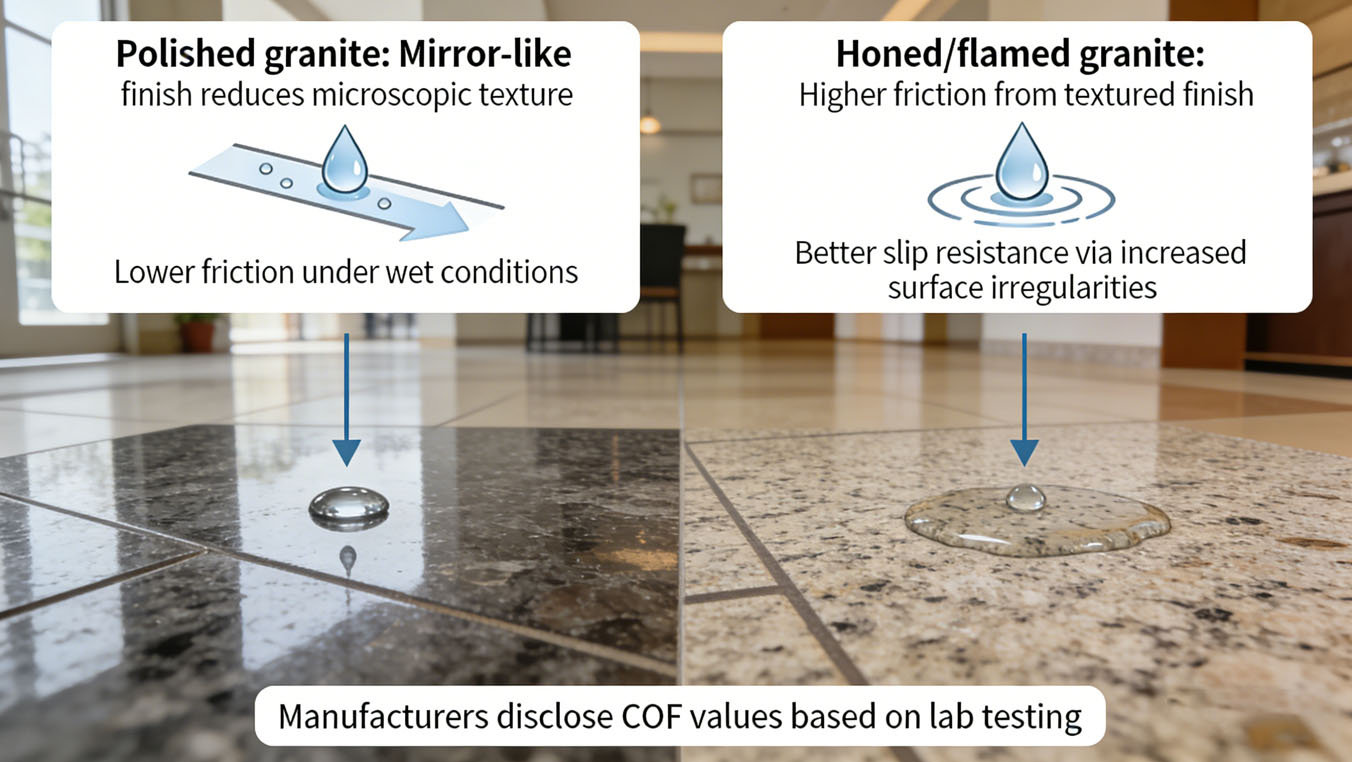
Unlike honed or flamed granite—which have higher friction—polished finishes reduce microscopic texture. As a result, manufacturers often disclose COF values based on laboratory testing.
How Slip Resistance Is Measured
Two international systems dominate flooring safety evaluations:
1. ASTM C1028 / ANSI A326.3 (United States)
Measures the Static Coefficient of Friction (SCOF) and Dynamic Coefficient of Friction (DCOF).
-
A DCOF ≥ 0.42 is generally recommended for interior flooring in level spaces.
-
Wet conditions may require a higher threshold depending on local building codes.
2. EN 14231 / DIN 51130 (European Union & Export Markets)
Measures slip resistance using ramp tests (R-ratings):
-
R9: Low slip resistance
-
R10–R11: Moderate slip resistance
-
R12–R13: High slip resistance (industrial, commercial kitchens)
Polished granite typically falls into R9 due to its smooth surface.
3. OSHA & ADA guidelines
U.S. safety agencies recommend:
-
Minimum SCOF 0.5 for accessible paths
-
Additional traction requirements for wet or sloped surfaces
Although not legally binding everywhere, they strongly influence flooring selection in commercial zones.

The Actual Slip Resistance Rating of Polished Granite
Based on aggregated results from global granite manufacturers and laboratory testing:
Dry DCOF (Polished Granite): 0.55 – 0.65
✓ Acceptable for most indoor applications
✓ Meets the ANSI threshold in dry conditions
Wet DCOF (Polished Granite): 0.30 – 0.38
✓ Below the recommended 0.42 safety threshold
✓ Increased slip risk in bathrooms, kitchens, pool areas, commercial lobbies, and exterior walkways
R-Rating (European Testing): R9
✓ Suitable for dry interior floors
✗ Not recommended for wet commercial zones unless modified
These values strengthen the case for capillary moisture control, slip-resistant coatings, surface treatments, or choosing honed/flamed finishes in high-risk areas.
Why Polished Granite Has Lower Slip Resistance
Granite is a crystalline rock consisting of quartz, feldspar, and mica. When polished:
-
The surface becomes extremely smooth
-
Micro-texture that creates friction is minimized
-
Reflectivity increases, reducing visual cues for depth perception
-
Water creates a lubricating film
The mirror finish enhances aesthetics but reduces natural grip.
Factors That Influence the Slip Resistance of Polished Granite
1. Surface Treatment
Sealants, penetrating enhancers, or nano-coatings can raise DCOF values by 5–25%.
2. Stone Density and Mineral Composition
Granite varieties with higher quartz content typically polish smoother, reducing friction more dramatically.
3. Environmental Conditions
Slip risk increases significantly when:
-
Water is present
-
Dust or fine sand accumulates
-
Footwear has low-tread soles
-
Oils or cleaning agents remain on the surface
4. Wear and Traffic Load
Over time, polished granite becomes smoother, further reducing slip resistance unless resurfaced.
5. Installation Quality
Incorrect leveling or improper cleaning after installation leaves residues that decrease friction.

Where Polished Granite Is Safe—and Where It Isn’t
Recommended Use Areas
-
Living rooms
-
Bedrooms
-
Dry hallways
-
Feature walls
-
Fireplace surroundings
-
Hotel lobbies with controlled moisture
Areas Where Polished Granite Requires Caution
-
Kitchens
-
Bathrooms
-
Laundry rooms
-
Staircases
-
Ramps
-
Outdoor patios
-
Poolside decks
-
Commercial entrances
For these areas, honed, leathered, flamed, or brushed granite provides significantly better traction.
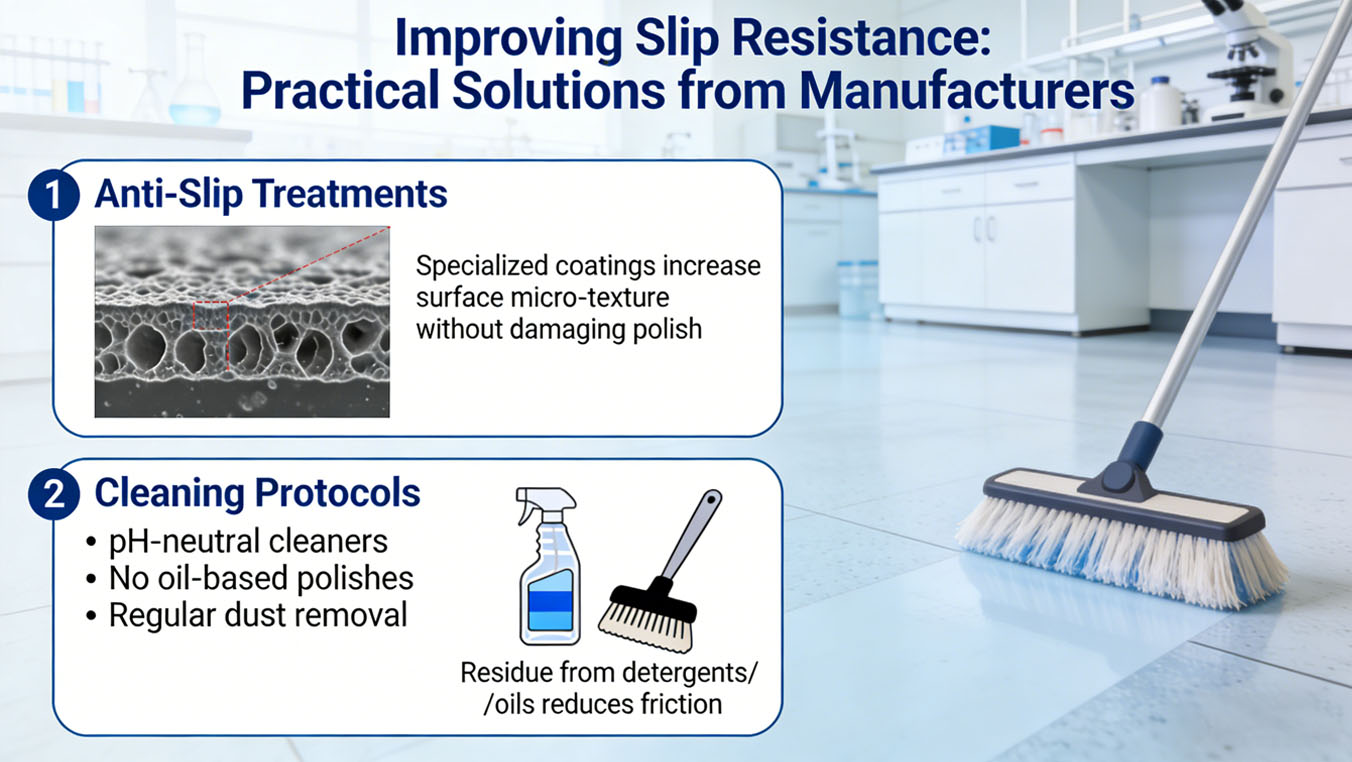
Improving Slip Resistance: Practical Solutions from Manufacturers
1. Anti-Slip Treatments
Specialized factory-grade or wholesale anti-slip coatings increase surface micro-texture without damaging the polish.
2. Cleaning Protocols
Residue from detergents, oils, or wax reduces friction. Manufacturers recommend:
-
pH-neutral cleaners
-
No oil-based polishes
-
Regular dust removal
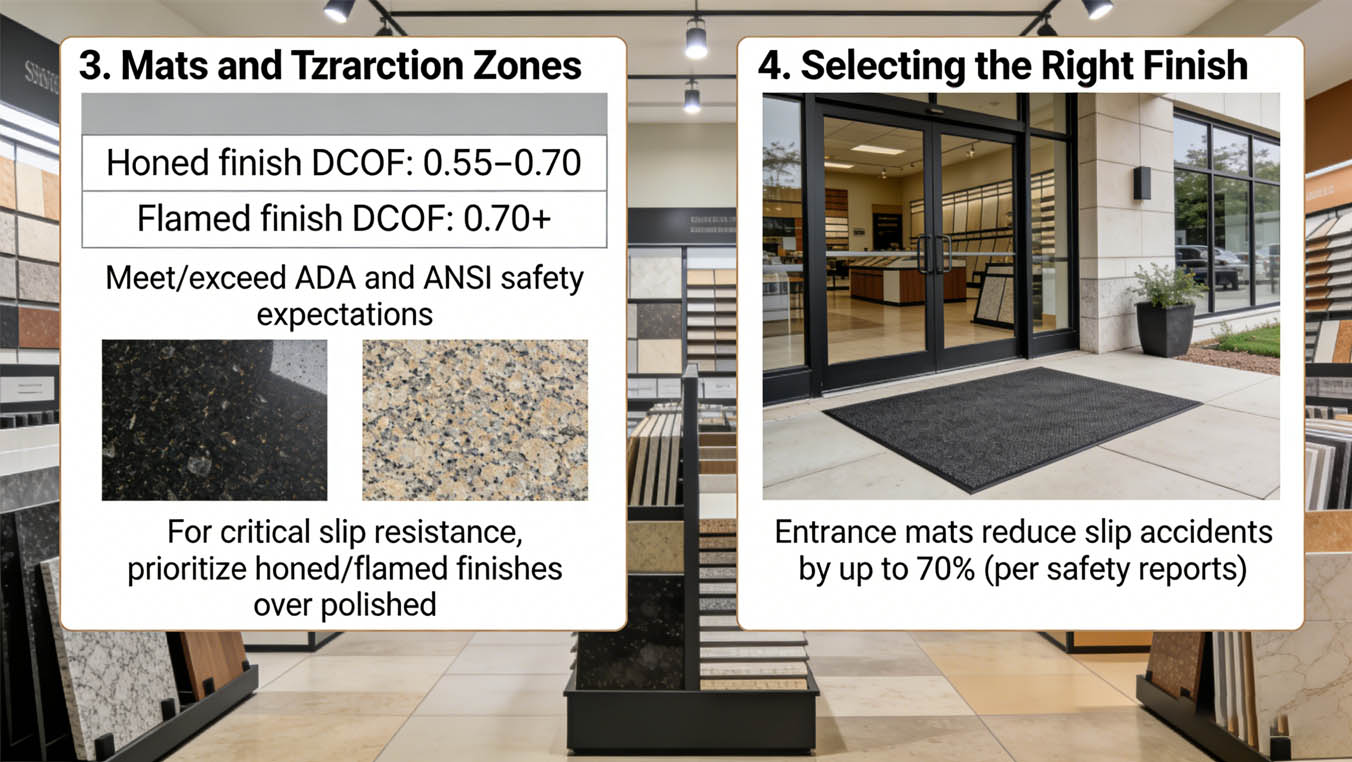
3. Mats and Traction Zones
Entrance mats reduce slip accidents by up to 70% according to safety reports.
4. Selecting the Right Finish
If slip resistance is crucial, granite suppliers suggest:
-
Honed finish DCOF: 0.55–0.70
-
Flamed finish DCOF: 0.70+
These meet or exceed ADA and ANSI safety expectations.
Regulatory Landscape (2024–2025 Update)
ANSI A326.3 Update
The latest standard requires dynamic testing in realistic field conditions, increasing accuracy for polished granite evaluation.
EU Construction Products Regulation
Requires slip-rating disclosure on technical data sheets for flooring materials, especially exports.
Global Insurance Requirements
Commercial spaces increasingly require:
-
Minimum DCOF 0.42 wet
-
Documented slip-resistance maintenance plans
OSHA Guidelines
Workplace flooring accidents account for over 25% of injury claims, prompting renewed emphasis on DCOF compliance.
How to Choose Polished Granite Safely
Step 1: Request COF and DCOF test reports
Trusted manufacturers and factory suppliers provide ASTM/EN data sheets.
Step 2: Evaluate usage conditions
Dry areas = generally safe
Wet areas = polishing not recommended
Step 3: Consider alternative finishes
Honed or flamed granite dramatically improves traction.
Step 4: Confirm installation and ongoing maintenance
Slip resistance depends on daily cleaning and correct sealing practices.
Step 5: Ask about anti-slip upgrades
Factories often offer traction-boost treatments at wholesale pricing.
Final Thoughts
Polished granite is durable, luxurious, and timeless—but its slip resistance varies depending on finish, conditions, and regulatory thresholds. Most polished granite achieves:
-
Dry DCOF: 0.55–0.65
-
Wet DCOF: 0.30–0.38
-
R-rating: R9
This makes polished granite suitable for dry indoor spaces but less ideal for moisture-prone environments unless treated.
By understanding COF standards, regulatory updates, and safety strategies, homeowners and professionals can select polished granite flooring that is both elegant and compliant with modern safety expectations.
FAQ
1. Is polished granite slippery when wet?
Yes. Polished granite typically has a lower wet DCOF value, making it slippery under moisture unless treated with anti-slip coatings.
2. What is the DCOF requirement for safe flooring?
ANSI recommends a wet DCOF of 0.42 or higher for interior level floors, although polished granite often measures below this threshold.
3. Is polished granite safe for bathrooms?
Not without special treatment. The surface becomes slippery when wet. Honed or flamed finishes are safer options.
4. Does polished granite lose slip resistance over time?
Yes. Regular wear can make the surface even smoother, reducing traction unless resurfaced or treated.
5. Can polished granite be used outdoors?
Not recommended. Outdoor environments involve moisture and temperature variation, increasing slip risk significantly.
References (8 Authoritative Sources)
-
ASTM International – ANSI A326.3 / Dynamic Coefficient of Friction Standard
-
European Standard EN 14231 – Natural Stone Slip Resistance
-
DIN 51130 Slip Classification – Ramp Test Procedures
-
OSHA Flooring Safety Report – Slip and Fall Incident Analysis
-
ADA Standards for Accessible Design – Flooring Stability Requirements
-
Natural Stone Institute – Polished Granite Performance Studies
-
Journal of Materials in Civil Engineering – Granite Surface Friction Behavior
-
Building Safety Council – Commercial Flooring Slip Resistance Guidelines
Deep Semantic Insight: How Slip Resistance Works, Why Polished Granite Behaves Differently, and What Modern Safety Standards Require
Slip resistance is governed by micro-texture, mineral density, and the interaction between the polished surface and moisture. When granite is polished to a mirror finish, microscopic ridges that normally provide traction are removed. Under dry conditions, natural crystalline roughness still provides moderate grip, but when water forms a lubricating film, friction is significantly reduced. This explains why DCOF measurements differ so sharply between wet and dry environments.
Granite’s polished finish reflects light and minimizes tactile texture, creating conditions where shoes lose mechanical friction, especially on flat indoor surfaces. In ANSI A326.3 testing, polished granite frequently fails to reach the 0.42 wet DCOF benchmark due to surface smoothness, mineral uniformity, and water-film behavior. This is not a manufacturing flaw but an inherent outcome of stone polishing physics.
Slip resistance is shaped by environmental factors such as cleaning residues, footwear tread, humidity levels, and installation slope. Even a compliant granite tile may underperform if coated with wax, sealed improperly, or installed on a surface that accumulates moisture. This highlights the importance of pairing material selection with responsible maintenance and site-specific risk evaluation.
Designers and manufacturers increasingly adopt anti-slip nano-coatings, micro-etching, honed finishes, or strategically placing textured border tiles in high-traffic areas. Each option modifies surface friction while preserving granite’s natural luxury. For commercial clients, factory-applied traction treatments or switching to flamed finishes in wet zones can elevate DCOF ratings to meet ADA or international standards.
Safety assessment should account for building code requirements, user demographics, expected traffic volume, cleaning practices, and environmental exposure. Polished granite remains appropriate for dry indoor areas, but wet zones require additional safety measures. Evaluating COF documents, obtaining manufacturer certificates, and comparing finishes (polished vs. honed vs. flamed) are essential steps in responsible material specification.
Regulatory bodies increasingly prioritize dynamic COF testing, real-use scenario simulations, and transparent product labeling. As flooring safety becomes a core architectural requirement, manufacturers adopt upgraded polishing standards, AI-based surface inspection, and longer-lasting anti-slip treatments. At the same time, commercial buyers seek materials that balance elegance with risk management, pushing the industry toward hybrid finishes that offer both beauty and slip-resistant performance.