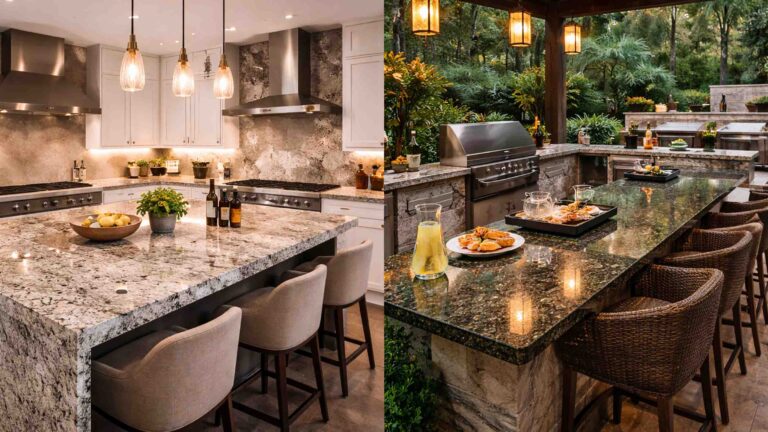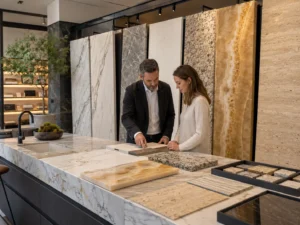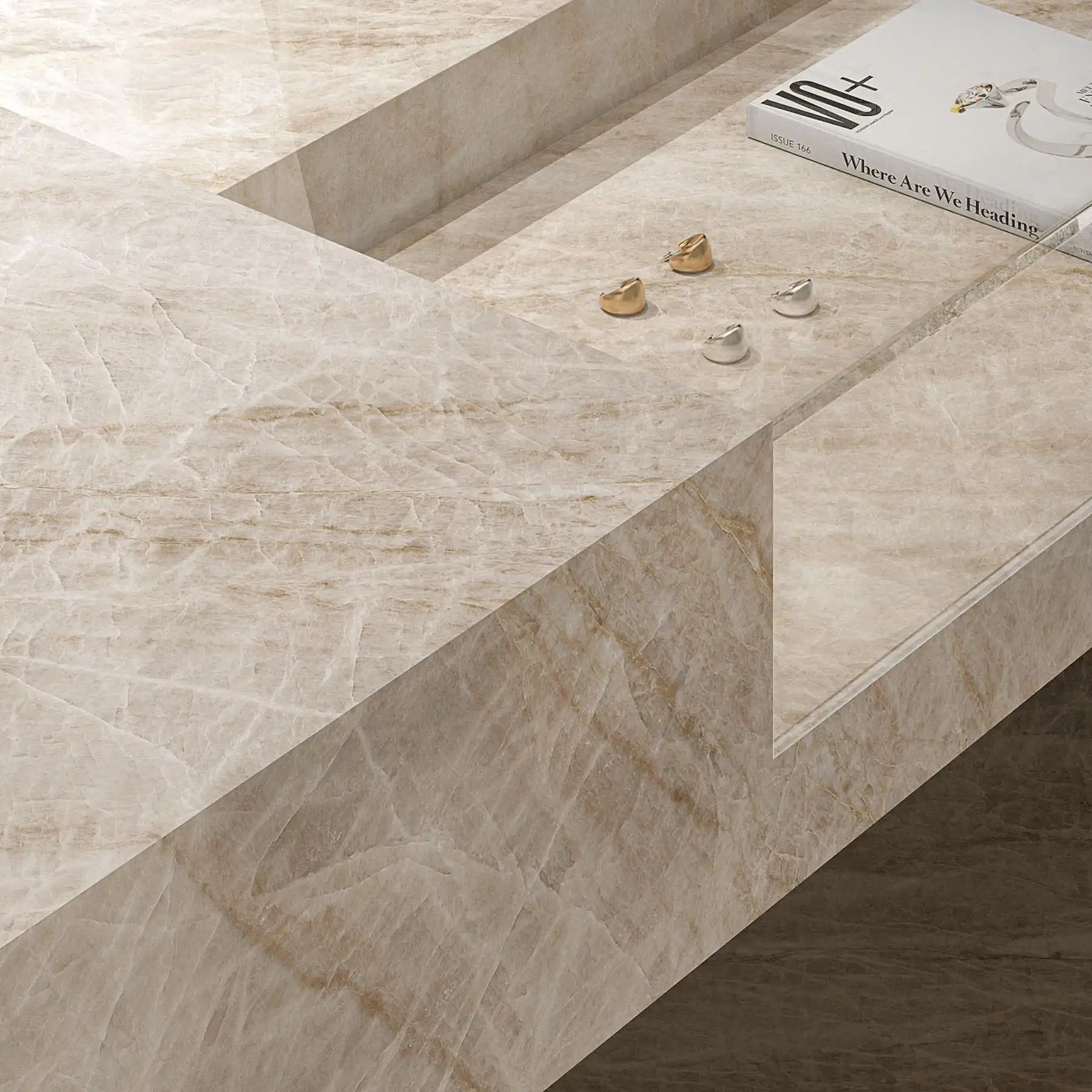
The top quartzite stones in the world for kitchen countertops and statement islands are being chosen in 2026 not only for dramatic beauty, but also for durability, heat resistance, natural movement, and stronger design value in luxury kitchens. From Taj Mahal and Cristallo to Patagonia and Mont Blanc, premium quartzite is becoming a preferred surface for buyers who want a natural stone that combines visual impact, practical performance, and high-end architectural appeal.
Quartzite is no longer the quiet alternative in luxury kitchens. In 2026, it is one of the clearest signals of where premium surface design is heading: toward natural materials, warmer tones, stronger movement, and statement islands that feel architectural rather than merely functional. The NKBA 2026 Kitchen Trends Report says natural quartzite ranks just behind quartz for countertop materials at 62% and for backsplashes at 61%, which is a remarkable position for a natural stone once treated as more niche. That ranking matters because it comes from a market where designers, builders, and kitchen specialists are balancing beauty, performance, and long-term practicality more carefully than ever.
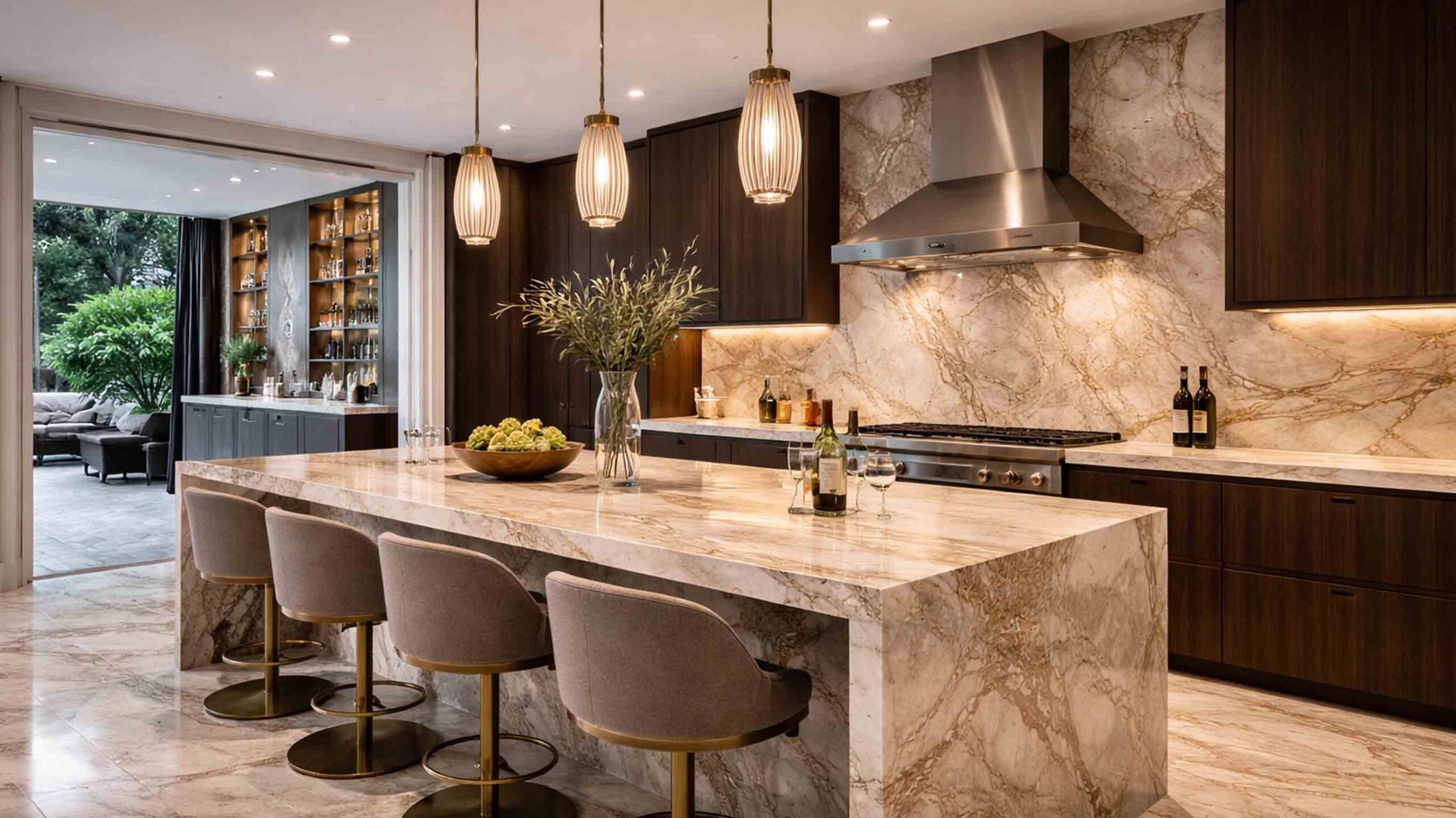
Quartzite is rising for another reason too: it sits in a commercially useful middle ground. Buyers often want the movement and elegance associated with marble, but they also want stronger resistance to scratching, better heat tolerance, and more confidence in busy kitchens. Geology.com describes quartzite as a nonfoliated metamorphic rock composed almost entirely of quartz, with hardness of about seven on the Mohs scale, which helps explain why it is valued in hard-wearing applications. In design terms, that means quartzite can offer the emotional pull of natural stone without automatically feeling too delicate for everyday use.
The timing also matters. The revised EU Construction Products Regulation entered into force on January 7, 2025, and key provisions took effect in January 2026, bringing stronger focus to digital product information, environmental data, and Digital Product Passports. At the same time, the NIOSH 2026 bulletin on engineered stone and silicosis has kept attention on fabrication safety and respirable crystalline silica exposure in the countertop industry. Together, those developments are pushing more buyers to ask harder questions about material transparency, fabrication practices, and the real difference between natural stone and highly silica-intensive manufactured surfaces. Quartzite benefits from that shift because it fits both the design narrative and the broader push toward documented, responsibly specified materials.
This article is not a geological catalogue pretending to be a buying guide. It is a practical ranking for designers, homeowners, developers, and quartzite suppliers who care about what actually performs in luxury kitchens. The list is based on current design demand, suitability for countertops and statement islands, sourcing relevance, and how each stone fits the 2026 language of kitchens: warm, tactile, expressive, and increasingly sculptural. Commercial names can vary by quarry, exporter, and market, but the selections below reflect the quartzite categories most often discussed in premium sourcing conversations today.
Why quartzite is winning attention in 2026 kitchens
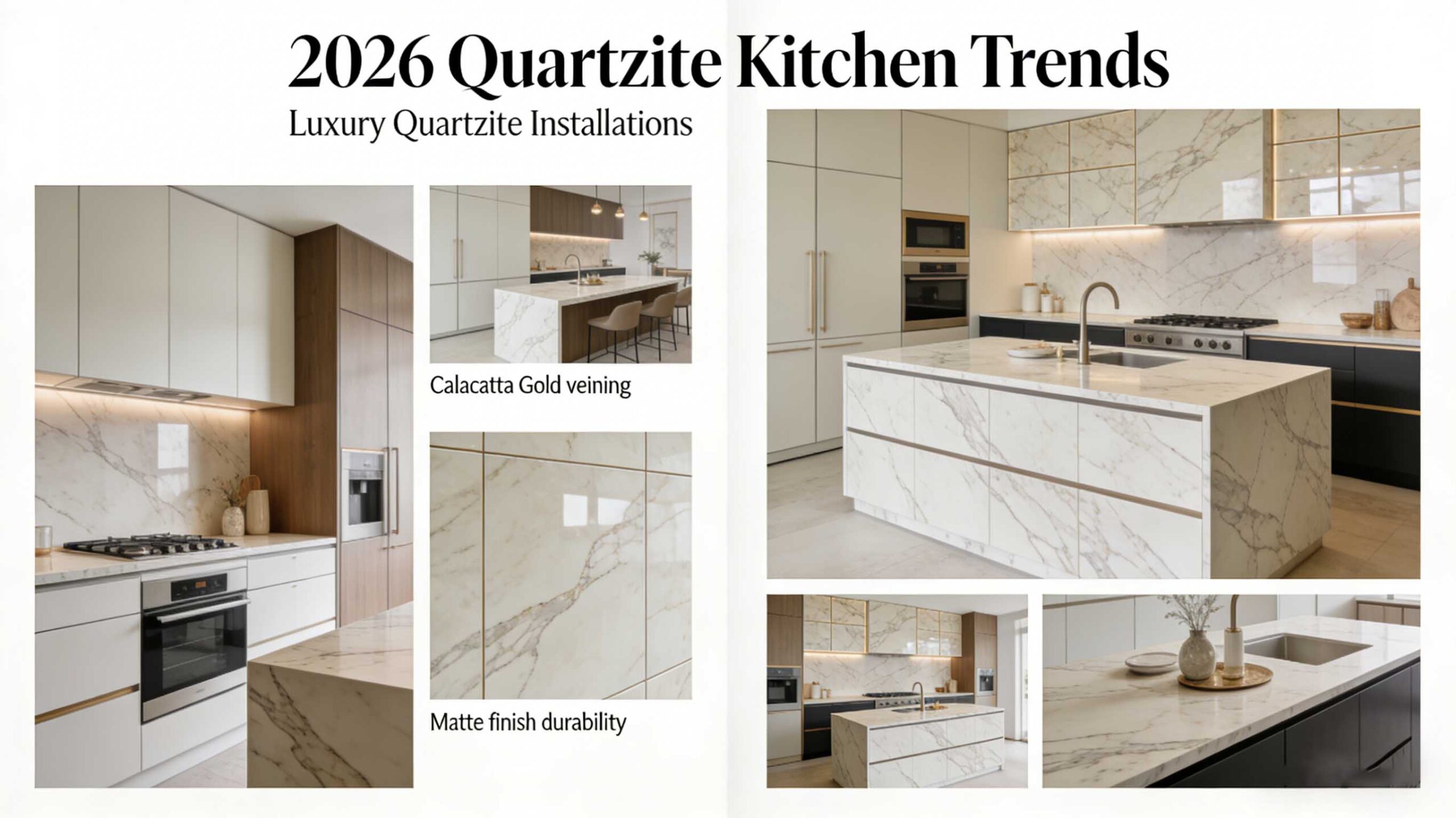
Quartzite is not trending simply because it looks expensive. It is trending because it answers multiple design and performance demands at once. Designers are leaning toward large islands, integrated splashbacks, warmer neutrals, statement veining, and natural materials that feel less manufactured. Quartzite fits all of those directions. Industry coverage for 2026 repeatedly points to natural quartzite as a preferred surface for feature worktops, large kitchen islands, and expressive stone compositions, particularly in creamy whites, pale greys, earthy tones, and more characterful, moody patterns.
There is also a practical angle that specifiers like. Quartzite is a natural stone formed through metamorphism of quartz-rich sandstone, and its quartz content helps explain its durability and scratch resistance. While no countertop is indestructible, quartzite is widely valued for handling kitchen wear better than many buyers expect from a stone that can still look refined and luxurious. It is particularly attractive for islands, where the surface needs to function both as workspace and as visual centerpiece.
How this top 10 list was selected
For a kitchen countertop or statement island, the right quartzite needs more than a pretty slab photo. It should have enough visual identity to carry a room, enough practical value to justify installation in a working kitchen, and enough sourcing consistency that a buyer can realistically specify it. That is why this list favors globally recognized quartzite types that are commercially established, visually versatile, and repeatedly requested in high-end kitchen projects. Some are warm and quiet. Some are dramatic and artistic. Some are spectacular in backlit or bookmatched applications. All are relevant to real kitchens, not just showroom fantasies.
Top 10 quartzite stones in the world for kitchen countertops and statement islands
1. Taj Mahal Quartzite
If there is one quartzite that defines the current luxury kitchen mood, it is Taj Mahal. Its soft cream base, flowing beige and taupe movement, and understated warmth make it the natural answer to a market that is moving away from cold white minimalism. Taj Mahal works beautifully on oversized islands, waterfall edges, full-height backsplashes, and open-plan kitchens that need elegance without harsh contrast. It is especially effective in homes using white oak, walnut, brushed brass, mushroom tones, and warm plaster-like finishes. It looks expensive without trying too hard, which is exactly why so many people want it.
For buyers who want to understand why this stone keeps appearing in premium kitchen conversations, our guide to Taj Mahal Quartzite gives a useful deeper look. The broader market trend supports its popularity too: Houzz notes that quartzite and quartzite-inspired surfaces are rising in 2026, with Taj Mahal specifically standing out for its elegant veining and warm, inviting tones.

2. Cristallo Quartzite
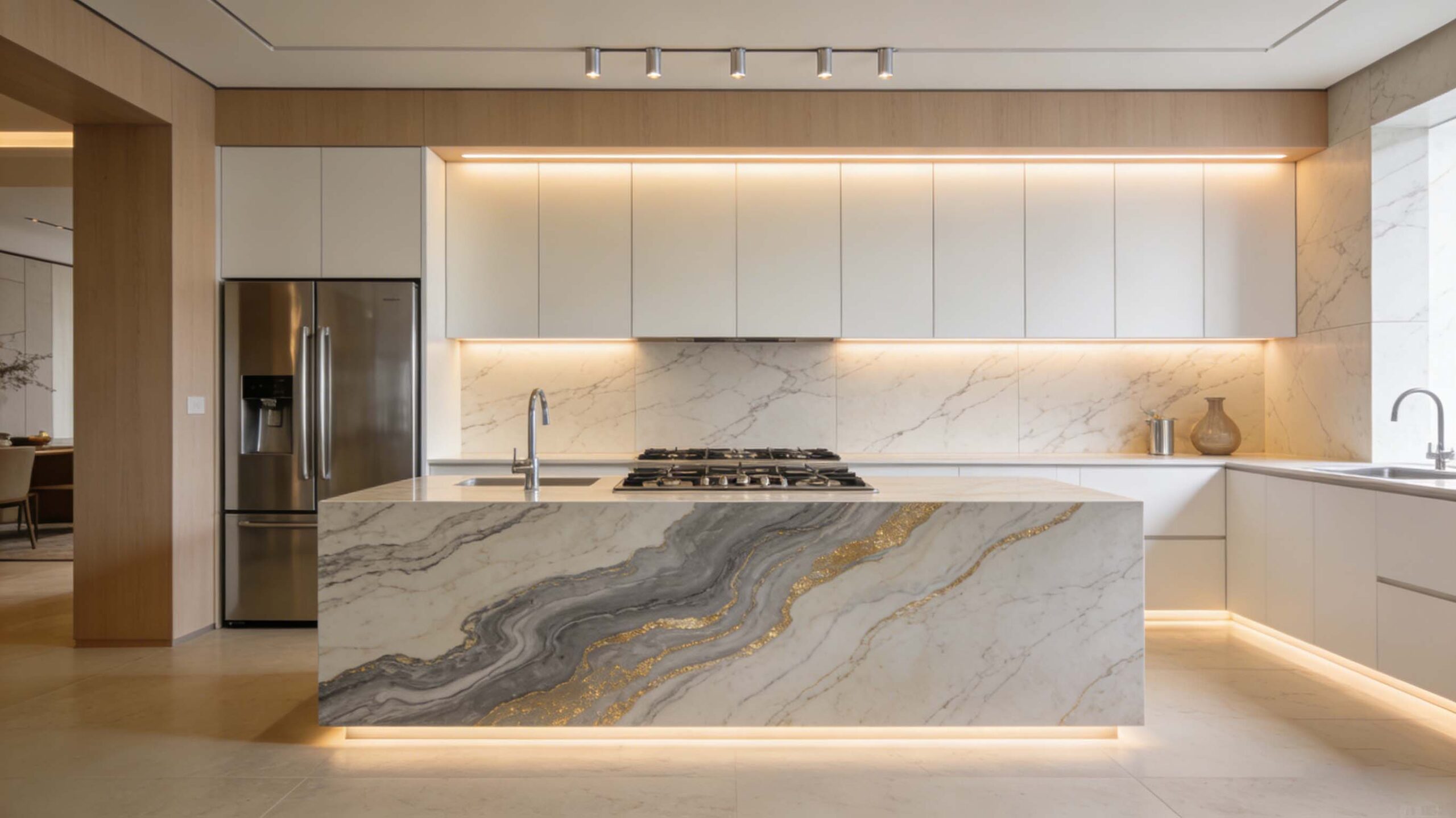
Cristallo belongs in any serious top 10 because it is one of the few quartzites that can function as both countertop material and luminous art piece. Its translucent qualities make it especially desirable for backlit islands, feature bars, and dramatic kitchen focal points. In a conventional installation, Cristallo still looks refined and premium. With lighting, it becomes almost theatrical. That makes it ideal for statement islands in luxury apartments, villas, and hospitality-led residences where the island is meant to be remembered.
Design reporting on backlit stone shows why Cristallo feels so current. Backlit quartzite is moving beyond novelty into serious residential and hospitality design, where it is used to create atmospheric focal points and layered visual depth.
3. Mont Blanc Quartzite
Mont Blanc is one of the best options for buyers who want the crisp, light look of premium white stone without choosing a more delicate marble-led visual language. Its cooler white and grey palette gives it excellent compatibility with contemporary kitchens, especially those with dark cabinetry, black detailing, or sharper architectural lines. It works particularly well when the goal is a clean luxury kitchen that still wants genuine stone movement rather than a flat manufactured look.
Mont Blanc also suits statement islands because its pattern is strong enough to carry a central surface but usually controlled enough not to overwhelm cabinetry and lighting. For minimalist kitchens that still need a pulse, it is a very smart choice.
4. Macaubas White Quartzite
Macaubas White is more linear and directional than many of the quartzites on this list, and that is precisely its strength. Its elongated veining can make an island feel longer, more elegant, and more deliberate. In long galley kitchens or large open-plan homes, it creates a streamlined look that feels sophisticated rather than busy. It is also useful for designers who want a statement stone without the swirling intensity of some highly dramatic quartzites.
Because kitchen design in 2026 is embracing cleaner forms paired with tactile materials, a quartzite like Macaubas White can sit right at the intersection of quiet luxury and high-end natural character.
5. Azul Macaubas Quartzite
Azul Macaubas is one of the few quartzites that can instantly shift a kitchen from beautiful to unforgettable. Its blue-grey to blue-white linear banding makes it ideal for projects that want color depth without descending into visual chaos. It is not for timid kitchens, but used well, it creates an extraordinary island or feature surface. In homes where the kitchen is designed as a social centerpiece, Azul Macaubas can deliver exactly the sort of memorable focal point that premium buyers increasingly want.
The 2026 countertop direction is not only about beige and cream. Darker and moodier tones are also gaining visibility, and statement color in natural stone is becoming more acceptable in luxury interiors. That helps explain why distinctive quartzites like Azul Macaubas are finding a stronger audience.
6. Patagonia Quartzite
Patagonia is for buyers who do not want their island to behave politely. It combines dramatic movement, larger crystalline structures, and visual energy that can make a single slab feel like a collectible object. Patagonia is especially compelling in islands with waterfall sides, monolithic detailing, or a lighting strategy that emphasizes its crystalline areas. In the right kitchen, it turns the island into sculpture.
Recent design coverage specifically mentions Patagonia quartzite as part of the growing interest in expressive, backlit, and feature-led stone compositions. That makes Patagonia one of the most relevant statement quartzites in current design culture.
7. Sea Pearl Quartzite
Sea Pearl is the introvert of luxury quartzite, and that is a compliment. Its softer palette and more understated movement make it ideal for kitchens that want calm, tonal elegance rather than instant spectacle. It performs especially well in transitional interiors, warm neutral kitchens, and homes that prioritize subtle luxury. On an island, Sea Pearl offers enough natural variation to feel elevated, but it rarely takes over the entire room.
That balance is commercially valuable. Not every buyer wants a slab that dominates the architecture. Many want a stone that supports cabinetry, lighting, and joinery while still reading as premium. Sea Pearl does that exceptionally well.
8. Infinity White Quartzite
Infinity White has become popular because it sits very comfortably in the current appetite for pale, clean, natural surfaces with just enough movement to avoid boredom. It is especially good for larger kitchens where an all-white or nearly all-white palette needs depth. On statement islands, Infinity White can create a seamless, monolithic effect while still allowing the eye to register genuine geological detail.
When paired with oversized islands and slim cabinetry, it helps produce the restrained but expensive-looking kitchen language that many designers are pursuing in 2026. Oversized islands themselves are increasingly treated as central architectural features, not just extra counter space, which makes stones like Infinity White more relevant than ever.
9. Fusion Quartzite
Fusion quartzites, including Blue Fusion and related varieties, are for high-drama kitchens. These stones often carry sweeping bands of blue, grey, gold, cream, and charcoal, creating a dynamic surface that feels almost painted. They are best used where the slab can be appreciated fully: large islands, slab splashbacks, feature walls adjoining the kitchen, or adjacent bar areas. They are not quiet, but that is exactly why designers specify them.
As statement islands continue to evolve toward sculptural, monolithic compositions, quartzites with stronger movement and bolder contrasts are gaining traction in elite residential work. A Fusion slab can anchor an entire kitchen concept if the surrounding finishes are edited with discipline.
10. Calacatta Quartzite
Calacatta Quartzite deserves a place on this list because it captures one of the strongest buyer desires in premium kitchens: the wish for the iconic elegance of Calacatta-style movement, but in a quartzite rather than a marble category. Commercially, the term often covers white quartzites with bold, marble-like veining, and buyers love them for islands and countertops where they want brightness, movement, and a more performance-led material story.
This is also where sourcing becomes important. Commercial naming can be loose in the market, so a reliable quartzite supplier should be able to explain exactly what is being offered, how the slabs vary, and whether the stone is suitable for the intended use.
How to choose the right quartzite for countertops and islands
Choose by room strategy, not just slab beauty
A spectacular slab alone does not guarantee the best kitchen. Taj Mahal can be perfect in a warm, hotel-like kitchen but may feel too soft-toned in a stark black-and-white composition. Patagonia may be magnificent in a large open-plan home but overpowering in a tighter layout. Sea Pearl may look modest on a small sample and superb across a full island. This is why any serious buyer should approach selection through application, layout, and finish context rather than by slab glamour alone.
A practical countertop selection guide is useful here because material choice is never only about the stone itself. It is about how the surface works with cabinetry tone, island size, edge profile, lighting, and the rhythm of the whole kitchen.
Understand the difference between quartzite and quartz in real use
One reason quartzite is benefiting from market attention is that buyers are more conscious of the trade-offs between engineered quartz and natural stone. Quartz can offer consistency and low porosity, but quartzite is often chosen when buyers want stronger natural movement, better heat confidence, and a more premium natural-stone identity. NIOSH’s 2026 engineered stone bulletin is also a reminder that countertop conversations increasingly include fabrication safety and silica exposure, especially when highly silica-intensive manufactured products are involved.
For users comparing these surfaces from a practical perspective, our article on what can damage quartz countertops helps clarify where engineered quartz behaves differently from natural stone options such as quartzite.
Match the stone to how the island will actually be used
A statement island can be a prep zone, breakfast table, homework station, serving area, and visual centerpiece at the same time. That means the right quartzite for an island depends partly on lifestyle. If the kitchen is highly active, a tighter-patterned or slightly warmer quartzite may hide everyday life more gracefully. If the island is mainly a showpiece in a design-led home, a more dramatic quartzite like Patagonia or Fusion can make sense. Good specification is not about choosing the prettiest slab in isolation. It is about choosing the slab that still feels right after real use begins.
Why regulation and documentation matter in quartzite sourcing now
Quartzite may be a natural stone, but it is not exempt from the wider regulatory and documentation direction affecting the construction products market. The EU’s revised Construction Products Regulation explicitly pushes the sector toward better digitalization, with Digital Product Passports intended to provide performance, conformity, safety information, and instructions for use. For exporters, importers, quartzite manufacturers, and project specifiers, that means better organized product data is becoming part of premium sourcing rather than an afterthought.
Natural stone also benefits from stronger environmental documentation than it did a few years ago. The Natural Stone Institute’s industry-wide EPDs and HPDs cover applications including countertops and represent common stone types used in the dimension stone industry, including quartzite. That does not magically make every slab sustainable in the same way, but it gives architects and buyers a more credible framework for discussing embodied carbon, material transparency, and green building goals. In a market where “luxury” increasingly has to justify itself, that is commercially useful.
Practical sourcing advice for buyers, suppliers, and manufacturers
If you are buying quartzite for a serious project, insist on full-slab visibility whenever possible. Small samples are notorious liars. They hide movement, patching, fissures, tonal shifts, and the scale of the pattern. This is doubly important for statement islands, where the slab is not background material but the focal point of the room.
If you are a quartzite supplier or quartzite factory, 2026 is not the year to sell only on aesthetics. Buyers want application guidance, finish clarity, packaging standards, lead-time confidence, and increasingly, documentation that supports specification. The suppliers who win are the ones who can explain not just what the stone looks like, but why it fits a given kitchen, how it should be fabricated, and what the buyer should realistically expect over time.
Conclusion
The best quartzite stones in the world for kitchen countertops and statement islands are not “best” because they are the most photographed on social media. They are best because they answer the actual needs of premium kitchens in 2026. Taj Mahal brings warm, effortless luxury. Cristallo brings luminous drama. Mont Blanc and Infinity White offer clean architectural clarity. Macaubas White and Sea Pearl bring calmer elegance. Azul Macaubas, Patagonia, Fusion, and Calacatta Quartzite deliver stronger visual identity for islands that are meant to be remembered.
More importantly, quartzite now sits at the intersection of beauty, practicality, and market relevance. It aligns with current kitchen trends, responds to buyer demand for natural materials, and fits a broader conversation about documentation, performance, and responsible specification. For designers, homeowners, developers, and quartzite manufacturers, that combination is exactly why quartzite is no longer a secondary luxury stone. It is one of the defining countertop categories of the moment.
FAQs
1. What is the best quartzite for kitchen countertops?
The best quartzite depends on the style and function of the kitchen. Taj Mahal is often favored for warm, elegant kitchens, while Mont Blanc and Infinity White work well in cleaner, brighter schemes. Patagonia and Fusion are stronger choices for statement islands where dramatic movement is the goal.
2. Is quartzite better than quartz for kitchen islands?
Quartzite and quartz serve different priorities. Quartzite is usually chosen for its natural veining, stronger stone identity, and better heat confidence, while quartz is often selected for its consistency and lower-maintenance reputation. For buyers who want a more natural, architectural island, quartzite is often the more compelling option.
3. Does quartzite need sealing?
Yes, most quartzite used for countertops should be sealed and periodically checked over time. Sealing helps reduce staining risk and supports easier day-to-day care, particularly in busy kitchens where oils, wine, coffee, and acidic ingredients are common.
4. Which quartzite is most popular in 2026?
Taj Mahal remains one of the most talked-about quartzites in 2026, especially for warm neutral kitchens and oversized islands. Broader market coverage also shows rising interest in soft-toned, natural quartzites and in more expressive stones such as Patagonia and other statement-led slabs.
5. How can buyers verify quartzite quality before ordering from a supplier?
Buyers should ask for full slab photos or videos, close-up images, finish details, batch consistency information, and packaging specifications. They should also ask whether the supplier has experience with large islands, waterfall edges, and bookmatching, because installation success often depends as much on slab selection and fabrication planning as on the material itself.
References
-
National Kitchen & Bath Association, “KBIS Releases Annual 2026 Kitchen Trends Report,” NKBA.
-
Directorate-General for Internal Market, Industry, Entrepreneurship and SMEs, “New EU Rules on the Safety and Sustainability of Construction Products Mark a New Step for the Sector’s Competitiveness,” European Commission.
-
Department of Housing, Local Government and Heritage, “Construction Products Regulation 2024,” Government of Ireland.
-
Alyson Fortner, R. Reid Harvey, Justine Lew Weinberg, Chelsea Woolsey, Fernanda Florez, “Engineered Stone and Silicosis,” NIOSH Science Bulletin, CDC.
-
Natural Stone Institute, “Natural Stone Institute Publishes First Industry-Wide Environmental Product Declarations and Health Product Declarations for Natural Stone,” Natural Stone Institute.
-
Hobart M. King, “Quartzite: Metamorphic Rock – Pictures, Definition & More,” Geology.com.
-
Molly Malsom, “11 Kitchen Countertop Trends for 2026,” Homes & Gardens.
-
“5 Trends in Countertops and Other Surfaces Shaping 2026,” Houzz.
Quartzite Countertop Insight for Luxury Kitchens and Statement Islands in 2026
Why is quartzite becoming one of the most desired natural stones for kitchens?
Quartzite is gaining more attention because it delivers something many premium buyers are now actively looking for: a natural stone surface that feels expressive and luxurious, while also offering stronger everyday confidence for kitchen use. In 2026, kitchen design is moving toward larger islands, warmer tones, more natural movement, and surfaces that feel architectural rather than artificial. Quartzite fits that direction extremely well because it brings depth, individuality, and a more authentic material story to the heart of the home.
What makes quartzite different from other countertop options in premium projects?
Quartzite stands apart because it combines visual sophistication with a stronger natural-stone identity than many engineered surfaces. It is often selected by buyers who want the elegance and movement associated with luxury interiors, but who also want a countertop material that feels more substantial, more heat-tolerant, and more distinctive in large-format applications. This makes quartzite especially appealing for statement islands, waterfall edges, and open-plan kitchens where the countertop is expected to function as both workspace and centerpiece.
How are kitchen design trends influencing quartzite selection in 2026?
Current kitchen trends are favoring oversized islands, full-height stone backsplashes, softer neutral palettes, monolithic forms, and materials with visible geological character. As a result, quartzite stones such as Taj Mahal, Mont Blanc, Cristallo, Patagonia, and Sea Pearl are being chosen not only for their surface beauty, but also for how they shape the overall spatial mood of a kitchen. Some quartzites help create calm, warm, and understated luxury, while others are used to create dramatic focal points that define the entire room. In both cases, quartzite is no longer a supporting material. It is often the main design decision.
What options are buyers prioritizing when choosing quartzite for countertops and islands?
Buyers are increasingly prioritizing quartzite options that match both visual intent and practical use. Warm, creamy quartzites such as Taj Mahal are favored for kitchens that want soft luxury and natural warmth. Cleaner stones such as Mont Blanc and Infinity White work well in brighter, more architectural spaces. More expressive quartzites such as Patagonia, Fusion, and Cristallo are often selected for statement islands where visual drama is a priority. This means the best quartzite is rarely the most famous one in abstract. It is the one that best supports the tone, scale, and daily function of the kitchen.
Consideration: what should global buyers look at before choosing a quartzite supplier or factory?
Global buyers should evaluate much more than the slab image. They should ask about full slab availability, consistency between slabs, finish options, fabrication suitability for large islands, edge and waterfall feasibility, packaging quality, and export experience. A reliable quartzite supplier or manufacturer should also be able to explain how the stone behaves in real kitchen environments, not just how it looks in a showroom. In 2026, premium sourcing is becoming more informed, and buyers increasingly prefer suppliers who can offer both material expertise and project-level guidance.
Why do regulation, documentation, and fabrication standards matter more now?
The global surface materials market is changing. Buyers are paying more attention to product documentation, sustainability positioning, declared performance, and safer fabrication practices. This is especially relevant as construction product frameworks in Europe move toward stronger digital information requirements and as health discussions around high-silica fabricated materials continue to shape the countertop sector. For quartzite, this creates an advantage when the material is supplied with clear origin information, organized technical support, and a credible project-use narrative. Luxury is no longer defined only by visual impact. It is increasingly supported by traceability, specification confidence, and long-term usability.
Where is the premium quartzite market heading next?
The premium quartzite market is moving toward more design-led, more application-specific, and more transparent sourcing. Buyers want surfaces that can perform in active kitchens while still looking unique, elevated, and naturally luxurious. This is why quartzite is likely to remain one of the strongest categories for upscale countertops and islands in the coming years. It answers both emotional and practical expectations, which makes it one of the most commercially relevant natural stones in modern kitchen design.