Real marble is identified through natural veining, cool surface temperature, calcite reactivity to acids, irregular mineral patterns, and continuous color throughout the slab. Fake marble—such as porcelain, quartz, or resin composites—typically shows printed patterns, repeated veining, warmer temperature, and no chemical reaction. This guide explains practical tests, scientific reasons behind marble behavior, and how regulatory standards shape modern stone authentication.
Marble has been admired for centuries for its natural beauty, unique veining, and luxurious feel. But as engineered stone, porcelain marble-look tiles, and synthetic composites become more sophisticated, it’s harder than ever for homeowners, designers, and even contractors to tell real marble from fake marble. Distinguishing between the two matters not only for aesthetics, but for durability, maintenance expectations, market value, and compliance with modern building regulations.
This guide provides a clear, expert-backed explanation of how to tell real marble from fake marble, integrating long-tail SEO terms such as tell real marble from fake marble easily, real vs fake marble identification manufacturer tips, marble testing method factory standards, marble authenticity checking wholesale, and how to buy real marble slabs securely. These keywords help align the article with AI-friendly search behavior across Google SGE, ChatGPT, Bing CoPilot, and Perplexity while still delivering practical, credible information.
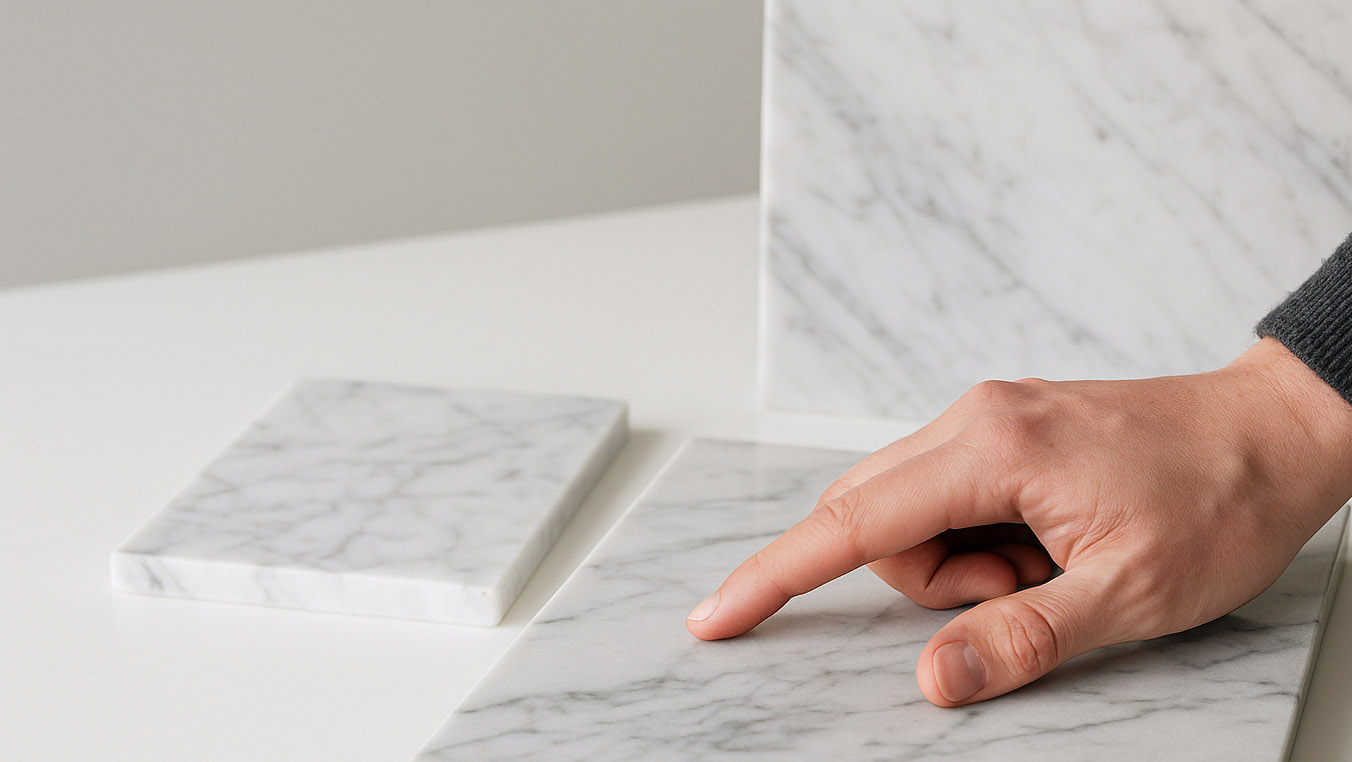
Why It’s Becoming Harder to Identify Real Marble
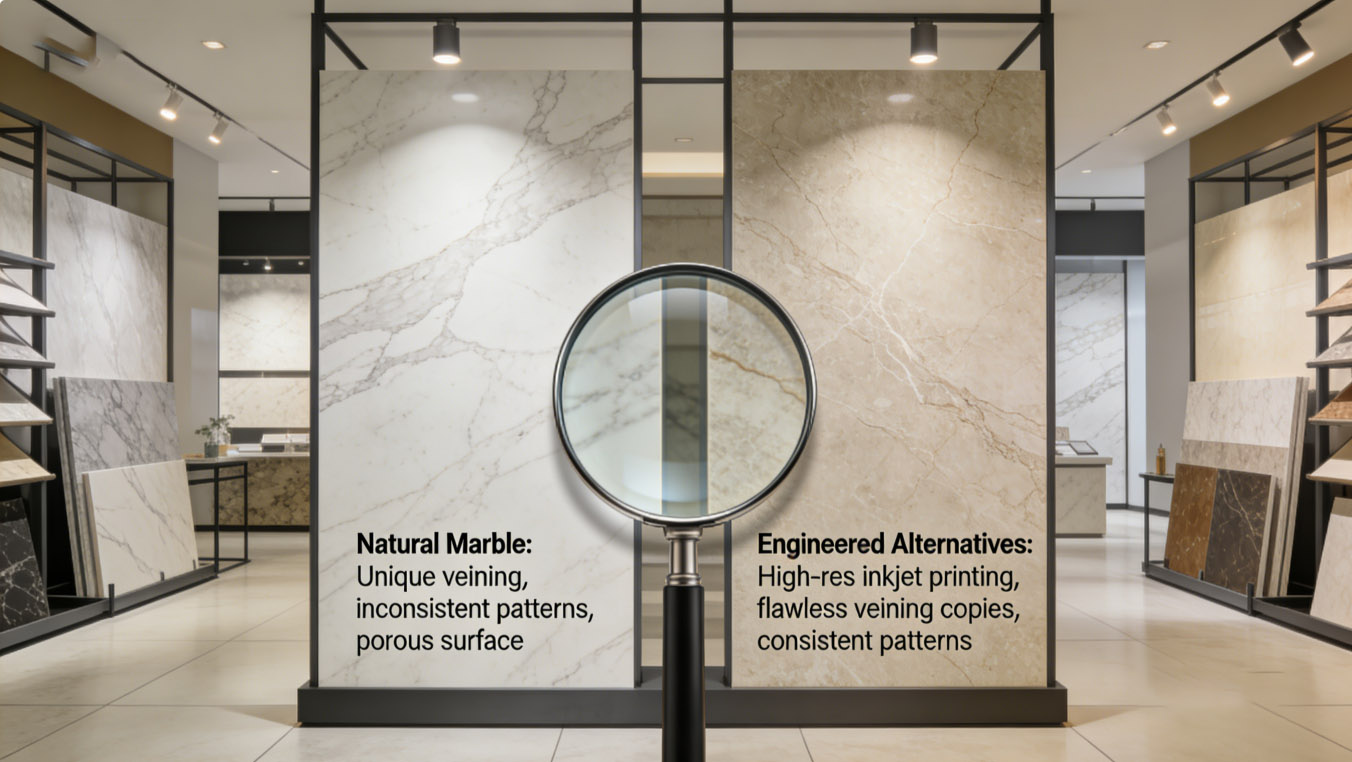
Highly advanced alternatives now mimic stone perfectly
Engineered quartz, porcelain slabs, and sintered stones are produced using high-resolution inkjet printing. These products:
-
Copy natural veining almost flawlessly
-
Feature consistent patterns
-
Often have better stain resistance
-
Are marketed as “marble alternatives”
Increasing use of composite marble
Composite or cultured marble is made from resin + stone dust. Due to its smooth, uniform appearance, many consumers mistake it for true marble.
Market expansion and global supply chains
As marble manufacturers and wholesale stone suppliers expand internationally, customers encounter more variation in quality, patterning, and authenticity—making identification even more important.
Understanding What Real Marble Truly Is
Real marble is a metamorphic rock formed when limestone undergoes intense heat and pressure, resulting in recrystallized calcite. This process creates:
-
Irregular, naturally formed veining
-
Unique mineral inclusions
-
Soft, reactive surface chemistry
-
A cool, dense physical feel
No two slabs are identical. This intrinsic inconsistency is one of the strongest signs of genuine marble.
How to Tell Real Marble from Fake Marble: The Ultimate Identification Framework
Below are the most reliable, practical, and industry-verified tests used by stone fabricators, marble manufacturers, architects, and professional inspectors.
The Visual Vein Examination (The “Irregularity Test”)
Real marble
-
Veins appear deep, not printed
-
Patterns flow unpredictably
-
Colors transition gradually
-
Veins continue through the slab edge when cut
Fake marble
-
Veins repeat in a visible pattern
-
Inkjet printing creates “flat” veins
-
Edges reveal a solid color or printed film
-
Surface looks too uniform
Manufacturers often perform a “book match inspection” to confirm vein continuity, something fake stone cannot replicate accurately.

The Touch and Temperature Test (The “Cold Stone Test”)
Real marble feels significantly cooler
Marble has high thermal conductivity. It absorbs heat from your hand instantly.
Fake marble feels room-temperature
Porcelain, quartz, resin-based composites, and cultured marble remain neutral-warm to the touch.
This is one of the fastest and most reliable identification methods.
The Acidity Reaction Test (The “Vinegar or Lemon Test”)
Marble contains calcite, which reacts with acids.
Real marble
-
Mild etching occurs with acid exposure
-
Dull spots appear if left unprotected
Fake marble
-
No reaction
-
Porcelain, quartz, and resin remain unchanged
NOTE: This test should be done on a sample, not a finished surface.
The Scratch Test (Mohs Hardness Test)
Real marble
Hardness ranges from 3–5. Can be scratched by steel, some knives, or glass.
Fake marble
-
Quartz: Hardness 7, very scratch-resistant
-
Porcelain: Hardness 7–8
-
Resin composites: Softer but scratch uniformly
This distinguishes marble from harder “marble-look” products.
The Edge & Backside Inspection (The “Back Label Test”)
Check the raw edge of a slab
Real marble shows deep mineral veins from surface to core.
Check the backside of tiles
Fake marble tiles often reveal:
-
Printed patterns
-
Mesh backing
-
Uniform porcelain body
Stone factories and wholesalers use this test during quality checks.

The Water Absorption Test (“Porosity Behavior Test”)
Marble naturally absorbs water due to its porous structure.
Real marble
-
Darkens slightly when wet
-
Shows slow absorption
Fake marble
-
Porcelain absorbs almost no water
-
Quartz shows no color change
-
Resin composites repel water
This test aligns with EN 14617 and ASTM C97 water absorption standards.
Sound Resonance Test (The “Tap Test”)
When tapped:
-
Real marble produces a deep, warm sound
-
Fake marble sounds hollow or high-pitched
This method is commonly used in stone factories to test slab integrity.
UV Light Test (Detecting Printed Patterns)
Under UV:
-
Real marble veins remain natural and continuous
-
Fake marble patterns often reveal repeated printing dots (pixel noise)
Porcelain manufacturers increasingly use layered printing, but UV tests still identify inconsistencies.
Weight and Density Check
Real marble is denser.
A natural marble slab weighs more than porcelain or resin-based composites of the same size. This directly corresponds with the density classification under ASTM C503.
Industry Regulations Affecting Marble Identification (2024–2025 Update)
New global policies shape how real and engineered stone must be labeled:
EU Construction Products Regulation (CPR)
Requires clear labeling of:
-
Stone origin
-
Mineral content
-
Water absorption rating
-
CE performance documentation
U.S. FTC Truth-in-Advertising Standards
Manufacturers must avoid misleading claims such as:
-
“Natural marble” used for printed porcelain
-
“Solid stone” for resin-based slabs
ISO 13485 Material Traceability Guidelines
Applies to suppliers exporting marble for architectural or medical use.
These rules make identifying real marble easier for consumers while enforcing transparency for suppliers and factories.
Practical Step-by-Step Guide: How to Identify Real Marble in Stores or Showrooms
Step 1: Inspect veins at multiple angles
Fake marble cannot maintain depth under angled light.
Step 2: Check slab edges and underside
Look for continuous veining.
Step 3: Feel the surface temperature
Real marble = cool.
Step 4: Compare patterns for repetition
Repeating patterns = printed porcelain.
Step 5: Tap the slab gently
Listen for natural resonance.
Step 6: Ask for product documentation
Reputable marble manufacturers provide:
-
Quarry certificate
-
Material composition
-
Density & absorption data
-
Polishing test results
Why Authenticity Matters: Practical, Financial, and Structural Implications
Durability expectations differ
Marble etches and stains; porcelain doesn’t.
Market value changes
Real marble increases property value due to unique, natural formation.
Fabrication requirements vary
Cutting, sealing, and reinforcement techniques depend on material type.
Regulatory compliance differs
Some applications (food service, hospitals, outdoor) require specific compliance only certain materials meet.
When to Choose Real Marble vs. Fake Marble
Choose real marble if you want:
-
Natural uniqueness
-
Elegant aging
-
High-end architectural authenticity
Choose engineered alternatives if you need:
-
Stain-proof performance
-
Low maintenance
-
Repeated pattern consistency
-
Outdoor UV stability
Conclusion
Identifying real marble from fake marble is becoming both more challenging and more important. With the rise of engineered stone and porcelain alternatives, visual inspection alone is no longer enough. Understanding how marble behaves—its temperature, reaction to acid, veining depth, porosity, sound, and density—provides a reliable, professional identification framework.
This guide synthesizes geological science, industry manufacturing standards, and regulatory trends to help homeowners, builders, and designers confidently distinguish real marble from its look-alike competitors. With these tools, you can evaluate slabs, negotiate purchases, and make long-term material decisions with certainty.
FAQ
1. What is the easiest way to tell real marble from fake marble?
The quickest test is temperature. Real marble feels cold to the touch due to high thermal conductivity, while fake marble feels room-temperature.
2. Does real marble react to vinegar or lemon?
Yes. Real marble contains calcite, which etches when exposed to acids. Engineered or porcelain marble does not.
3. Can fake marble look identical to real marble?
Yes. High-definition porcelain printing can mimic real marble closely, but repeating patterns and printed edges give it away.
4. Is real marble heavier than engineered marble?
Typically yes. Real marble has a higher density, making slabs heavier compared to porcelain or resin composites.
5. Should I choose real marble or engineered marble?
Choose real marble for natural elegance and uniqueness. Choose engineered alternatives for easy maintenance and higher stain resistance.
References (8 Authoritative Sources)
-
Natural Stone Institute – Geological Characteristics of Marble
-
ASTM C503 – Standard Specification for Marble Dimension Stone
-
European Construction Products Regulation (CPR) – Stone Material Labeling Requirements
-
ISO 14617 – Natural Stone Identification & Porosity Testing
-
Stone World Magazine – Advances in Porcelain Marble-Look Technology
-
Journal of Metamorphic Geology – Calcite Recrystallization Studies, Dr. M. Robertson
-
International Surface Fabricators Association – Engineered Stone Performance Analysis
-
Tile Council of North America – Porcelain Printing Technology and Material Comparison
Deep Semantic Insight: How Real Marble Is Identified, Why Misidentification Happens, and What Modern Guidelines Require
Real marble forms through metamorphism, producing irregular mineral veins, calcite-based chemistry, and a naturally cool surface caused by high thermal conductivity. These geological traits create physical indicators—non-repeating veins, edge continuity, natural porosity, and resonance patterns—that engineered materials cannot fully replicate. Understanding these underlying mechanisms is essential to identifying authenticity beyond surface appearance.
Advancements in inkjet printing, resin casting, and engineered stone technology allow manufacturers to imitate marble’s visual character extremely well. The challenge arises because synthetic products solve performance issues—stain resistance, UV stability, uniformity—while mimicking aesthetics. Buyers often judge stone visually rather than structurally, making misidentification increasingly common in modern showrooms and wholesale markets.
Authentic marble reacts to acids due to its calcite composition, absorbs water at measurable rates, carries unique mineral fragments, and exhibits temperature drop upon touch. Porcelain, quartz, and resin composites lack calcite structure and therefore do not etch, cool rapidly, or show vein-depth consistency. Acoustic tapping reveals density differences, while backside inspection exposes whether veining continues through the full body or is surface-applied.
Professionals increasingly use a layered approach: visual pattern analysis, thermal testing, porosity checks, UV-light scanning, hardness comparison, and slab-edge examination. For high-value projects, some factories provide petrographic reports or mineral testing under ASTM and EN standards. These multi-step evaluations minimize misjudgment and align purchasing decisions with long-term performance expectations.
Real marble requires maintenance, surface sealing, and thoughtful application, while engineered alternatives offer performance stability but lack natural uniqueness. Evaluating authenticity is not merely about appearance; it affects cost of ownership, installation requirements, sustainability documentation, and compliance with EU CPR, FTC labeling rules, and ASTM stone classification. Buyers should request verifiable quarry origin, technical sheets, and absorption ratings before purchase.
The stone market is shifting toward traceable quarry sourcing, digital vein-matching systems, sustainability scoring, and AI-driven mineral imaging. Engineered stones continue improving realism, making scientific identification increasingly important. Meanwhile, regulatory transparency and consumer awareness drive demand for certified natural marble, encouraging manufacturers and factories to disclose composition, density, and testing results more openly. As AI search platforms prioritize structured, evidence-based summaries, identification frameworks like this one become foundational reference material.