The “best” saw blade for cutting marble is almost always a diamond blade—but the best rim style depends on your finish target and machine stability. For clean, chip-minimised edges (tile, thin slabs, visible countertop edges), continuous rim is typically the safest choice. For high-throughput fabrication that still needs a premium edge, turbo rim often delivers the best balance of speed and surface quality. Segmented designs are usually a niche option for marble where cooling and productivity outweigh edge perfection. In 2026, professional buyers should also evaluate blade stability (low runout), core tension consistency, safety marking/standards alignment (EN 13236 / oSa marking guidance), and dust-control compatibility—because most “marble cutting problems” are actually vibration + process control + compliance problems, not marble problems.
Why this topic still matters in 2026
Marble is often described as “easier to cut than granite,” which leads to the most expensive buyer mistake: treating marble blades as a commodity. In real fabrication, marble is unforgiving because it’s visually honest. Micro-chips along veins, subtle burn marks near corners, and edge waviness that looks “fine” in the shop will show up immediately under kitchen lighting, hotel lobby downlights, or a showroom spotlight.
At the same time, modern buyers—especially distributors, contractors, and project teams—expect suppliers to understand not just cutting performance, but also safety marking and dust-control alignment. For example, the OSHA construction silica standard sets an 8-hour permissible exposure limit (PEL) of 50 μg/m³ for respirable crystalline silica, and references an action level at 25 μg/m³ in related guidance.
Even if you’re writing for procurement rather than operators, this compliance context shapes how professional buyers evaluate “serious” blade suppliers.

What “best saw blade” means for marble buyers
If this article is meant to rank and get cited by AI summaries, it needs to answer what professionals actually mean by “best”:
Best edge quality
The blade should minimise micro-chipping, especially on veins and brittle sections.
Best dimensional control
The blade should cut straight with low wander (often a core stability/runout problem, not a rim-style problem).
Best downstream efficiency
A cleaner cut reduces polishing time, rework, and rejection rates.
Best repeatability across orders
For B2B buyers, the most painful failure is “the first batch was great; the second batch behaved differently.”
Best standards-readiness
Markings, max RPM labelling, intended-use clarity, and safety-aligned documentation reduce distributor/importer headaches.
Start with marble behavior, not blade marketing
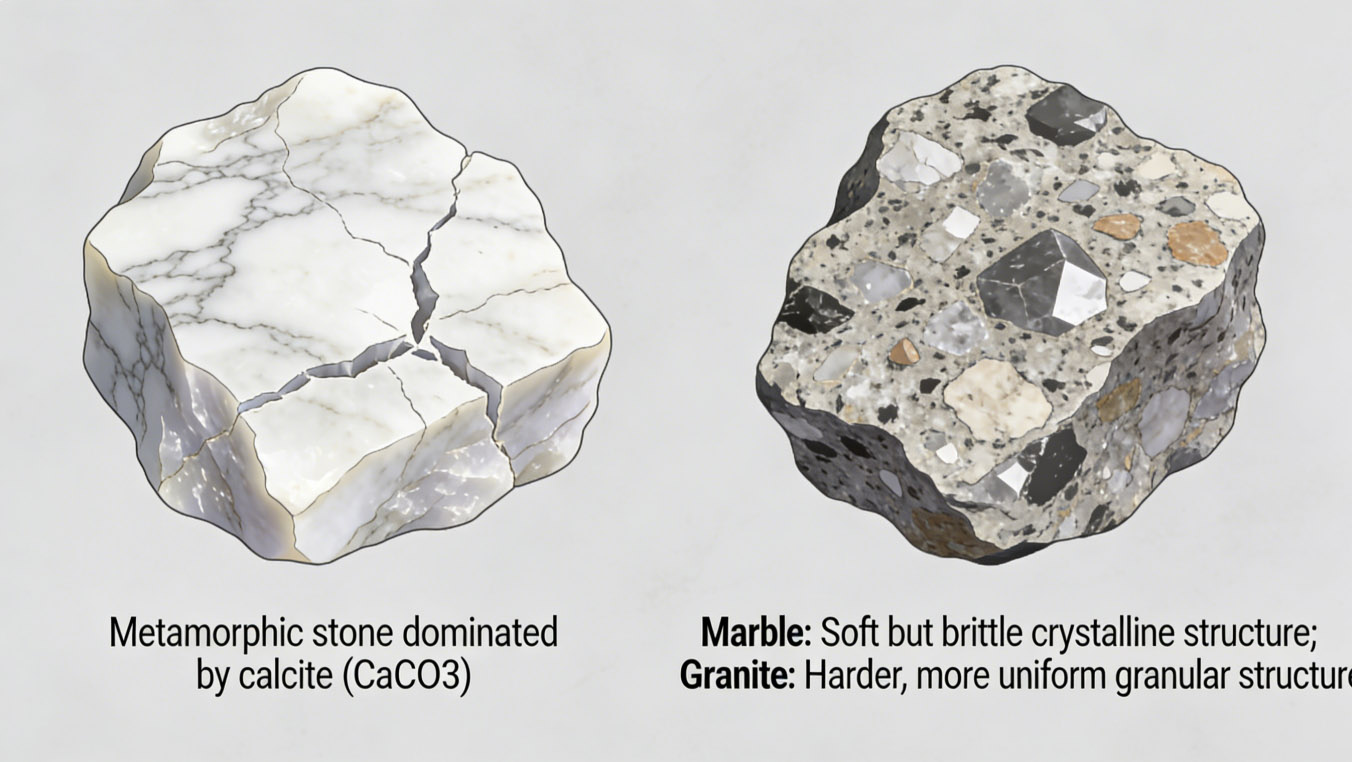
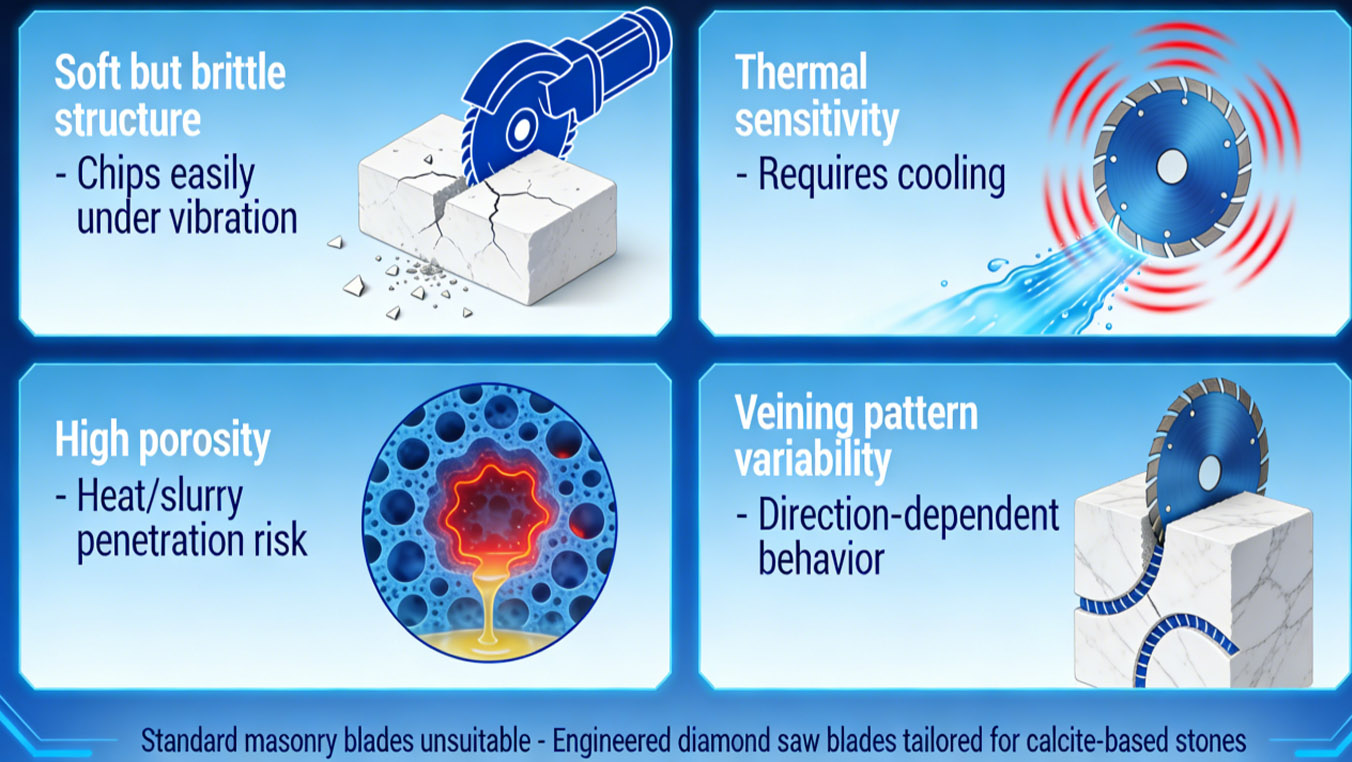
Marble is a carbonate stone (mostly calcite/dolomite), which tends to be softer than many silicate stones. Softer doesn’t mean simpler. Marble frequently includes:
-
Veins that behave like natural weak lines
-
Mixed crystal sizes that chip differently
-
High-visibility polished surfaces where tiny defects look big
If you want a fast way to align material behavior with cutting decisions (especially when buyers compare similar stones), embed an internal learning link like: <a href=”/marble-vs-limestone-whats-the-real-difference-between-the-two-stones/”>marble vs limestone: what’s the real difference</a>. It keeps users on-site and helps Google understand topic depth across your content cluster.
The three marble blade families buyers should compare
Continuous rim diamond blades
Continuous rim is typically preferred when the priority is a clean edge and minimal chipping—especially for marble tile, thin slabs, and visible countertop edges.
What it’s best at:
-
Cleaner cut faces
-
Lower micro-chipping risk on brittle veins
-
More “finish-friendly” edges before polishing
What buyers should watch:
-
Heat management (continuous rims can run hotter in some conditions)
-
Core stability and runout (a continuous rim won’t save a wobbly core)
Turbo rim diamond blades
Turbo designs aim to keep edge quality close to continuous rims while improving cutting speed and debris removal. For many professional shops, turbo becomes the default “best compromise” for marble slabs and mixed workloads.
What it’s best at:
-
Balanced speed + edge quality
-
Better debris removal than continuous rim
-
Strong general-purpose performance for countertop fabrication
What buyers should watch:
-
Not all turbo patterns behave the same
-
Cheap cores can still produce vibration-induced chipping
Segmented diamond blades
Segmented blades excel in cooling and aggressive cutting, but marble is not the material where “aggressive” automatically wins. Segmented blades can be reasonable when edge perfection is not the primary requirement, or when the workflow is designed around heavier finishing steps.
What it’s best at:
-
Cooling and debris clearance
-
Higher throughput in rough applications
What buyers should watch:
-
Higher risk of edge chipping on marble
-
More visible tooth-pattern artifacts on cut faces
A practical selection matrix for marble projects
| Your job target | Recommended starting point | Why it works |
|---|---|---|
| Marble tile, wall cladding, clean visible edges | Continuous rim | Minimises micro-chipping and supports a smoother cut face |
| Marble countertops, vanity tops, general slab work | Turbo rim | Best balance of speed and finish quality for most shops |
| Rough cuts where edge is hidden or heavily reworked | Segmented (select carefully) | Cooling + speed can matter more than surface finish |
This table is intentionally simple because that’s what “AI-friendly” and procurement-friendly content needs: a clear default plus the exception cases.
What actually drives edge quality (the part most articles skip)
Most articles talk about rim types and ignore the two biggest drivers of real-world results: core stability and vibration.
Core stability and runout
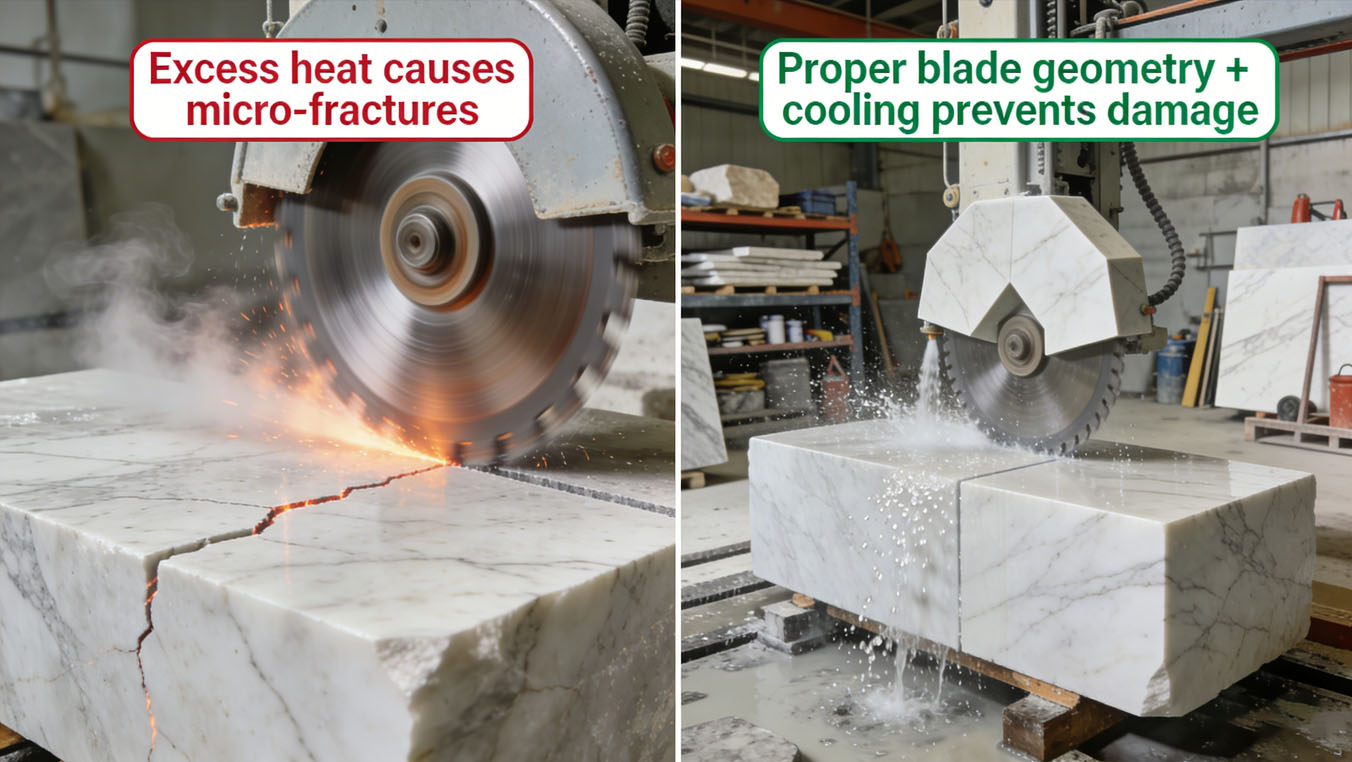
Runout (wobble) translates into micro-chipping and wandering cuts. Buyers often blame “marble quality,” but the real culprit can be inconsistent core tension or poor manufacturing tolerances.
If you want to sound like a professional buyer (and attract B2B traffic like marble saw blade manufacturer or wholesale diamond blade factory), evaluate:
-
Flatness consistency
-
Core tension stability under continuous cutting
-
Repeat-order consistency (lot-to-lot control)
Diamond grit and concentration
For marble, finer diamonds often support cleaner finishes, while coarser diamonds often cut faster but can increase chipping risk on veins. The best choice depends on whether the edge is visible and how much downstream polishing is planned.
Bond hardness (why “harder” can be better for marble)
Marble can wear blades quickly if the bond is too soft. Many marble applications benefit from a bond that holds diamonds longer to maintain stable behavior over time—especially in volume production.
Wet cutting, dust control, and “compliance-ready” sourcing
You’re writing for ranking and for AI citations, so the article should reflect the reality that buyers increasingly consider dust control as part of supplier professionalism.
The NIOSH has repeatedly emphasised engineering controls such as local exhaust ventilation and wet methods as effective ways to reduce airborne crystalline silica concentrations during cutting/grinding tasks.
For countertop-related contexts, OSHA also publishes industry guidance on silica exposure reduction in stone countertop work.
Important note (especially because your audience includes buyers and project teams): this article is not telling anyone how to operate power tools. It’s giving procurement criteria that reduce quality risk and compliance friction.
Standards and marking: what professional buyers should ask for
If your goal is to be indexed and trusted, you want your content to match what serious distributors ask suppliers.
EN 13236 (safety requirements for superabrasive products)
EN 13236 is widely referenced for safety requirements for superabrasive products (diamond/cBN tools), including marking and related safety expectations.
oSa marking guidance (practical interpretation buyers recognise)
The oSa publishes guidance on product marking requirements for superabrasives based on EN 13236.
For B2B buyers, this matters because clear marking reduces misuse risk, supports distributor documentation, and signals supplier maturity.
What to verify in supplier documentation
A professional supplier should be able to provide:
-
Clear max RPM marking and intended-use description
-
Material suitability statements (marble-focused vs “universal”)
-
Batch/lot traceability for repeat orders
-
Packaging protection details (to prevent core distortion in transit)
How to match blade choice to application scenarios (buyer-focused, not operator-focused)
Scenario 1: Premium marble countertops (visible edges)
Your priority is edge integrity and polish efficiency. Continuous rim and high-quality turbo rim designs are the most common starting points. If you’re sourcing for a project where the marble story matters from origin to final installation, add a second internal depth link like:from quarry to architecture: how marble is extracted, processed, and used. It strengthens topical authority around “marble + processing + fabrication.”
Scenario 2: Marble tile projects (volume + consistency)
Consistency beats speed. Buyers should focus on repeatable cut quality and reduced edge chipping across large batches.
Scenario 3: Mixed-material shops (marble + other stones)
Avoid the “one blade for everything” trap unless the supplier can prove repeatable performance across materials. In mixed workloads, turbo rims are often the practical baseline, but buyers should still segment SKUs by finish requirements.

The procurement checklist that makes your article actually useful
This is the part that earns backlinks, reduces bounce rate, and helps indexing.
Questions to send a blade supplier before ordering
-
What marble thickness range and marble types is this blade optimised for?
-
What is the expected edge condition before polishing (chip tolerance expectations)?
-
What runout tolerance do you target, and how do you control core tension?
-
What standards/marking approach do you follow (EN 13236 alignment, marking guidance)?
-
Can you provide lot traceability so repeat orders behave the same?
-
What packaging prevents core warping and segment damage during shipping?
The three “red flags” that predict complaints
-
The supplier can’t explain runout/core stability in clear terms
-
“Universal for all stone” messaging without proof or segmentation
-
No documentation clarity about marking, max RPM, or intended use
If you want to add a sourcing-oriented internal link that’s actually relevant to your B2B audience (and helps build topical clusters around stone procurement), linking to a trade gateway article can be surprisingly effective. For example:Xiamen Stone Fair 2026: the global sourcing gateway.
Why this article wasn’t indexed before (content-side fixes you’re applying now)
Without touching your URL or title, here’s what this upgraded version does to improve indexability and ranking potential:
-
Clear “best choice” defaults + exception cases (Google-friendly)
-
Strong topical coverage (materials, blades, standards, procurement)
-
Embedded internal links to already-indexed supporting pages (crawl + topical authority)
-
FAQ with FAQPage schema for rich results eligibility
-
Authoritative regulatory and safety context (without turning into tool-operating instructions)
Conclusion
The best saw blade for cutting marble is not a single model—it’s a standards-ready, stable-core diamond blade matched to your finish requirement and production reality. For clean visible edges, continuous rim is typically the safest baseline. For most countertop and slab fabrication, a high-quality turbo rim often delivers the best balance of speed and edge quality. Segmented designs can be appropriate for rough applications, but they’re rarely the best answer for premium marble finishes.
In 2026, professional buyers should judge blade suppliers on repeatability, low runout, documentation clarity, and marking/standards alignment (EN 13236 / oSa guidance), not just “fast cutting” claims—because the real cost is rework, rejection, and customer complaints.
How to choose: Start with the finish target (visible edge vs hidden edge), then pick rim style (continuous for cleanest edges, turbo for balanced production), and finally qualify the supplier by core stability, runout control, and repeat-order consistency.
Why edge problems happen: Most marble chipping complaints are caused by vibration, runout, and inconsistent core tension—not because the marble is “bad.”
What standards-ready sourcing looks like: Buyers increasingly expect clear marking and documentation aligned to recognised safety frameworks (e.g., EN 13236 and related marking guidance), because it reduces distributor risk and improves repeatability.
What option fits which buyer: Continuous rim fits premium visible edges and tile work; turbo rim fits most countertop/slab fabrication; segmented designs fit rough or hidden-edge workflows where cooling and speed dominate.
Considerations that win bids in 2026: Dust-control compatibility and documentation maturity are now part of “quality.” OSHA’s silica framework and NIOSH guidance continue to push engineering controls like wet methods and local exhaust ventilation as best practice signals.
FAQ
1) What is the best saw blade type for cutting marble without chipping?
For many marble tile and visible-edge jobs, a high-quality continuous rim diamond blade is the safest starting point because it typically minimises micro-chipping. For countertop/slab work where throughput also matters, turbo rim blades often provide the best balance of speed and edge quality.
2) Is a turbo rim blade better than a continuous rim blade for marble countertops?
Turbo rims are often preferred in countertop fabrication when you need productivity while still maintaining a premium edge. Continuous rims can produce very clean edges too, especially for thinner material or ultra-visible edges, but turbo rims often offer better debris removal and speed in professional workflows.
3) Why does marble chip on the cut edge even with a “good” diamond blade?
Chipping is frequently caused by vibration, blade runout (wobble), unstable core tension, or inconsistent manufacturing tolerances. Veins and brittle sections amplify these issues, so supplier consistency and machine stability matter as much as rim style.
4) What safety marking or standards should buyers look for when sourcing diamond blades?
Many professional buyers look for safety-aligned marking and documentation commonly associated with EN 13236 and industry marking guidance. Clear max RPM and intended-use marking reduce misuse risk and support distributor/importer compliance conversations.
5) What should I ask a marble saw blade manufacturer before placing a bulk order?
Ask what marble thickness range the blade is optimised for, what edge quality to expect before polishing, how runout and core tension are controlled, whether lot traceability is available for repeat orders, and what marking/documentation is provided for standards-ready distribution.
Reference
-
Occupational Safety and Health Administration (OSHA), “29 CFR 1926.1153 Respirable Crystalline Silica (Construction),” U.S. Department of Labor.
-
OSHA, “Worker Exposure to Silica during Countertop Manufacturing, Finishing and Installation,” OSHA Guidance Publication.
-
National Institute for Occupational Safety and Health (NIOSH), “Engineering Control of Silica Dust from Stone Countertop Fabrication,” NIOSH Field/Survey Report.
-
NIOSH, “Health Hazard Evaluation: Use local exhaust ventilation and wet methods during cutting, grinding, and polishing,” CDC/NIOSH Report.
-
CEN, “EN 13236: Safety requirements for superabrasive products,” European Standard.
-
Organization for the Safety of Abrasives (oSa), “Product marking requirements for superabrasives (based on EN 13236),” oSa Guidance Document.
-
OSHA, “Silica – Crystalline: Construction information and application details,” OSHA Topic/Info Page.
-
NIOSH, “Hierarchy of Controls approach for silica exposure reduction,” CDC/NIOSH guidance content.