Why EU “tariffs” feel confusing (even when the duty rate is simple)
Most buyers don’t get burned by the base duty; they get burned by classification and “extra measures.” The EU applies a Common Customs Tariff across Member States, so the core “third country duty” is harmonised at EU level, while other parts of the landed cost (especially VAT and local handling) vary by destination country.
Two 2026 realities make this more important than ever:
First, the EU updates the Combined Nomenclature (CN) and the Common Customs Tariff every year; the 2026 version applies from 1 January 2026, so tariff code wording and splits can change even if your product hasn’t.
Second, trade defence and tariff mechanics are increasingly “code-driven.” The wrong 10-digit TARIC code can quietly flip on an additional duty, quota, or paperwork requirement.
The 3-minute duty check method (works for granite, marble, and quartz surfaces)
Minute 1: Identify the right HS/CN/TARIC code (do not guess)
Think of your code in layers:
HS (6 digits) is the global base.
CN (8 digits) is the EU’s detailed classification used to determine duties and treatment.
TARIC (10 digits) is what you actually file for EU imports, and it can also link to EU-specific measures.
For stone, your biggest classification “forks” usually come from form and processing stage, not from the marketing name:
Granite: blocks/rough, cut-to-size, tiles, paving, monuments
Marble: blocks/rough, slabs, tiles, cut-to-size
Quartz: natural quartz (raw material) versus engineered quartz surfaces (manufactured “artificial stone” articles)
If you ship “engineered quartz slabs,” be careful with terminology. Many shipments labelled “quartz” by sales teams are not “quartz” for customs classification purposes. Treat the product description like a technical specification: composition, manufacturing process, and intended use.
If you need certainty for repeat shipments, consider requesting Binding Tariff Information (BTI). It’s designed to reduce classification risk and give you a defensible basis when customs asks questions.
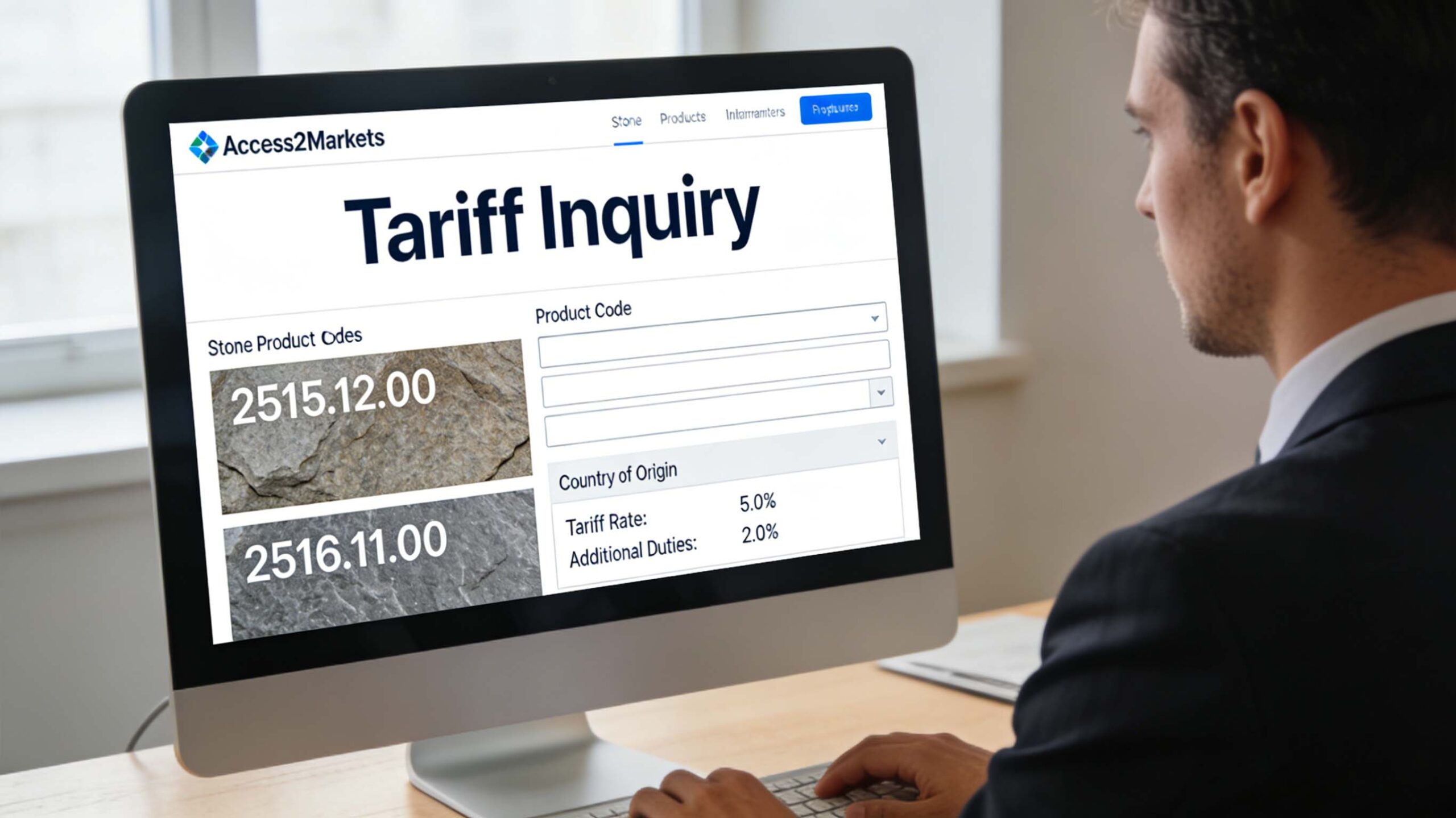
Minute 2: Pull the duty rate in Access2Markets (fast) or TARIC (deep)
Fastest route for buyers and non-customs teams is the EU’s Access2Markets “My Trade Assistant.” Enter origin country, destination, and product code; it returns applicable duties and related measures.
If you want the most “customs-accurate” view, use the official TARIC consultation. TARIC is where you confirm the third country duty and any linked tariff measures.
A simple rule: use Access2Markets to move fast and keep teams aligned; use TARIC to verify edge cases, special measures, or when your broker flags a risk.
Minute 3: Scan for extra measures that change the bill (and the paperwork)
Your base duty is only one line item. The other common “surprises” include:
Trade defence measures (anti-dumping, countervailing, safeguards) that may add extra duty or require extra coding/documentation.
Tariff quotas or suspensions that change duty treatment depending on timing and volume.
Preferential tariffs under FTAs or preference schemes, which require proof of origin to claim the reduced rate.
VAT rules, which can vary by Member State and by how you structure import/clearance.
This is why “checking duties in 3 minutes” is not just a duty-rate lookup. It’s a quick risk scan.
Granite: where EU duty checks usually go wrong
Typical granite shipment types buyers import into the EU
Granite can be declared as crude/rough stone, sawn/cut stone, or worked articles. Those are not interchangeable in tariffs, even if the end-use is “countertops.”
The EU is a major importer of crude or roughly trimmed granite; in 2024, the European Union appears among top importers in WITS/Comtrade for crude granite trade flows, which signals ongoing demand for raw material processing and downstream fabrication capacity.
If you are a wholesale granite manufacturer, factory, or exporter selling into Europe, your commercial offer should explicitly match the customs reality: blocks, slabs, tiles, or finished pieces. Buyers will use those exact product forms to confirm the correct duty treatment.
Granite duty outcomes hinge on three details
Origin and processing location. The origin that matters is the origin for customs purposes, not the port of loading. If rough stone is processed substantially in a second country, origin can shift, which can change preference eligibility or measure exposure.
Product form and finish. “Sawn, cut-to-size, polished, flamed, bush-hammered” are not marketing adjectives in customs terms; they can affect the relevant code and duty treatment.
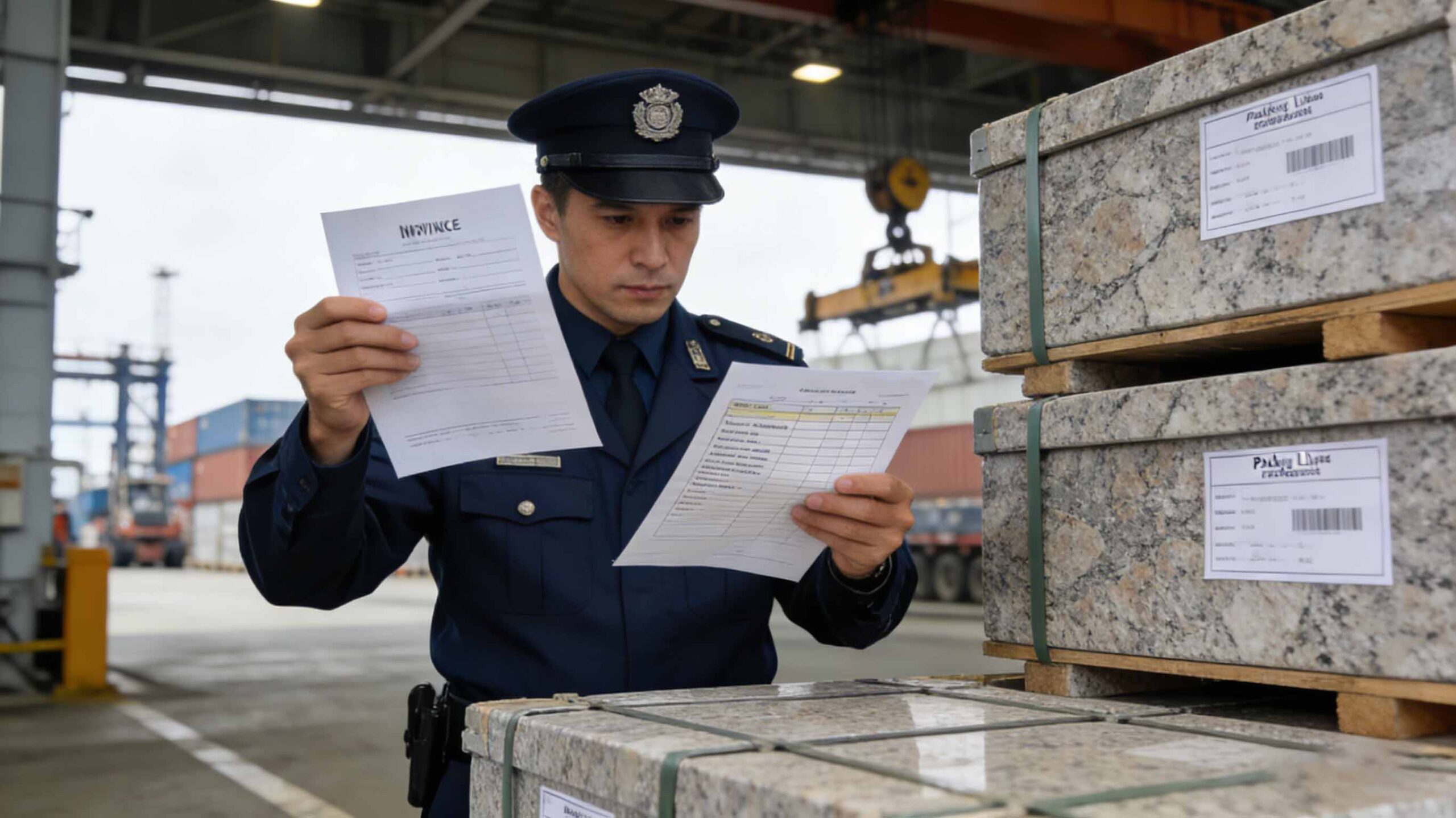
Consistency across documents. Invoice, packing list, and broker entry should describe the same product. Customs challenges often start when the commercial invoice says “granite slabs” but the packing list implies “tiles,” or the product description hides the real nature of the goods.
Marble: duty checks are often easy, until they aren’t
Marble buyers should separate “marble as stone” from “marble as an article”
Marble can travel as blocks/rough stone or as worked building stone articles. The duty logic can change depending on whether customs sees it as raw stone material or as processed building material.
If your shipment is a “marble surface product” (for example, cut-to-size, worked edges, finished tiles), treat your classification step as non-negotiable. Marble’s commercial naming often overlaps with limestone and similar stones, which can trigger classification questions. When in doubt, BTI is your friend for repeatable, defensible classification.
One practical marble tip: lock your spec sheet to customs language
Your spec sheet should include:
Stone type and geological description (as used in trade)
Dimensions and thickness
Surface finish and edge treatment
Declared intended use (countertops, wall cladding, flooring, monuments)
This is not bureaucracy for its own sake. It helps you and your buyer confirm the correct CN/TARIC code quickly, and it lowers the chance of customs reclassification.
Quartz: the most common EU confusion is “natural quartz” versus engineered quartz surfaces
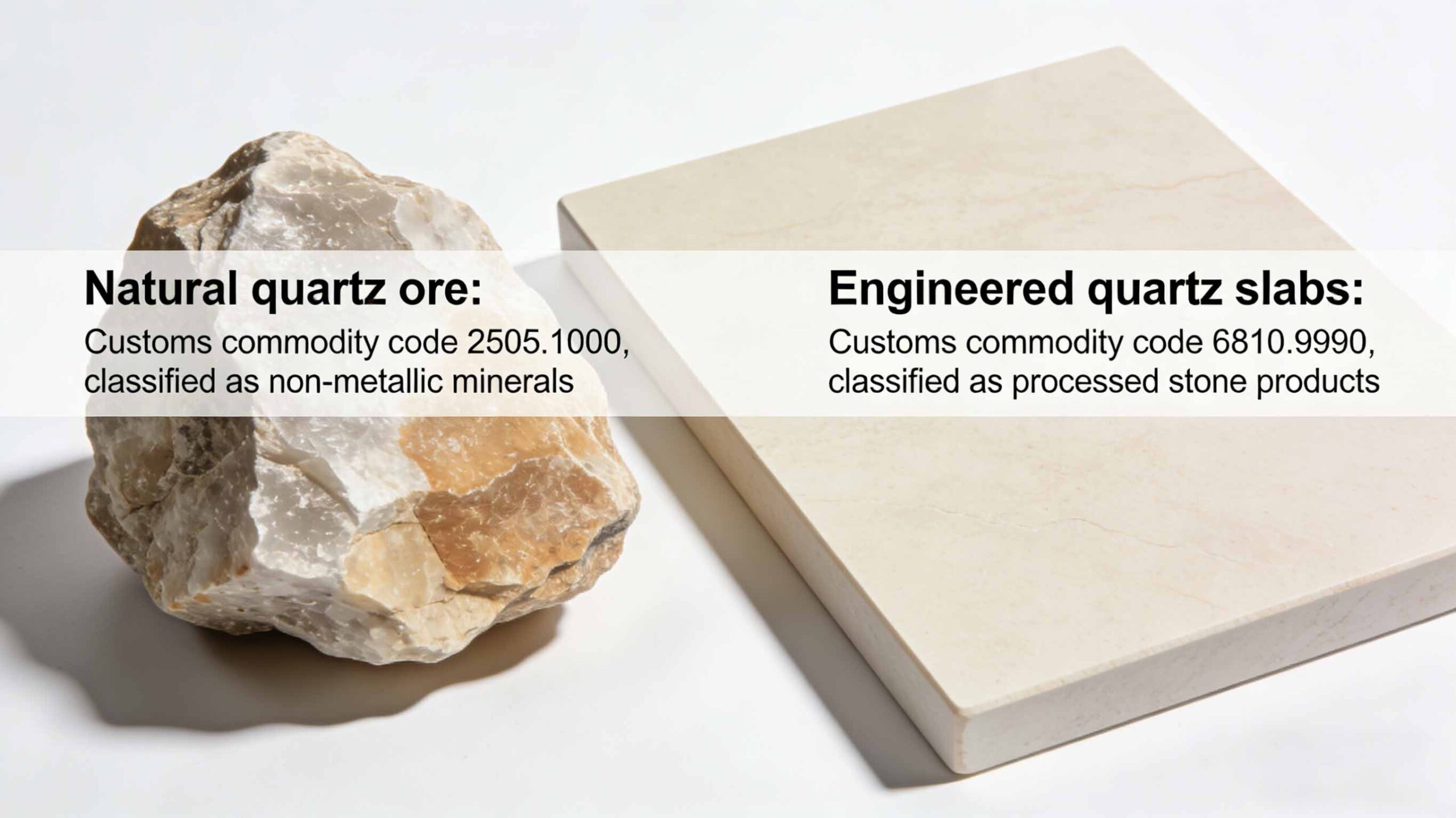
Natural quartz is not engineered quartz surfaces
Natural quartz as a mineral/raw material is not the same category as engineered quartz slabs used for kitchen and bath surfaces. Many “quartz” surfaces are manufactured articles (often treated as artificial stone or cement/concrete-based articles depending on composition and how the product is made). That’s why engineered quartz duty checks often require extra care and broker alignment.
If you sell engineered quartz surfaces wholesale, your customer will ask questions that sound simple but matter a lot:
Is the product an article of artificial stone?
Is it a composite with cement binder?
Is it supplied as slabs, tiles, or finished pieces?
What is the exact composition by weight?
Those answers drive the code selection and therefore the duty result.
Quartz surfaces have a second dimension: compliance expectations beyond customs duty
EU buyers increasingly treat stone procurement as a risk-managed category. Even when tariffs are stable, occupational health and safety expectations around respirable crystalline silica (RCS) influence purchasing decisions, especially for engineered stone fabrication environments. EU legislation has explicitly addressed RCS in workplace exposure contexts, and many buyers and fabricators now demand stronger documentation and safer processing practices.
This is not a “tariff” cost, but it can become a market-access cost: documentation, training, and process controls.

Preferential tariffs: when “duty-free” is possible, and what you must prove
If your goods qualify under an EU free trade agreement or preference scheme, the preferential rate is not automatic. It is claimed, and it is proven.
Access2Markets lays out the proof-of-origin concept and how origin status is evidenced through documents accompanying the import declaration.
Practical buyer advice: do not treat preference as a sales promise unless your origin documentation workflow is genuinely ready. A “duty-free” claim that cannot be substantiated during audit becomes a buyer’s nightmare.
VAT and landed cost: the part buyers forget until the invoice arrives
Import duty is only one part of what the buyer pays. VAT treatment depends on the importing Member State and how the import is structured. Access2Markets explicitly flags VAT as a core EU tax topic, and its My Trade Assistant help addresses how VAT is charged in the EU.
For buyers who want a clean landed-cost model, the best approach is to treat the EU clearance like a checklist:
Customs duty (third country duty or preferential rate)
Any trade defence duty (if applicable)
Customs value basis and adjustments (freight/insurance depending on Incoterms and valuation rules)
Import VAT and potential VAT deferral mechanisms (country-specific)
Broker fees, port handling, demurrage risk, inspections
This is where many “cheap-looking” quotes collapse. The supplier did not price the tariff risk; the buyer pays it later.
Where this EU guide fits inside a bigger 2026 tariff strategy
EU duty checks are only one node in a multi-market reality. If your team sells to the EU, the UK, the U.S., and the Middle East, you need a single source of truth that maps tariff exposure by country and by product form.
Use this pillar playbook as your “hub” and link your regional duty guides back to it: Stone Import Tariffs in 2026: A Country-by-Country Playbook for Granite, Marble, and Quartz Surfaces.
That hub-and-spoke structure is also exactly what helps search engines and AI tools understand topical authority: one comprehensive pillar, supported by specialised pages that answer narrower questions.
Conclusion: the fastest path to fewer customs surprises
If you remember one thing: EU stone tariff checks are not hard, but they are exact. Get the CN/TARIC code right, verify duty and measures in Access2Markets or TARIC, and treat origin and documentation as part of the product. Do that consistently, and you’ll eliminate most “surprise duty” scenarios that derail timelines and margins.
FAQs
1) What is the easiest way to check EU import duty for granite slabs?
Use Access2Markets “My Trade Assistant.” Enter the origin country, EU destination, and your product code; then verify the result in TARIC if your broker flags special measures.
2) Is the import duty the same across all EU countries?
The EU’s base customs duty is harmonised under the Common Customs Tariff, but VAT and some local costs vary by Member State, so the final landed cost can differ.
3) What is a TARIC code and why does it matter for stone imports?
TARIC is the EU’s integrated customs tariff classification used for imports. It links product codes to duty rates and tariff measures, which is why the correct code is essential.
4) How can I reduce duty legally when importing marble or quartz into the EU?
If your goods qualify for preferential treatment under an FTA or preference scheme, you must claim it and provide valid proof of origin. Without proof, customs will apply the standard third country duty.
5) How do I know if my stone product is subject to anti-dumping or safeguard duties?
Check the tariff measures in TARIC and review the trade defence guidance and databases referenced by the European Commission, especially if your product category has a history of investigations.
References (with links)
-
European Commission (Taxation and Customs Union). “EU Customs Tariff (TARIC).” https://taxation-customs.ec.europa.eu/customs/calculation-customs-duties/customs-tariff/eu-customs-tariff-taric_en
-
European Commission (Access2Markets). “How can I find the import duty that applies to my product?” https://trade.ec.europa.eu/access-to-markets/en/faqs/how-can-i-find-import-duty-applies-my-product
-
European Commission (Access2Markets). “Combined Nomenclature.” https://trade.ec.europa.eu/access-to-markets/en/content/combined-nomenclature-0
-
European Commission (Taxation and Customs Union). “The Combined Nomenclature.” https://taxation-customs.ec.europa.eu/customs/calculation-customs-duties/customs-tariff/combined-nomenclature_en
-
European Commission (News). “Commission publishes the 2026 version of the Combined Nomenclature.” https://taxation-customs.ec.europa.eu/news/commission-publishes-2026-version-combined-nomenclature-2025-10-31_en
-
European Commission (Access2Markets). “Tariffs (quotas, anti-dumping, safeguards, BTI).” https://trade.ec.europa.eu/access-to-markets/en/content/tariffs-2
-
European Commission (Taxation and Customs Union). “Binding Tariff Information (BTI).
-
European Parliament and Council (EUR-Lex). “Directive (EU) 2017/2398 (amending worker protection rules, including respirable crystalline silica context).” https://eur-lex.europa.eu/eli/dir/2017/2398/oj