In 2026, engineered quartz is still a star material for kitchens, hospitality fit-outs, and multi-family projects. But it is also becoming one of the most “policy-sensitive” surface categories in global trade. Even when the headline import duty looks harmless, buyers can run into hidden friction: trade-remedy risk, customs scrutiny on origin and product scope, and health-driven restrictions that function like a hard stop.
This guide focuses on where the pressure points are building outside the U.S., how they change your landed-cost math, and how to structure sourcing so your shipment does not turn into an expensive lesson in “tariffs are only the beginning.”
What “engineered quartz” means to customs and regulators
Commercial language vs customs language
Buyers say “engineered quartz,” “quartz countertops,” or “quartz slabs.” Regulators often say “engineered stone,” “artificial stone,” or “quartz surface products.” Those labels matter because duties, controls, and exemptions are usually written around defined product scope (slabs vs cut-to-size; panels vs benchtops; silica content thresholds; installed vs raw material).
HS code reality: classification drives the duty, not the marketing name
In many tariff schedules, engineered stone products often sit in Chapter 68 (stone, plaster, cement, asbestos substitutes, and similar materials). One commonly used heading is 6810 for “articles of cement, of concrete or of artificial stone,” which is where some customs authorities place engineered stone forms depending on composition and presentation. As a practical buyer move, treat HS code confirmation as a pre-order deliverable, not a post-shipment surprise.

The 2026 landscape beyond the U.S. in one sentence
Outside the U.S., the biggest risk is not always a high MFN rate; it is sudden “market access loss” (Australia), growing health-driven procurement restrictions (more countries discussing tighter rules), and the spillover of trade actions pushing supply into new markets, which can trigger new cases.
If you want the wider, multi-stone view (granite, marble, quartz together), anchor this article inside your pillar playbook here: Stone Import Tariffs in 2026: A Country-by-Country Playbook for Granite, Marble, and Quartz Surfaces.
Australia: the world’s clearest non-U.S. pressure point (and it behaves like a tariff wall)
Domestic prohibition: engineered stone effectively “out” since July 1, 2024
Australia’s national approach is anchored in worker health policy. Safe Work Australia states that WHS ministers agreed to ban the use, supply, and manufacture of engineered stone from July 1, 2024.
Border control: import prohibition and seizure powers from January 1, 2025
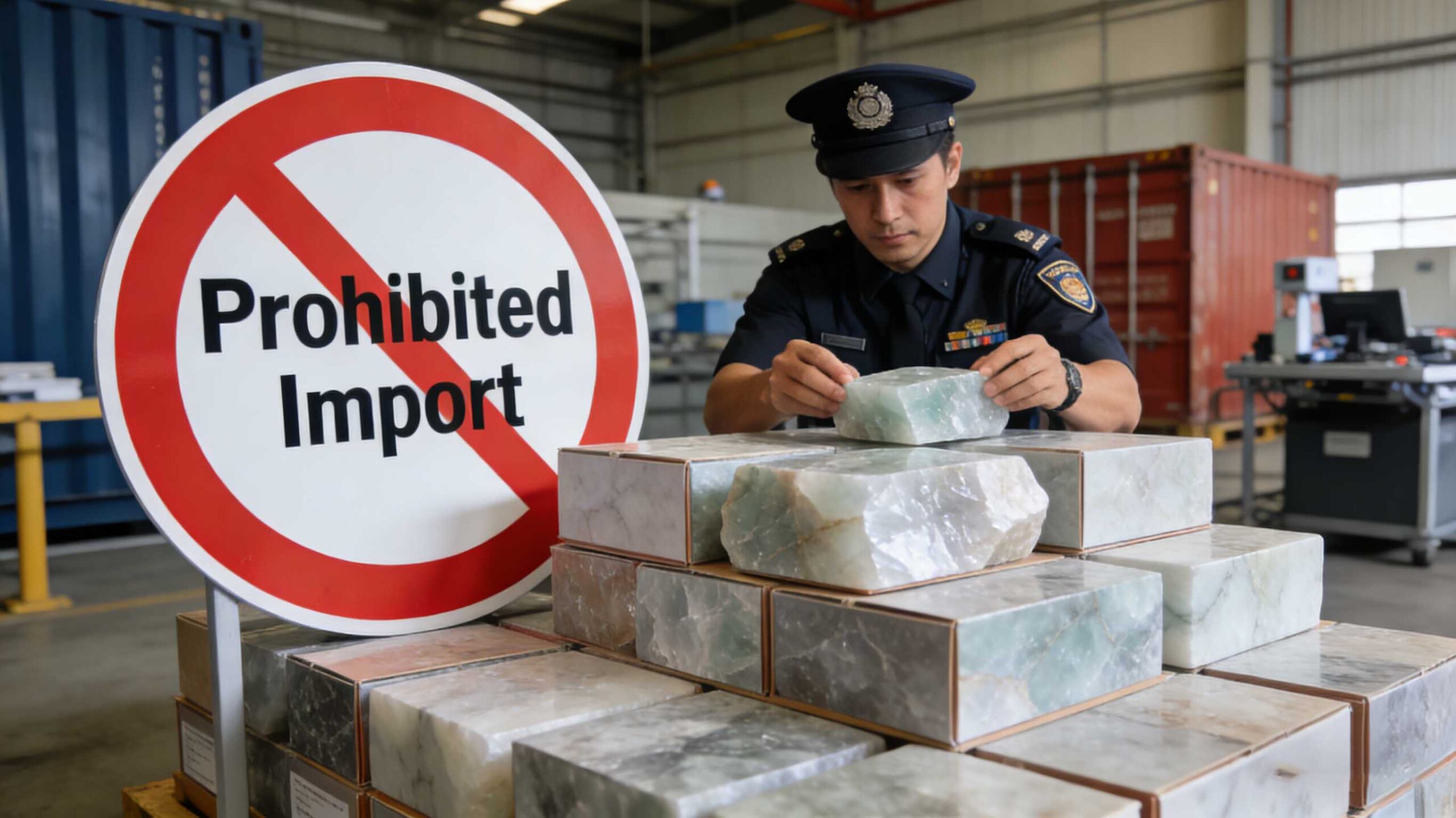
Australia did not stop at domestic controls. The Australian Border Force (ABF) explains that engineered stone is a prohibited good category, with the domestic ban effective July 1, 2024, and import enforcement enabling seizure at the border.
The “how” matters for buyers: the Australian Customs Notice (ACN 2024/45) outlines that from January 1, 2025, engineered stone benchtops, panels, and slabs became prohibited imports under a new regulation framework.
What this means for global buyers in 2026
If you supply engineered quartz into projects that might be re-exported, installed by Australia-linked contractors, or specified by Australia-influenced design teams, you need a “substitution strategy” (sintered stone, porcelain, lower-silica alternatives where acceptable, or different engineered products that meet exemptions if any). In real terms, Australia is a warning siren to other regulators: engineered quartz can move from “popular finish” to “prohibited risk” quickly when health evidence and politics align.
Why Australia’s decision keeps echoing internationally
Safe Work Australia’s ongoing review work highlights that the prohibition is being actively evaluated for effectiveness and unintended consequences, which is exactly the kind of policy posture that other governments watch when deciding whether to follow or adapt the approach.

EU: low headline duties can still hide real risk in 2026
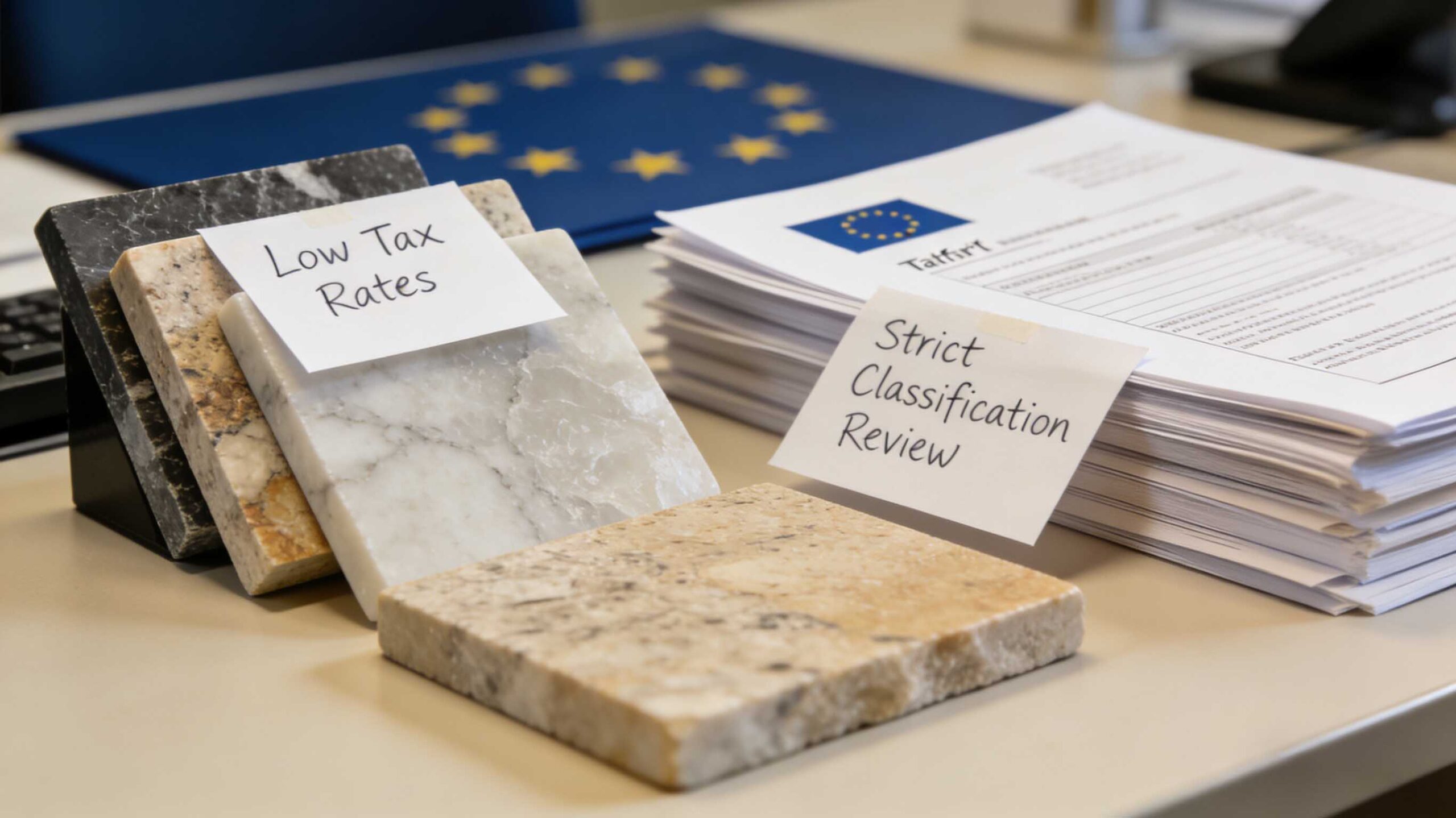
Tariffs: often modest, but classification and origin matter more than the percentage
For many engineered stone items classified under HS 6810.99, EU “third country duty” rates can sit in low single digits (Access2Markets shows an example of 1.70% for 6810.99).
In practice, that does not mean “easy market.” It means:
-
Customs classification disputes can erase your margin faster than a 2% duty ever could.
-
Preferential duty rates (FTAs) can be attractive, but only if rules of origin are clean and documentable.
-
“Anti-circumvention” scrutiny rises when one market clamps down and volume diverts elsewhere.
Policy pressure: health-driven restrictions are becoming part of the trade story
A 2024 BMJ Group press release summarizing an editorial in Occupational & Environmental Medicine urged European governments to follow Australia’s lead on artificial/engineered stone due to silicosis risk. That type of mainstream medical-policy signal often translates into procurement restrictions first (public projects, large contractors), then tougher regulation later.
Buyer implication: even if the tariff rate is stable, your spec may get questioned. Build a documentation pack that explains composition, fabrication method, and dust-control guidance for installers and fabricators.
Canada: a “normal” tariff schedule, plus a fast-growing compliance mindset
Tariffs: know your MFN baseline before you negotiate the “factory price”
Canada’s Customs Tariff shows MFN duty for 6810.99.00 as 5%.
That MFN baseline is useful for buyers because it sets the ceiling you must beat with smarter levers:
-
correct classification (and supporting rationale),
-
preferential treatment where applicable,
-
accurate valuation and packing configuration,
-
logistics optimization that reduces dutiable add-ons.
Why Canada can still become a pressure point even without “headline drama”
Canada’s compliance culture around workplace hazards and supply chain due diligence is tightening, even when the tariff itself is straightforward. Engineered quartz sits at the intersection of construction, occupational health, and imports, which means procurement teams increasingly want proof: material transparency, clear installation guidance, and evidence you are not shipping “mystery stone.”

The Middle East and Southeast Asia: stable tariffs, rising enforcement on paperwork
Many GCC and Southeast Asian markets keep relatively stable tariff regimes, which makes them attractive when other regions become volatile. The catch is that stable tariffs do not guarantee smooth clearance.
In 2026, the friction often comes from:
-
inconsistent HS coding across suppliers,
-
origin claims that do not match shipping reality,
-
product description mismatches (slab vs cut-to-size vs assembled),
-
missing technical sheets for composition and intended use.
If you are selling as a wholesale quartz countertops factory or engineered quartz slabs manufacturer into these markets, your competitive edge is not just lead time; it is “customs-friendly consistency.”
Three global triggers that can turn “low duty” into “high risk” in 2026
1) Trade diversion after major actions
When one large market raises barriers, suppliers and traders pivot to alternative markets. That shift can be good for buyers (more options) until it becomes a trigger for new trade cases or intensified customs review in the destination market.
Buyer move: track import surges into your target market (even informally through brokers) and ask suppliers for proof of stable, legitimate origin.
2) Origin enforcement and anti-circumvention behavior
Even without new tariffs, customs agencies can apply pressure by auditing origin claims, scrutinizing minimal processing, and challenging “last substantial transformation.” The result is not always a higher tariff rate; it is delays, penalties, or reclassification that changes duty outcomes.
Buyer move: require a documented manufacturing narrative (raw materials, processing steps, facility location, and bills of materials) before you place volume orders.
3) Health policy transforming into market access limits
Australia demonstrates the extreme case: engineered stone is treated as a major health hazard category, leading to domestic prohibition and border controls.
Other regions may move slower, but the policy direction matters because it can reshape what architects specify and what large contractors will accept.
Buyer move: prepare an “acceptable alternatives” list for each project type so your pipeline does not depend on one material class.
A buyer’s de-risk playbook for 2026 engineered quartz sourcing
Step 1: lock the scope definition before pricing
Write the scope in customs terms:
-
product form (slab, panel, benchtop, cut-to-size),
-
composition (binders, fillers, silica content where relevant),
-
surface finish,
-
intended use (construction fit-out, countertop, wall cladding).
This reduces misclassification and prevents the classic trap: supplier quotes a slab, you thought you were buying cut-to-size, and the duty treatment changes.
Step 2: make HS code support part of your contract
Do not just ask for an HS code. Ask for:
-
the supplier’s classification rationale,
-
supporting technical sheets,
-
photos of product form and packing,
-
consistency across invoices, packing lists, and product descriptions.
Step 3: build a “customs-ready” documentation packet
A strong packet typically includes:
-
commercial invoice with consistent description,
-
packing list aligned to product form,
-
certificate of origin where relevant,
-
technical data sheet (composition and use),
-
compliance statement for destination market expectations.
Step 4: plan for “policy volatility” like it is normal (because it is)
In 2026, engineered quartz is no longer a sleepy commodity. It is a high-visibility product in both trade and health policy. Your procurement plan should include:
-
an approved alternative material path,
-
a second-source strategy,
-
clear communication to your customers about compliance and installation safety.
2026 watchlist: what to monitor quarterly
Australia: enforcement and exemptions
ABF guidance and notices are your first stop, because Australia’s import control is explicit and enforced at the border.
If your supply chain touches Australia directly or indirectly, treat it as a separate compliance universe.
EU and UK: rising attention from health-policy voices
When major medical and safety voices push for bans or stronger controls, procurement often shifts before law does.
That shift can change your spec acceptance rate even if your tariff line stays unchanged.
Canada: tariff stability, documentation expectations rising
The MFN rate is knowable; the clearance smoothness depends on how clean your paperwork is and how defensible your classification and valuation are.
Conclusion: the winning engineered quartz strategy in 2026
In 2026, engineered quartz is traded in a world where “tariff rate” is only one variable. The larger reality is policy convergence: trade enforcement, origin scrutiny, and health-driven restrictions are blending into a single buyer requirement—proof. Buyers who win are the ones who can explain, document, and defend their product story across borders. If you build that system once, it becomes a durable advantage you can reuse for every market you enter.
FAQs
1) What is the difference between “engineered quartz,” “engineered stone,” and “quartz surface products” for importing?
They are often used interchangeably in business, but regulators may define scope differently by product form and composition. Always align your paperwork to the destination market’s definitions and your HS classification.
2) Which non-U.S. market is the strictest on engineered quartz in 2026?
Australia is the clearest strict market: engineered stone is prohibited domestically and controlled as a prohibited import category for slabs, panels, and benchtops.
3) Are EU tariffs on engineered quartz always low?
They can be modest for certain classifications, but the bigger risks are classification disputes, origin scrutiny, and policy-driven procurement restrictions that can limit demand regardless of duty rate.
4) What documents reduce customs delays for engineered quartz shipments?
Consistent invoices and packing lists, a defensible HS classification rationale, a technical data sheet showing composition and intended use, and reliable origin documentation are the core package.
5) How can buyers future-proof quartz countertop sourcing against new restrictions?
Maintain an approved alternative-material list, qualify a second source, and build a repeatable compliance packet so you can pivot quickly if a market tightens rules or enforcement.
References (with links)
-
Safe Work Australia — Engineered stone ban (Silica)
-
Australian Border Force — Prohibited goods: Engineered stone
-
Australian Border Force — Australian Customs Notice ACN 2024/45 (PDF): New Import Control on Engineered Stone
-
Safe Work Australia — Review of the engineered stone prohibition (PDF)
-
EU European Commission — Access2Markets (example duty view showing third-country duty for HS 6810.99)
-
Canada Border Services Agency — Customs Tariff 2026, Chapter 68 (shows MFN for 6810.99.00)
-
BMJ Group / Occupational & Environmental Medicine — Researchers urge EU/UK action on artificial stone risk
-
Australian Border Force — Newsroom update on import-law enforcement and seizures (engineered stone)