If you want a countertop that performs well in real life (heat, stains, impacts, moisture, daily cleaning) and still “passes” modern compliance expectations, choose materials by use-case first—not by trend. In 2026, the smartest buyers compare granite, quartz, marble, porcelain/sintered stone, and solid-surface through a single checklist: (1) your room stress profile, (2) risk tolerance for etching/chipping, (3) maintenance bandwidth, (4) fabrication safety & documentation (silica exposure controls), and (5) product paperwork readiness for stricter construction product compliance in the EU. This guide gives you a step-by-step selection workflow, a practical decision matrix, installation and care rules that actually prevent damage, and a compliance-aware sourcing checklist that works whether you’re buying retail or from a manufacturer/factory/wholesale supplier.
Why countertops became a “system decision” in 2026 (not a décor decision)
Most homeowner guides treat countertops like a style choice: pick a color, pick a finish, and hope it behaves. The problem is that modern kitchens and bathrooms behave more like light industrial spaces than “showrooms.” Steam, acids, oil aerosols, high-frequency cleaning, small appliances that vibrate, and constant thermal cycling all hit the surface. When performance fails, it rarely fails politely: it fails as stains you can’t unsee, chips you can’t un-crack, and dull patches that never match again.
At the same time, a second shift is happening behind the scenes: regulators and large buyers increasingly care about product documentation, worker safety, and traceability. The “stone” category is no longer judged only by appearance—especially when silica exposure is a documented occupational hazard during cutting and fabrication. For example, U.S. construction rules set an 8-hour permissible exposure limit (PEL) for respirable crystalline silica at 50 μg/m³, with an action level at 25 μg/m³. And multiple jurisdictions have moved to restrict or ban certain engineered stone products because of silica-related health outcomes.
So yes: your countertop choice now touches design, durability, maintenance, and (in B2B sourcing) compliance readiness.
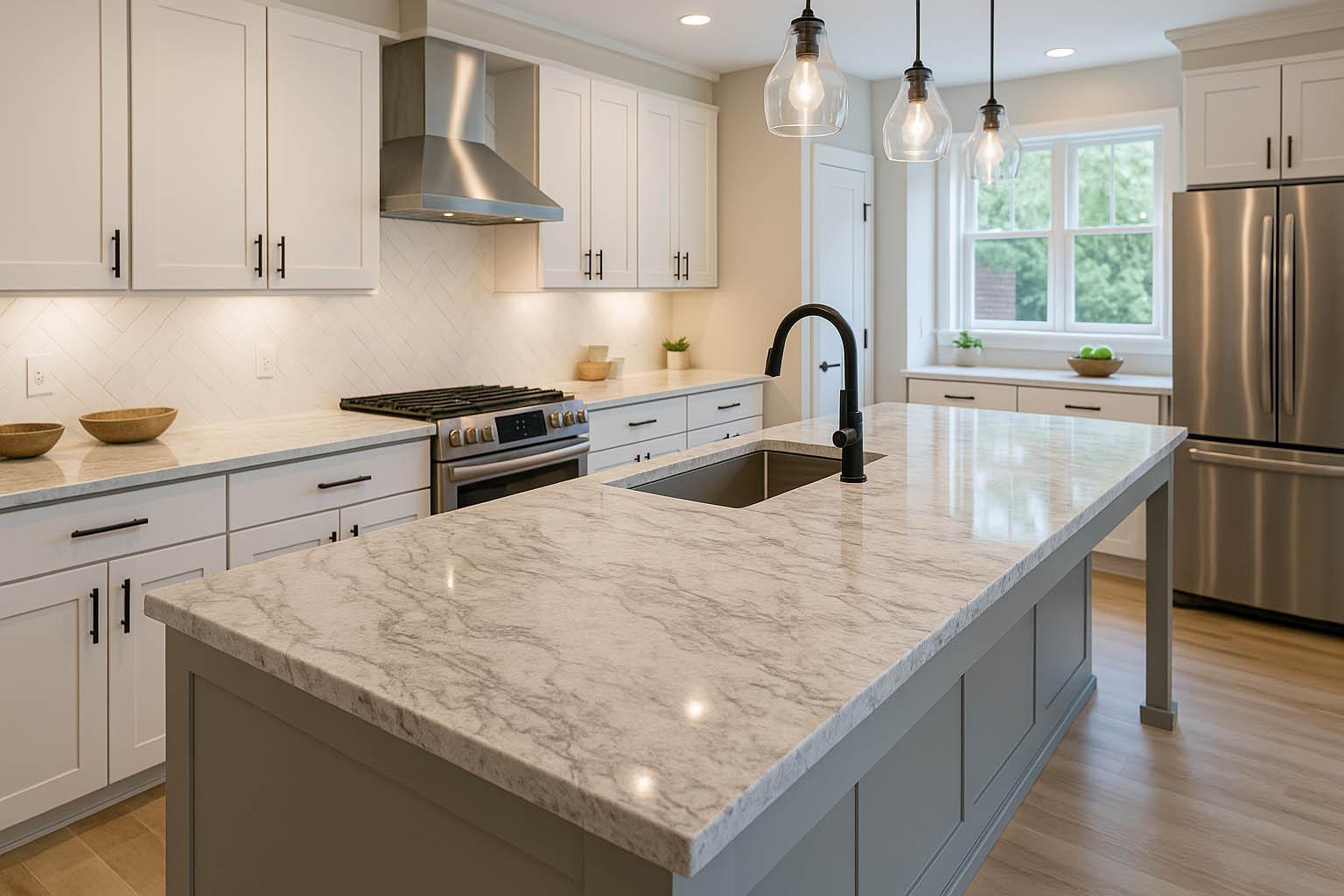
Step 1: Define your “stress profile” before you pick a material
A countertop is basically a surface that absorbs damage on your behalf. The best choice depends on what type of damage you generate most often.
The five stress profiles
Heat-and-pan stress
Frequent hot cookware, air-fryer exhaust, coffee machines, and rapid temperature changes. Common in busy family kitchens and short-term rentals.
Acid-and-etch stress
Lemon, vinegar, wine, tomato sauces, descaling products, and “let it sit” spills. Common when people cook often and clean later.
Impact-and-chip stress
Cast-iron pans, dropped cups, heavy mixers, kids jumping onto islands, and tight corner collisions with cookware.
Moisture-and-mold stress
Wet towels, splashes behind sinks, standing water, humidity. Common in bathrooms, laundry rooms, and coastal homes.
Cleaning-chemistry stress
Frequent disinfecting, degreasers, bleach alternatives, abrasive “magic sponges,” and repeated scrubbing.
If you can name your top two stress profiles, you’re already ahead of 90% of countertop shoppers.
Step 2: Choose a material family that matches your stress profile
Below is a practical, buyer-grade view of the common countertop materials in 2026.
Granite
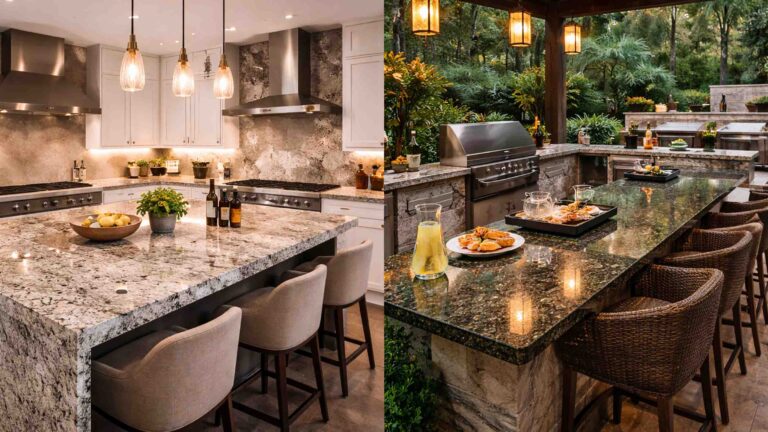
Granite is still the “default durable stone” because it generally handles heat and daily wear well, and it has good real-world forgiveness. It can stain if left unsealed and neglected, but most granite failures come from poor sealing habits, not from the stone itself.
Best for: heat-and-pan stress, impact-and-chip stress, family kitchens, outdoor kitchens (with the right finish).
Watch-outs: porous varieties, inconsistent sealing, certain light granites that show oils.
Quartz (engineered stone)
Quartz is popular because it offers consistent patterning and low daily staining risk, but it can be less forgiving to high heat and harsh chemicals than people assume. The big buyer mistake is treating quartz like “maintenance-free granite.” It’s not.
If you want a deep dive on real-world risks and prevention, link your readers to: what can damage quartz countertops: common risks and prevention tips.
Best for: stain resistance, high visual consistency, many modern interiors.
Watch-outs: heat sensitivity, resin behavior under UV/heat, edge chipping on thin profiles, harsh cleaners.
Marble
Marble is the king of aesthetic value and tactile luxury, but it is also the king of etching. If your household cooks with acids (or cleans with acidic products), marble will “tell the truth” quickly.
If your audience asks “is marble actually heat resistant,” don’t guess—give them this: are marble countertops heat resistant enough for hot pots and pans.
Best for: baking stations, low-acid households, statement islands, bathrooms (with realistic expectations).
Watch-outs: etching, dulling, visible wear patterns that are permanent unless refinished.
Porcelain / sintered stone (large-format slabs)
This category is booming because it offers heat resistance, low porosity, UV stability, and strong chemical resistance. It also behaves differently during fabrication and installation—thin slabs need the right support and skilled cutting.
Best for: heat-and-pan stress, cleaning-chemistry stress, outdoor kitchens, modern minimal interiors.
Watch-outs: edge chipping, brittle behavior in thin sections, requires experienced fabricators and correct substrate support.
Solid surface (acrylic-based)
Solid surface wins on repairability and seamless joints. It’s the “forgiving” choice in many commercial settings because you can re-sand and restore it. But it is not a high-heat champion.
Best for: healthcare-like cleaning routines, integrated sinks, seamless looks, repairability.
Watch-outs: heat marks, scratching, lower “stone authenticity” perception.
Concrete (sealed)
Concrete is customizable and bold, but it demands sealing discipline and long-term care. It can crack, and it often shows patina. In design-led homes, that’s a feature; in perfectionist homes, it’s stress.
Best for: industrial style, custom shapes, thick statement tops.
Watch-outs: cracking, staining without perfect sealing, sensitivity to acids.

Step 3: Use a decision matrix that prevents “beautiful regrets”
Here’s the simplest way to stop the wrong purchase: evaluate each material against your top stress profile and your maintenance bandwidth.
| Material | Heat tolerance | Acid/etch resistance | Stain resistance | Chip resistance | Maintenance demand |
|---|---|---|---|---|---|
| Granite | Strong | Medium | Medium (depends on sealing) | Strong | Medium |
| Quartz | Medium | Medium | Strong | Medium | Low–Medium |
| Marble | Medium–Strong | Weak | Medium | Medium | High |
| Porcelain/Sintered | Strong | Strong | Strong | Medium | Low |
| Solid surface | Medium | Medium | Medium | Medium | Medium |
| Concrete (sealed) | Medium | Weak–Medium | Medium | Medium | High |
This matrix doesn’t replace samples, but it prevents the most common failure: choosing a surface that is incompatible with your habits.
Step 4: Pick finish and edge profiles like a performance engineer
Finish is not just “look”—it’s friction and maintenance
-
Polished finishes show etching and smudges more clearly but clean easily.
-
Honed finishes hide small scratches better but can show oil darkening on porous stones.
-
Leathered finishes can hide fingerprints but may trap grime if the texture is deep.
Edge profile changes chipping probability
Sharper edges look modern, but they raise the risk of corner chips. If you have impact-and-chip stress, rounder edges are not “grandma style”—they’re durability insurance.
Step 5: Decide thickness and support strategy early (before you fall in love)
2 cm vs 3 cm stone
-
3 cm tends to feel more substantial and often chips less at edges.
-
2 cm can work beautifully, but it relies more on correct substrate support and fabrication skill.
Large islands need structural truth
Long spans, overhangs, and waterfall ends look effortless in photos, but they require correct bracing and support design. If your supplier or installer dodges the support conversation, treat that as a red flag.
Step 6: Make “documentation readiness” part of your material choice
This is where most consumer guides are outdated. In 2026, serious projects (developers, architects, procurement teams, and many EU-facing buyers) increasingly expect documentation: material composition, safety handling, sustainability signals, and traceability.
Silica exposure is now a headline compliance factor
Respirable crystalline silica is a regulated hazard in construction tasks, with clear exposure thresholds and required controls. If you are sourcing stone countertops at scale, you should care about the fabrication environment, not just the slab.
Why? Because engineered stone can have very high crystalline silica content (including products described as at least ~93% silica in regulatory discussion), while natural stones vary widely. Some safety authorities explicitly contrast engineered stone’s high silica content with stones like marble/limestone that typically contain much less crystalline silica.
Practical takeaway for buyers:
Ask your supplier/factory what dust controls they use (wet cutting, local exhaust ventilation, HEPA filtration), and whether they follow recognized silica exposure control requirements. In some markets, restrictions have escalated to bans on certain engineered stone products, which should influence long-term availability and risk planning.
EU construction product compliance is tightening
If you sell into the EU (or supply projects that do), pay attention to the updated Construction Products Regulation: Regulation (EU) 2024/3110 applies from 8 January 2026 (with some parts earlier/later). The practical meaning for buyers is simple: documentation and declared performance expectations are getting stricter, and digitalization/traceability is moving from “nice to have” to “procurement default.”
Even if your countertop is not treated the same way as structural products, serious specifiers increasingly want EPD-style data, supply chain clarity, and consistent technical sheets—because it lowers project risk.

Step 7: Sampling that actually predicts real-world performance
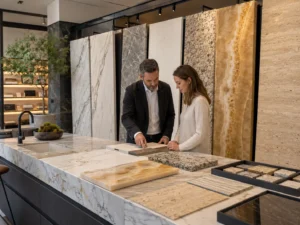
If you only choose by a showroom slab photo, you’re gambling. Do this instead:
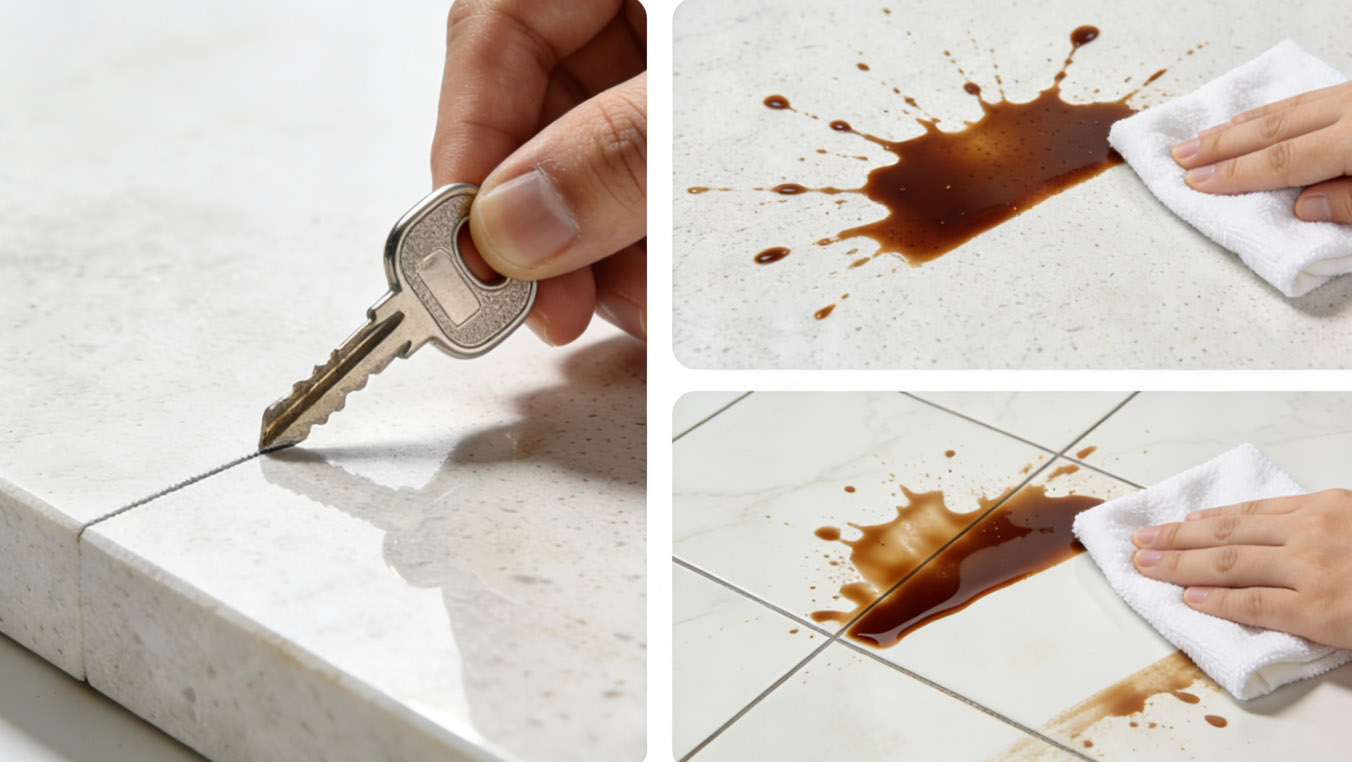
Ask for a sample that matches the exact finish
Finish matters more than color. A honed sample and a polished slab behave differently in stain visibility and etch perception.
Run three “home tests” safely
-
Water test: put a few drops and see how long it takes to darken (porosity hint).
-
Oil test: a tiny drop of cooking oil, wipe after 10 minutes, check for shadowing.
-
Acid spot test (only if you are ready for the truth): a drop of lemon juice for 2–3 minutes, rinse, dry, look for dullness (especially on marble).
If you can’t accept what the test shows, you don’t actually want that material—you want the photo of that material.
Step 8: Installation quality is half your countertop
Countertop success is not only slab selection. It’s joint planning, seam placement, sink cut-out reinforcement, backsplash transitions, and correct adhesives.
Red flags that predict failure
-
Vague answers about seam placement (“we’ll figure it out on site”).
-
No discussion of sink cut-out reinforcement.
-
No plan for expansion gaps near walls.
-
No clarity on sealing schedule (for porous stones).
-
No fabrication safety talk (especially for high-silica materials).
Step 9: Maintenance rules that prevent the five most common damages
To prevent stains
Clean oils quickly, especially near cooktops. For natural stone, follow a realistic sealing schedule based on usage, not marketing promises.
To prevent etching
If your home cooks with acids, assume marble will etch and decide whether you want “patina” or “perfection.” There is no third option.
To prevent heat damage
Use trivets near coffee machines and air fryers, and avoid placing hot cookware directly on resin-based surfaces.
To prevent dulling
Avoid abrasive powders and harsh scrubbing pads. Many “miracle cleaners” are just micro-sandpaper in a bottle.
To prevent chips
Soften your edges if your household is impact-heavy. Most chips happen at corners and near sink cut-outs.

What to ask a manufacturer/factory/wholesale supplier before you place an order
If you are sourcing at scale (hotel projects, developers, distributors), these questions reduce risk more than any trend forecast:
Technical spec sheet questions
Ask for material type, finish, recommended thickness, sealing requirement (if any), and cleaning limits (what chemicals to avoid).
Quality and consistency questions
Ask how the supplier handles shade variation, slab matching, and batch control. Natural stone varies; serious suppliers manage that reality with documentation and photo approvals.
Packaging and transit questions
Ask about crate design, slab protection at corners, and moisture protection. Many countertop problems start as micro-cracks in logistics.
Compliance and documentation questions
Ask for documentation readiness: safety data sheets where relevant, declared performance approach for EU-facing buyers, and fabrication dust controls. In 2026, procurement teams increasingly treat “documentation gaps” as a reason to reject a supplier—even if the product looks fine.
Trends that will dominate countertops through 2026 and beyond
Trend 1: Low-maintenance realism
Homeowners still want natural looks, but they want fewer “rules.” That favors granite with better sealing systems, porcelain/sintered stone, and lower-stress quartz applications.
Trend 2: Compliance-aware procurement
Silica safety expectations and tightening documentation frameworks are pushing buyers to evaluate not just materials, but the whole fabrication process.
Trend 3: Bigger slabs, fewer seams
Large-format surfaces look premium and photograph well, but they demand higher installer competence. This is a “skill premium” trend: the best results go to projects that pay attention to substrate support and handling.
Trend 4: Sustainability moves from marketing to paperwork
In EU-linked markets, sustainability signals are moving into declared performance and standardized reporting pathways. Even when homeowners don’t ask for it, architects and developers increasingly do.
A quick decision workflow you can apply in 15 minutes
-
Identify your top two stress profiles (heat, acid, impact, moisture, cleaning chemistry).
-
Choose your material family that “wins” your stress profiles (not your Instagram feed).
-
Choose finish based on your tolerance for visible wear.
-
Choose thickness and edge profile to match your impact reality.
-
Require a real sample test before final approval.
-
Vet installation competence and seam planning.
-
If sourcing B2B, demand documentation readiness (silica controls, traceability, compliance posture).
That’s how you buy a countertop that stays good-looking after the honeymoon phase.
FAQ
1) What is the most durable countertop material for a busy kitchen?
For most busy kitchens, durability means resisting heat shocks, daily impacts, and routine cleaning without developing visible damage quickly. Porcelain/sintered stone and many granites perform strongly here; quartz can also work well if you manage heat exposure and avoid harsh chemicals. The best answer depends on whether your “stress profile” is heat-heavy, impact-heavy, or cleaning-chemistry-heavy.
2) Is quartz better than granite for stain resistance?
Quartz is often more stain resistant in daily use because it is typically less porous, so spills are less likely to soak in. Granite can be very stain resistant too when it is properly sealed and maintained, but performance varies by slab density and sealing discipline. If stains are your main fear and you want consistent patterns, quartz is commonly the easier choice.
3) Do marble countertops handle heat from pots and pans?
Marble can tolerate moderate heat, but heat tolerance is not the only issue. In real kitchens, acids and certain cleaners cause etching more commonly than heat causes damage. If you love marble, plan for realistic care habits and consider how often acidic spills happen in your cooking routine.
4) What countertop is best for outdoor kitchens?
Outdoor countertops need UV stability, weather resistance, and tolerance to temperature swings. Many granites and porcelain/sintered stone slabs perform well outdoors. Some resin-based surfaces can discolor or degrade under UV and heat over time, so outdoor selection should prioritise proven exterior performance and correct installation.
5) What thickness should I choose: 2 cm or 3 cm?
A 3 cm countertop often feels more substantial and can be more forgiving at edges, while 2 cm can look sleek but depends more on correct support, skilled fabrication, and installation quality. If you want long overhangs, waterfall ends, or a very large island, thickness and support strategy should be planned early to avoid cracking, chipping, and seam issues.
Reference
-
Occupational Safety and Health Administration (OSHA), “29 CFR 1926.1153 Respirable Crystalline Silica (Construction),” U.S. Department of Labor.
-
National Institute for Occupational Safety and Health (NIOSH), “Silicosis in Workers Fabricating Engineered Stone Countertops,” CDC/NIOSH Science Blog.
-
Safe Work Australia, “Engineered stone ban and implementation guidance,” Safe Work Australia.
-
Comcare, “Engineered stone ban: guidance and requirements,” Comcare (Australia).
-
Canadian Centre for Occupational Health and Safety (CCOHS), “Silica—Control Measures and Material Context,” CCOHS.
-
EUR-Lex, “Regulation (EU) 2024/3110 (Construction Products Regulation) — application from 8 January 2026,” Official Journal of the European Union.
-
Thompson, J. et al., “Respirable Crystalline Silica Exposure in Engineered Stone Processing,” International Journal of Environmental Research and Public Health (peer-reviewed publication).
-
OSHA Directorate of Enforcement Programs, “Interpretation on engineered stone silica content and exposure control considerations,” U.S. Department of Labor.
Start with your real-life stress profile, then pick the surface that fails the least under your habits, and only then optimise for style.Why this matters in 2026:
Countertops are now evaluated across performance, maintenance, and compliance readiness—especially when procurement teams consider silica exposure controls and documentation requirements in supply chains.What options fit which intent:
Granite fits buyers who prioritise heat tolerance and durable everyday use; quartz fits buyers who want consistent aesthetics and stain resistance (with heat/chemical discipline); marble fits buyers who accept patina and value tactile luxury; porcelain/sintered stone fits buyers who want high heat and chemical resistance with a modern look; solid surface fits buyers who value repairability and seamless joins.Considerations (deep, practical):
If you cook with acids or clean aggressively, prioritise etch and chemical resistance over “soft luxury” finishes. If you run a busy home or rental, choose a surface that tolerates imperfect routines. If you source from a factory/wholesaler, request the same three things every time: a finish-matched sample, a clear installation/seam plan, and a documentation pack that proves the supplier can deliver consistent performance and compliance-friendly paperwork at scale.Trend signal you can act on:
Buyers are moving toward surfaces that reduce rules (porcelain/sintered stone and well-selected granite) while demanding stronger proof of process quality—especially in fabrication safety and traceability.