What Desert Brown Granite typically looks like in real projects
Most buyers choose Desert Brown Granite for one of two reasons:
A warm neutral that doesn’t feel “flat”
Many beige/brown stones read as uniform from a distance. Desert Brown Granite usually has enough veining or flow to stay interesting in large areas (hotel lobbies, open kitchens, reception walls), without being visually chaotic.
A forgiving surface for daily life
Warm browns hide crumbs, water spots, and minor dust better than ultra-dark stones. That’s a practical advantage in kitchens and high-traffic commercial spaces, especially when clients want “low drama” surfaces.
Where Desert Brown Granite works best
The key is not “can it be used here?” but “what finish + thickness + edge + maintenance expectations make it succeed here?”
Kitchens and islands
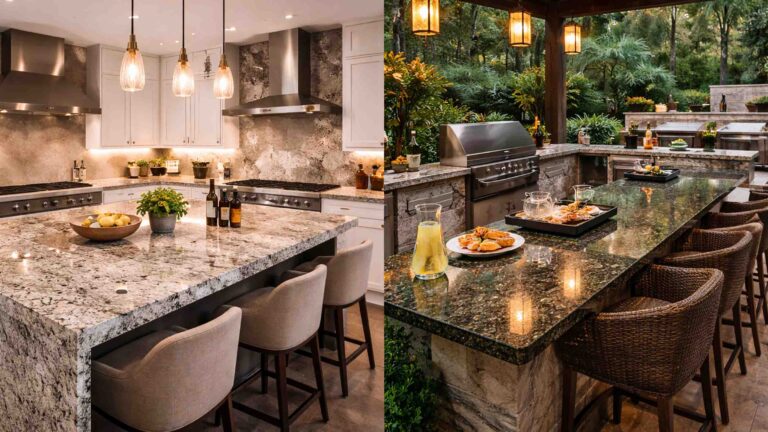
For desert brown granite countertops, the biggest success factor is choosing the right finish and edge detail for how the kitchen is actually used.
Best-fit scenarios
Polished or fine-honed surfaces work well when the priority is wipeability and a cleaner, more reflective look. Leathered finishes can be excellent for hiding fingerprints and adding texture, but they require slightly more attention to cleaning routines because the micro-topography can hold residues.
Fabrication notes that prevent complaints
Overhang design, sink cutout reinforcement, and seam placement matter more than most buyers expect. If you’re supplying slabs, the buyer should plan seam locations around the main flow lines so the veining “continues” visually instead of looking like two unrelated pieces.
If you’re still comparing options across materials (granite vs quartz vs marble vs sintered stone), use a decision framework rather than vibes—this step-by-step guide can help:countertop selection guide for modern homes.
Flooring in residential and commercial spaces
Granite is commonly specified for flooring because it can deliver abrasion resistance and strength when properly selected and finished. The practical choice is usually honed, flamed, or textured finishes for slip control, especially in public areas or entrances.
Stair treads and risers
Stairs are a “stress test” for stone: point loads, edge impacts, and consistent wear. Desert Brown Granite performs well as stair treads when thickness and edge profiles are chosen conservatively and the installation is executed with proper support.
Exterior paving and façade applications
Outdoor use is totally achievable, but you must match the finish to climate and slip requirements. Flamed, bush-hammered, or textured finishes are common choices for exterior paving because they improve traction.
For façade/cladding, engineering details (anchors, kerfing, wind load calculations, and freeze-thaw considerations) become as important as the stone itself. When projects are engineered, designers often ask for test data aligned to recognized methods for absorption, flexural strength, and compressive strength.
The technical side buyers should actually care about
Most “stone blogs” avoid numbers because they vary. Serious buyers do the opposite: they ask for test reports, ranges, and project-specific verification.
Standards that are commonly referenced in stone specs
For granite used as dimension stone, ASTM standards are widely used in procurement and specification workflows. ASTM C615 is specifically written for granite dimension stone selection and physical requirements.
For performance and project suitability, common testing conversations include absorption, density, compressive strength, flexural strength, abrasion resistance, and sometimes slip resistance depending on application.
Why you should ask for updated testing data
Even if the stone is “the same name,” test data can be outdated or not representative of the current supply. Industry guidance often recommends fresh testing when introducing new stone, when technical data is old (for example, older than a few years), or when the project has special installation conditions.
Typical granite performance (use as a benchmark, not a promise)
Granite properties vary by quarry and even by block. Still, benchmarks help buyers sanity-check claims. For example, Natural Stone Institute materials data for certain granites shows absorption values well under 1% and compressive strength in the hundreds of MPa range in published test datasets. Use this as a reference frame, and then request the specific test report for Desert Brown from the supplier batch you’re buying.
Finishes, textures, and how they change real-world behavior
A finish is not just aesthetics—it changes slip resistance, stain visibility, maintenance effort, and even how seams visually blend.
Polished
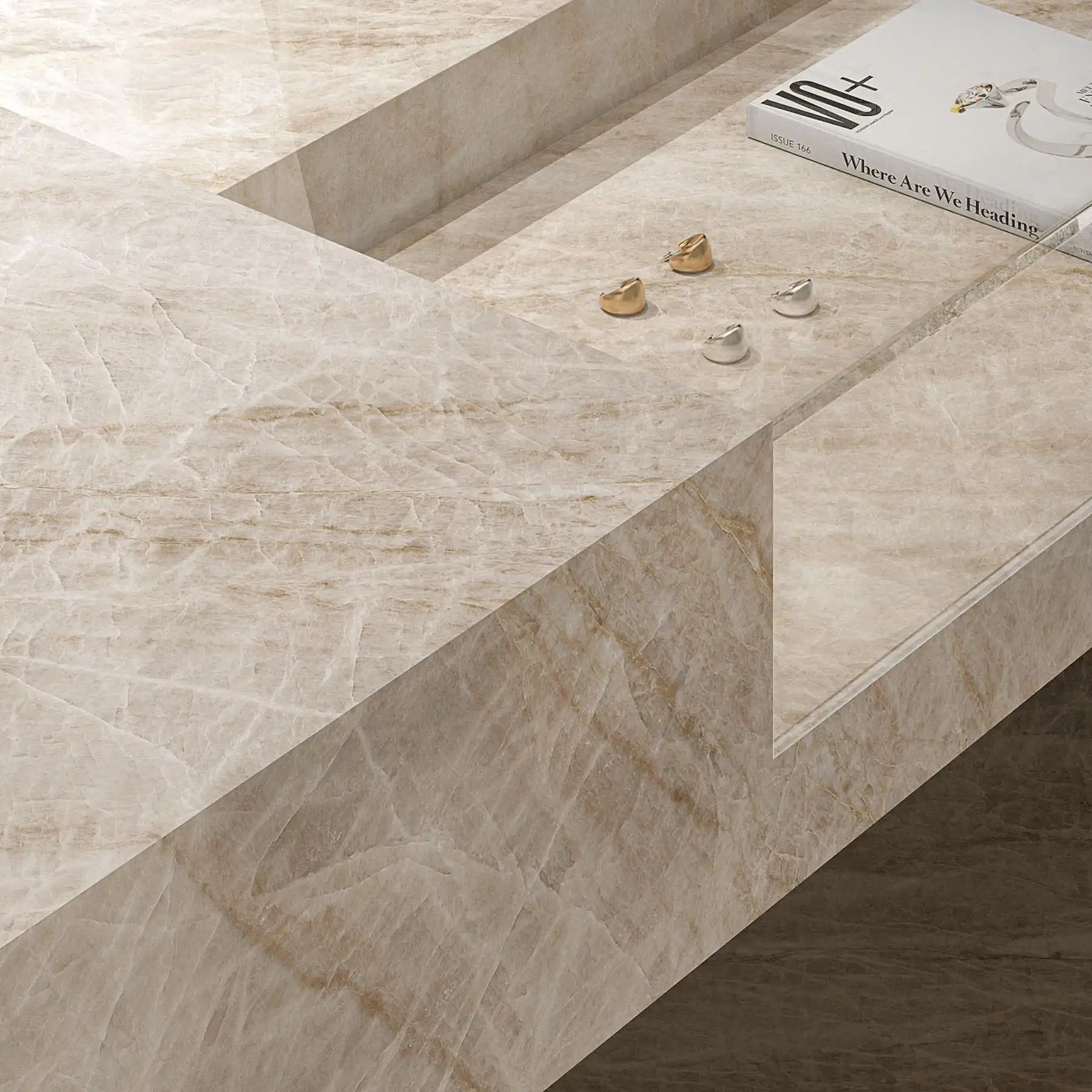
Polished desert brown granite slabs tend to look richer and deeper in color. It’s usually the easiest finish to wipe clean. The trade-off is that it can be more reflective and may show smudges under certain lighting.
Honed
Honed surfaces reduce reflection and can read more “architectural.” They can be slightly more prone to showing oils if the stone is not sealed appropriately, especially in kitchens. The right sealer and cleaning routine usually solves this.
Leathered
Leathered finishes add texture and hide fingerprints well. For restaurants or busy family kitchens, it can be a practical aesthetic. The cleaning approach matters: you want non-residue cleaners to avoid build-up in the texture.
Flamed / bush-hammered / textured
These are common for exterior paving and pool surrounds because traction becomes priority number one. If a supplier claims “it works outdoors” but only offers polished, that’s a yellow flag (it might still work—but it’s not the typical best practice).
Color consistency and why “the name” can mislead buyers
“Desert Brown Granite” is often used as a commercial label. Two shipments with the same label can look different because:
Quarry zone variation
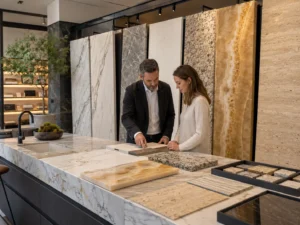
Even within the same quarry area, mineral content and pattern density can shift. If the project demands uniformity, buyers should request block photos, slab bundles, and a shade range agreement.
Resin treatment and surface enhancement
Some slabs are resin-treated to improve surface integrity or reduce micro-fissures. That’s not inherently bad, but it should be disclosed. For projects that demand strict technical transparency, ask the supplier to declare treatment methods and provide consistent finishing processes.
Lighting and application context
A stone that looks warm in a warehouse can shift under cool LED lighting in a modern kitchen. Good suppliers provide photos in multiple lighting conditions and recommend sample review on-site.
A practical buyer checklist: how to source with fewer surprises
This is the part that saves money and relationships.
Match your purchase unit to your project
If you’re fabricating countertops, you’re buying slabs, not “a color.” Confirm slab size range, thickness availability, and the expected yield for your common countertop layouts.
If you’re supplying contractors, clarify whether they need tiles, cut-to-size pieces, or prefabricated elements (treads, risers, window sills, coping).
Ask for the documents that actually matter
A smooth import and a clean project handover depend on documentation quality. Typical document hygiene includes consistent product description, matching quantities across invoice and packing list, and clear origin/producer identification.
If your shipping lane touches the U.S. market, you also need to think about tariff exposure and classification strategy—not as a political topic, but as a procurement risk management topic. A good starting point is this internal playbook:stone import tariffs country-by-country playbook.
Control risk with sampling and bundling rules
If the project is large (hotel lobby, commercial flooring, multi-unit residential), don’t buy based on one sample. Require:
-
representative samples from the current block range,
-
bundle photos that show the shade distribution, and
-
a written allowance for natural variation so expectations are aligned.

2026 regulations and compliance trends that influence stone buying
This section is not here to scare anyone. It’s here because the market has changed: documentation quality and product information are now part of competitiveness.
EU: CPR 2024 pushes more product information and digital traceability
The new Construction Products Regulation (EU) 2024/3110 entered into force in 2025 and becomes generally applicable from 8 January 2026, replacing the previous CPR 305/2011 (with some transitional details).
What matters for stone industry buyers is the direction of travel:
environmental information expectations are rising, the scope extends in ways that support circularity (including used products), and a digital product passport concept is explicitly part of the framework.
If you sell Desert Brown Granite into EU construction supply chains, the practical implication is simple: you’ll increasingly be asked for clearer, standardized performance declarations, better traceability, and supporting documentation that can plug into digital procurement systems.
U.S.: tariff volatility and exclusion timing remain a live variable
For U.S.-bound stone imports (direct or via distribution), tariffs can affect landed cost and planning. The Office of the U.S. Trade Representative announced extensions of certain Section 301 exclusions until 10 November 2026.
This does not mean “all products are excluded,” and it does not mean your stone category is automatically covered. The actionable takeaway is that buyers should:
-
confirm HTS classification with their customs broker,
-
track whether the relevant tariff list applies to their product form (slabs vs tiles vs fabricated items), and
-
maintain documentation that supports correct classification and origin.
Design pairing ideas that perform well in modern interiors
Because “it looks nice” isn’t a spec.
Cabinets and wood tones
Desert brown granite countertops pair naturally with walnut, oak, and medium-tone woods. The stone’s warmth can also soften ultra-minimalist kitchens that might otherwise feel sterile.
Backsplashes and wall finishes
For a cleaner modern look, matte tiles and minimal grout lines often pair well. For a richer classic look, a warm off-white or cream backsplash can lift the stone and prevent the space from feeling too heavy.
Metals and fixtures
Brushed nickel and matte black are safe. Brass can work beautifully if the veining includes warm notes, but it’s easier to make mistakes—test samples together under the actual lighting.
Maintenance and longevity: what to tell clients so they don’t blame the stone
A lot of “stone problems” are actually expectation problems.
Sealing: do you need it?
Many granites benefit from sealing in kitchen environments because it reduces absorption risk and makes daily cleanup easier. The right sealer choice depends on finish and intended use.
Cleaning rules that prevent haze and build-up
Use pH-neutral cleaners and avoid leaving soap residue. For textured finishes, residue build-up is the most common reason clients think “the stone stains easily.”
Heat, scratches, and daily wear
Granite generally handles normal kitchen temperatures well, but thermal shock is still a thing in extreme scenarios. The practical guidance is to treat it as a durable surface, not an indestructible one: don’t move a blazing-hot pan directly from burner to a cold, wet area on the stone.
Procurement scenarios: who should buy what form of Desert Brown Granite
Different buyers should buy differently.
For distributors
Prioritize stable supply, batch consistency, and standard sizes that your downstream fabricators can optimize. Build a repeatable process for shade approval and bundle documentation so you can scale without chaos.
For fabricators
Focus on slab yield, resin treatment disclosure, and predictable polishing quality. Your reputation will rise or fall on seams, edge finishing, and whether the stone behaves consistently during fabrication.
For project contractors
Insist on test reports aligned with project conditions, and avoid last-minute substitutions that cause visible shade mismatch. If the job is public/commercial, the slip and abrasion conversation matters more than the pattern.
Common mistakes that get Desert Brown Granite projects rejected
Mistake 1: choosing finish before defining the use case
Polished looks great—until it becomes a slip risk in wet exteriors.
Mistake 2: approving from a tiny sample
A hand sample can’t represent movement density across multiple slabs. Always request current-batch slab photos.
Mistake 3: ignoring documentation until the container arrives
Customs delays and reclassification headaches are rarely “bad luck.” They’re usually missing consistency across invoice descriptions, packing lists, and product declarations.
Mistake 4: mixing lots without a transition plan
If a project needs multiple lots, plan transitions (zones, borders, feature walls) so any shade shift looks intentional.
Conclusion
Desert Brown Granite is popular for good reasons: it’s warm, versatile, and performs well across kitchens, flooring, stairs, and selected exterior applications when specified correctly. But in 2026, “good stone” is not enough—good information is part of the product. Buyers who win consistently are the ones who treat Desert Brown Granite as a system: stone selection + finish strategy + testing alignment + documentation discipline + compliance awareness. Do that, and you get fewer rejections, fewer surprises, and more repeatable procurement outcomes—exactly what both Google and real customers reward.
FAQ
1. Is Desert Brown Granite good for kitchen countertops?
Yes. Desert Brown Granite is commonly used for kitchen countertops because it offers strong daily durability, hides minor dust and crumbs well, and suits both modern and classic designs. The best results come from selecting the right finish for your lifestyle and confirming batch consistency before fabrication.
2. Does Desert Brown Granite need sealing?
In most kitchens, sealing is recommended. A quality sealer reduces absorption risk, makes cleanup easier, and helps prevent oil or food residue from lingering—especially on honed or leathered finishes. Always follow the sealer manufacturer’s maintenance cycle and test on a small area first.
3. What finishes are available for Desert Brown Granite slabs?
Common finishes include polished, honed, leathered, and textured options such as flamed or bush-hammered. Polished is easiest to wipe clean, honed looks more matte and architectural, leathered hides fingerprints, and textured finishes are often preferred outdoors for traction.
4. Can Desert Brown Granite be used outdoors in freezing climates?
It can, but specification matters. Choose an outdoor-appropriate finish (usually textured), confirm the stone’s absorption and freeze-thaw suitability with test reports, and ensure proper installation and drainage details. Outdoor success depends on both stone properties and project engineering.
5. What should I check before importing Desert Brown Granite from a supplier or manufacturer?
Confirm the exact product form (slabs, tiles, cut-to-size), verify current-batch photos and shade range, request updated test reports aligned to recognized standards, and ensure documentation consistency for customs clearance. For U.S.-bound shipments, also confirm HTS classification and tariff exposure with a customs broker.
References
-
ASTM International, “ASTM C615/C615M – Standard Specification for Granite Dimension Stone”, ASTM International.
-
Natural Stone Institute, “Which ASTM Standards Are Relevant To Natural Stone”, Natural Stone Institute.
-
Natural Stone Institute, “ASTM Standards Test Laboratory for Natural Stone”, Natural Stone Institute.
-
Natural Stone Institute / BNP Media Continuing Education, “The Importance of Testing When Specifying Natural Stone”, BNP Media (Natural Stone Institute course).
-
Natural Stone Institute, “Stone of the Year (Physical/Mechanical Properties dataset page)”, Natural Stone Institute.
-
Office of the United States Trade Representative, “USTR Extends Exclusions from China Section 301 Tariffs Related to Forced Technology Transfer Investigation”, USTR.
-
Department of Housing, Local Government and Heritage (Ireland), “Construction Products Regulation 2024”, gov.ie.
-
Deutsches Institut für Bautechnik (DIBt), “The revised Construction Products Regulation (CPR) is available”, DIBt.