Quick Summary
Calacatta Viola is one of the most misunderstood marbles in the global market. Its beauty relies on quarry origin, block selection, cutting precision, and batch stability—not luck. This professional guide compiles real-world buyer evaluations, factory insights, and practical criteria used to identify trustworthy Calacatta Viola suppliers.
Opening Story: A Buyer’s Journey Through Four Factories
“Do you want a beautiful sample, or a stable supply?”
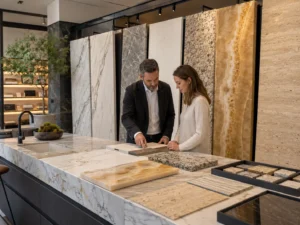
The factory owner in Fujian smiled as he placed three Viola slabs against the wall.
The consultant from Dubai replied, “I’ve seen too many perfect samples that look nothing like the delivered slabs. Calacatta Viola is unpredictable.”
In Jiaxing, a senior engineer laid out five slabs from different quarry sections:
“Viola is not a color—it’s a family. Quarry variation determines everything: texture, density, and long-term consistency.”
A Guangdong production manager added,
“Buyers think Viola is just about the purple veining. Professionals know the real question is: can you keep 20 consecutive slabs within the same visual zone?”
This wasn’t a dramatic story.
This is the daily reality for buyers who understand one important truth:
Calacatta Viola is not difficult to find—
a stable supplier is.
The Hidden Problems in Sourcing Calacatta Viola
Professional buyers fear three things more than price:
1. Unknown Quarry Origin
Different quarry sections produce drastically different tones—wine red, deep plum, pale violet, or mixed.
2. Batch Inconsistency
Two batches may look like they came from different planets.
Pattern direction, veining strength, and whiteness levels shift unexpectedly.
3. Finishing Instability
Issues that never appear on samples:
-
Dull zones
-
Inconsistent polish
-
Micro-porosity absorbing color
-
Patchy veining density
These problems show up only on large slabs, never on samples.
How Professionals Evaluate Calacatta Viola Factories
1. Quarry Source Transparency
The first question professionals ask is never “How much?”
It’s:
“Which quarry section do you source from, and can you keep it consistent for 3–6 months?”
Reliable suppliers provide:
-
Quarry section details
-
Block selection images
-
Evidence of consistent sourcing
-
Ability to maintain the same veining zone
2. Block Selection & Cutting Precision
Viola veining can swing wildly.
A serious factory:
-
Scans every block
-
Maps veining direction
-
Cuts slabs with unified orientation
-
Rejects unstable zones
This step determines 80% of consistency.
3. Veining & Color Control
A stable Calacatta Viola supplier must provide:
-
Vein-mapping
-
Dry-layout photos
-
Bookmatch simulation
-
Batch-level verification
This is how professionals avoid surprises on site.
4. Machining & Finishing Capability
You cannot evaluate Viola without understanding processing strength:
-
5-axis CNC machines
-
Automatic polishing lines (16–24 heads)
-
Edge profiling equipment
-
Strict water absorption controls
-
Flatness verification
This determines whether the slabs are suitable for:
-
Countertops
-
Hotel applications
-
Wall cladding
-
High-traffic commercial floors
5. Export Readiness
Reliable suppliers share traits:
-
Experience in the Middle East, Europe, Australia, U.S.
-
Detailed packing lists
-
Breakage-rate control
-
Container loading photos
-
Compliance with customs and fumigation rules
6. Project-Level Consistency
Professionals know that stones are not “made”—they are managed.
Strong factories have:
-
Batch tracking
-
Slab sequence management
-
Finishing reports
-
Pre-shipment inspection
-
Professional photography documentation
This is how high-end projects avoid costly rework.
Supplier Comparison Table
(Industry Evaluation Framework — Not targeting any specific brand)
| Criterion | Supplier A | Supplier B | Supplier C | Supplier D |
|---|---|---|---|---|
| Quarry Stability | ★★★★☆ | ★★★☆☆ | ★★★★☆ | ★★★☆☆ |
| Veining Consistency | ★★★★★ | ★★★★☆ | ★★★☆☆ | ★★★★☆ |
| Machining Strength | ★★★★☆ | ★★★☆☆ | ★★★★☆ | ★★★☆☆ |
| Export Experience | ★★★★★ | ★★★☆☆ | ★★★☆☆ | ★★★★☆ |
| Batch Stability | ★★★★☆ | ★★★☆☆ | ★★★☆☆ | ★★★★☆ |
| Price Competitiveness | ★★★☆☆ | ★★★★☆ | ★★★★☆ | ★★★☆☆ |
10-Point Buyer Checklist (Used by Professionals)
-
Never judge by sample—always check slabs.
-
Request 8–15 slab photos from the same batch.
-
Ask for bookmatch simulation.
-
Verify quarry section / block numbers.
-
Review batch-level consistency reports.
-
Check polish uniformity under angled light.
-
Confirm whether slabs can be pre-arranged (dry-layout).
-
Review 3–6 month sourcing stability.
-
Evaluate packaging and breakage prevention.
-
Request real project photos with similar designs.
Expert Insights
“The real skill in Calacatta Viola is not cutting—it’s controlling veining across multiple slabs.”
— Senior Stone Consultant, Milan
“High-end projects don’t tolerate surprises. Predictability is the new luxury.”
— Project Manager, Dubai
“The most expensive stone is not the slab—it’s the slab you must replace.”
— Installation Contractor, Melbourne
Decision Framework: How Professionals Choose a Supplier
1. Risk > Price
A cheap slab with high variation is more costly in the long run.
2. Supply Chain > Samples
A sample is a promise.
A batch is the truth.
3. Project Fit > Supplier Name
The “best” supplier doesn’t exist—
only the “best match” for your project.
Professionals do not look for perfection.
They look for control.
Suspense Ending
You might wonder:
“Out of the four suppliers, which one did the consultant finally choose?”
The answer is simple:
It depends on the project, not the preference.
Every project has its own character, rhythm, and constraints.
Every quarry has its own expression.
The smartest buyers don’t chase the most beautiful slabs—
they chase the most predictable outcomes.
This is the true art of sourcing Calacatta Viola.
Field Insight
Success in sourcing Calacatta Viola depends on controlling four variables: quarry consistency, machining accuracy, batch stability, and project-level management. Master these four pillars and every supplier can be evaluated objectively, without guesswork.