How I Compared Global Brands and Chinese Suppliers When Sourcing Calacatta Viola: A Real Buyer’s Experience

Quick Summary
Across the global stone market, Calacatta Viola has become one of the most requested marbles for luxury interiors—from boutique hotels to private residences and high-end commercial spaces. Yet many buyers discover the same problem: this marble looks dramatically different depending on the supplier, the quarry selection, the slab batch, and even the processing style.
Based on real sourcing experience with international distributors, Chinese processing factories, and project-based buyers, this guide offers a clear and neutral framework for evaluating Calacatta Viola. If your goal is to choose reliable material—not just marketing—it will help you reduce uncertainty and make better long-term decisions.
1. The Question That Started My Search
My journey began with a simple question:
“Where do people actually buy Calacatta Viola, and what should I expect?”
At first, I assumed all Calacatta Viola looked similar.
I quickly learned that wasn’t true.
The deeper I looked, the more I realized:
-
veins can be tight or loose
-
tones can be warm or cold
-
background can be creamy or bright white
-
pattern density varies dramatically
So before speaking to any factory in China, I decided to study how global brands present this stone.
If the world’s top distributors could show me the benchmark, I could use those standards later to evaluate Chinese suppliers.
2. Why Calacatta Viola Has Become a Global Design Priority
Calacatta Viola is not trending by accident. Designers choose it because it delivers three things at the same time:
-
High visual impact – the contrast of white base and wine-red or plum veining creates instant architectural presence.
-
A clear sense of luxury – it belongs to the same “Italian prestige family” as Calacatta Gold and Calacatta Borghini.
-
Adaptability across styles – it works in minimal, neoclassical, hospitality, residential, and boutique retail spaces.
But this stone is also widely misunderstood.
Many people think “Calacatta Viola = one single look.” In reality, it appears in multiple expressions:
-
warm cream-white base vs. crisp bright white
-
dense spider-web veining vs. large sweeping veins
-
wine-red vs. plum-purple vs. burgundy tones
-
heavy, chunky pattern vs. more linear and directional veining
That is why sourcing this marble is a professional task, not a casual aesthetic choice.
3. What I Learned from Three Global Brands
Before contacting factories, I started with three well-known international distributors.
This helped me understand:
-
how they photograph Calacatta Viola
-
what slab sizes they consider “standard”
-
how they communicate natural variation
-
how they structure the buying experience
It completely changed the way I look at this material.
3.1 Marble Systems (United States)
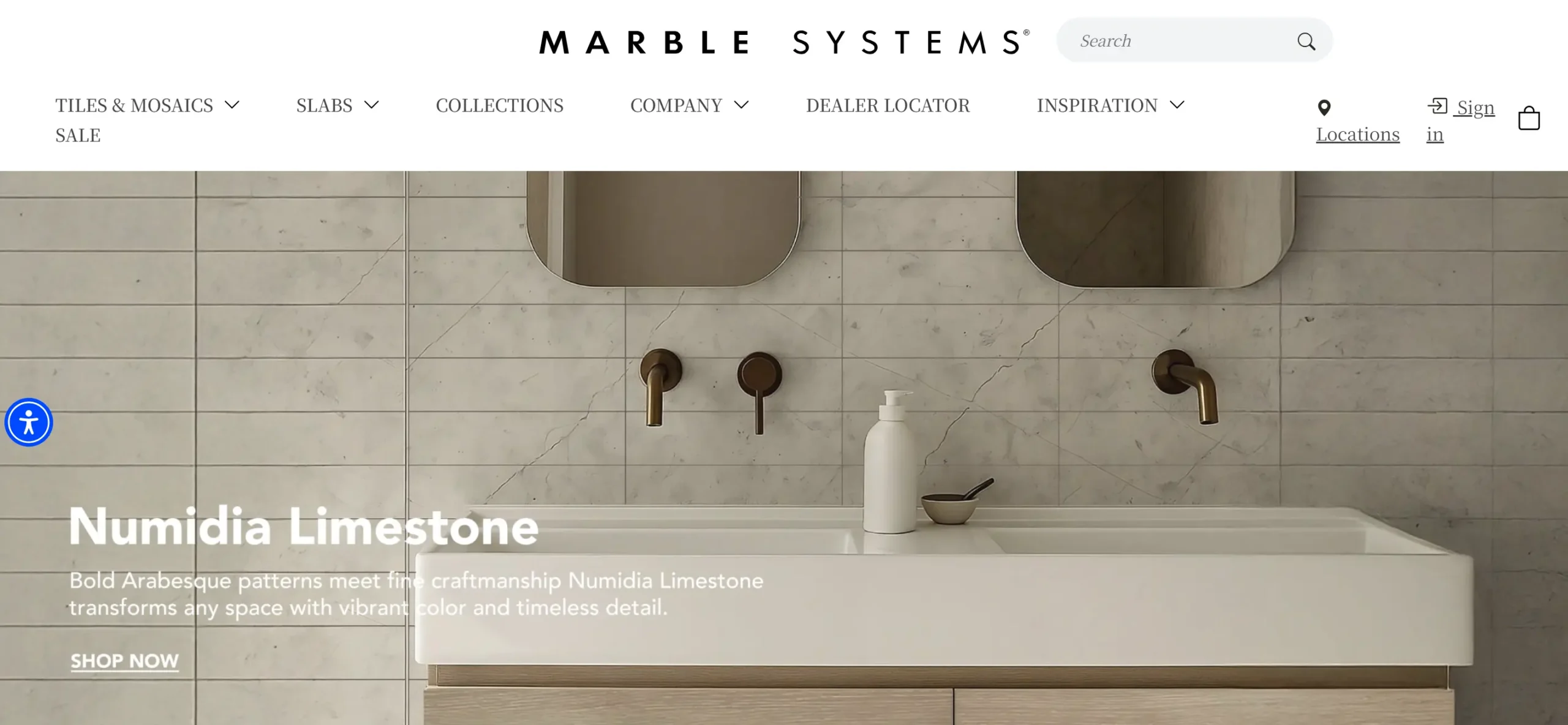
Marble Systems describes Calacatta Viola with design-focused language and showcases it through:
-
professional, well-edited photography
-
consistent lighting conditions
-
structured catalog categories and curated collections
Their whole system feels built for:
-
interior designers
-
architects
-
premium residential and boutique commercial clients
What I learned:
Global brands excel at clarity. Their photos set a visual expectation for what “good slabs” should look like in real projects.
3.2 New York Stone (United States)

[A major New York–based importer with a large in-stock slab inventory, transparent sizing/thickness data, and full-slab photos aimed at premium residential and commercial projects.]
New York Stone displays full slabs with clearly listed dimensions such as:
-
124″ × 71″
-
116″ × 75″
Almost all slabs are:
-
2 cm thick
-
individually labeled
-
photographed under clean, neutral lighting
What I learned:
Large-format slabs at 2 cm thickness are a global standard for many premium applications—especially kitchen countertops, wall cladding, and feature panels.
3.3 Imperial Stone Group (United Kingdom / EU)

Imperial Stone Group presents variations such as “Calacatta Viola Oro,” with a strong emphasis on:
-
suitability for European projects
-
controlled color variation
-
CE-focused documentation and technical notes
-
long-term performance in interior environments
What I learned:
European distributors tend to prioritize compliance, naming accuracy, and technical documentation, not just visual appeal.
⭐ Key Insight from Studying Global Brands
The safest and most accurate way to describe the difference is this:
“The price difference between international brands and Chinese factories is noticeable — not because one is ‘expensive’ or ‘cheap’, but because their business models, service structures, and operating costs are fundamentally different.”

This became my foundation when I started evaluating Chinese suppliers.
4. Turning Back to China — Using Global Standards to Evaluate Factories
After studying global brands, I asked myself:
“If I apply the same evaluation standards to Chinese suppliers, what will I find?”
So I selected five Chinese suppliers to compare.
My goal was not to find “the cheapest one.”
My goal was to find the most suitable factory for a specific project—using global benchmarks as the evaluation tool.
5. What Buyers Must Understand About Chinese Stone Processing Factories

This part is not marketing. It’s a neutral summary of how the industry actually works.
Most Calacatta Viola projects worldwide require:
-
stable, repeatable supply
-
texture and pattern consistency across slabs
-
fabrication capabilities (book-matching, edge finishing, back-mesh reinforcement)
-
realistic lead times
-
reliable export packaging and documentation
In many cases, these requirements are met not by the quarry directly, but by Chinese processing hubs such as Fujian and Guangdong.
5.1 Key Capabilities of Chinese Processing Factories
-
Strong fabrication capability
-
high-precision book-match
-
complex edge profiles and shaping
-
large-volume processing with consistent quality
-
-
Diverse sourcing channels
-
blocks from Italy and other regions
-
different quarries and batches
-
a mix of first-choice and commercial-grade materials
Because of this, professional buyers always ask for:
-
batch consistency
-
consistent vein direction
-
controlled color variation
-
-
Fast and flexible delivery
-
suitable for project-based orders such as hotels, retail spaces, and restaurants.
-
-
International-level packaging
-
reinforced wooden crates
-
metal or steel support where needed
-
back-mesh reinforcement
-
edge and corner protection
-
-
Improving photography and presentation
-
more factories now offer “architect-grade” slab photos
-
easier communication with overseas buyers
-
This is why many designers, traders, and contractors start with the visual and branding systems of international distributors, but ultimately work with Chinese factories for actual project fulfillment.
It’s not simply about price.
It’s about how the global stone supply chain is structured.
6. My Shortlist of 5 Chinese Suppliers (Real Research Experience)
6.1 Estas Stone (whitemarblegranite.com)
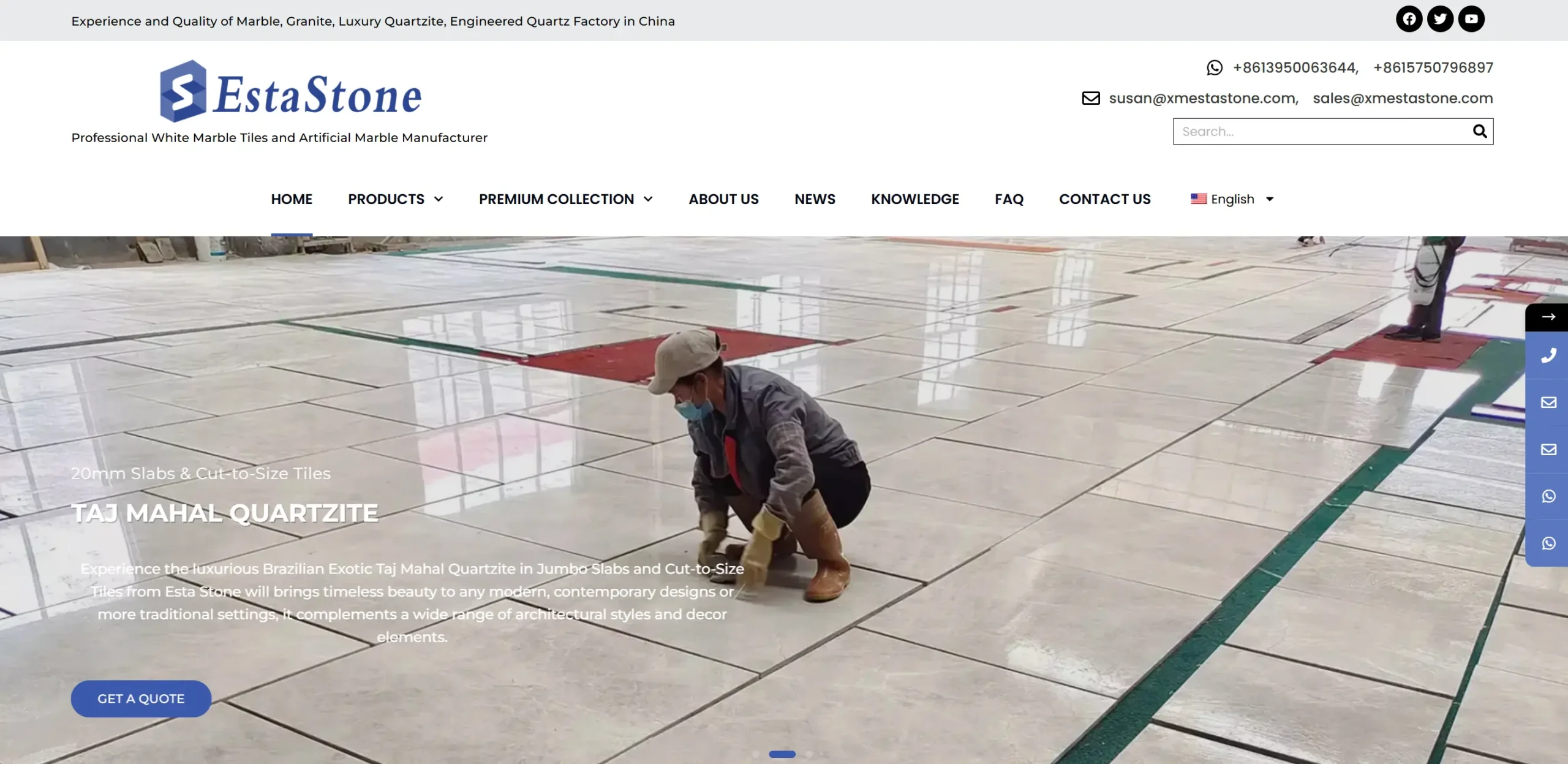
worker Specializing in high-end stone engineering processing – CSS
Why it caught my attention:
-
well-organized slab inventory
-
clear product categories
-
strong export history
-
consistent slab photography
Cautions:
-
Viola availability varies by batch
-
color consistency must be confirmed with real photos
Best for:
Buyers who need stable mid-to-high-end project supply.
6.2 HCENTURY STAR (hcenturystar.com)
Professional engineering with a variety of high-end marbles – CSS
Why it stood out:
-
wide stone catalog
-
responsive communication
-
flexible finishing and sizing options
Cautions:
-
not all listings are factory-direct
-
some products require extra verification
Best for:
Buyers who need mixed containers with multiple colors and materials.
6.3 Shihui Stone (stone007.com)
Why I liked it:
-
excellent fabrication quality for décor and furniture pieces
-
strong book-match craftsmanship
-
English-friendly product pages and communication
Cautions:
-
slab tonnage can fluctuate
-
stronger in fabrication than in direct quarry sourcing
Best for:
Furniture designers and high-end custom fabrication projects.
6.4 Funshine Stone (funshinestone.com)
A stone processing factory with quality as its core focus – CSS
Strengths:
-
capable of polished, honed, and leathered finishes
-
fast, flexible communication
-
suitable for small to medium-size orders
Cautions:
-
Viola consistency varies from batch to batch
-
website is still being improved
Best for:
Buyers who need flexible, project-based handling rather than very large volumes.
6.5 FOR U STONE (forustone.com)

If you’re looking for high quality, then you absolutely must visit this place – CSS
Strengths:
-
strong export capability and experience
-
stable processing lines for slabs, tiles, and cut-to-size
-
broad catalog of grey and white marbles
Cautions:
-
Calacatta Viola stock depends heavily on quarry and season
-
some slabs require detailed quality confirmation
Best for:
Buyers who value steady communication, consistent finishing, and diversified marble options.
7. The Real Sourcing Workflow: How Professionals Evaluate Calacatta Viola
Based on many conversations with buyers and factories, the practical workflow often looks like this:
Step 1 — Start with Global Distributors
Use international brands to define the visual direction you want:
-
Marble Systems → classic, bold veining
-
New York Stone → realistic batch photos and large slabs
-
Imperial Stone Group → multiple variants and European-style documentation
Once you know your preferred look and texture, you move to the next step.
Step 2 — Review Chinese Processing Capabilities
Key questions:
-
Can the factory provide slabs from the same batch?
-
Do they offer high-resolution slab photos (front, close-up, and side)?
-
Can they do book-matched sets for walls or islands?
-
Do they have proven export packaging experience?
-
Can they provide 2cm and 3cm thickness with controlled tolerances?
This step determines whether a supplier is technically reliable.
Step 3 — Verify Technical Details
Professional buyers look at:
-
how natural cracks are repaired and filled
-
whether back-mesh reinforcement is securely applied
-
whether polishing is even and consistent
-
whether edges chip easily
-
slab moisture content and porosity (for wet areas)
Step 4 — Logistics & Packaging
For high-value stone, logistics are as important as the stone itself:
-
reinforced anti-shock wooden crates
-
proper corner and edge protection
-
safe lifting structure and stacking method
-
container loading plan (sequence, weight balance)
-
crate photos before and after loading
-
clear responsibility in case of transport damage
Many issues people call “quality problems” are in fact packaging problems.
8. Global Trends for 2025–2027 in Calacatta Viola
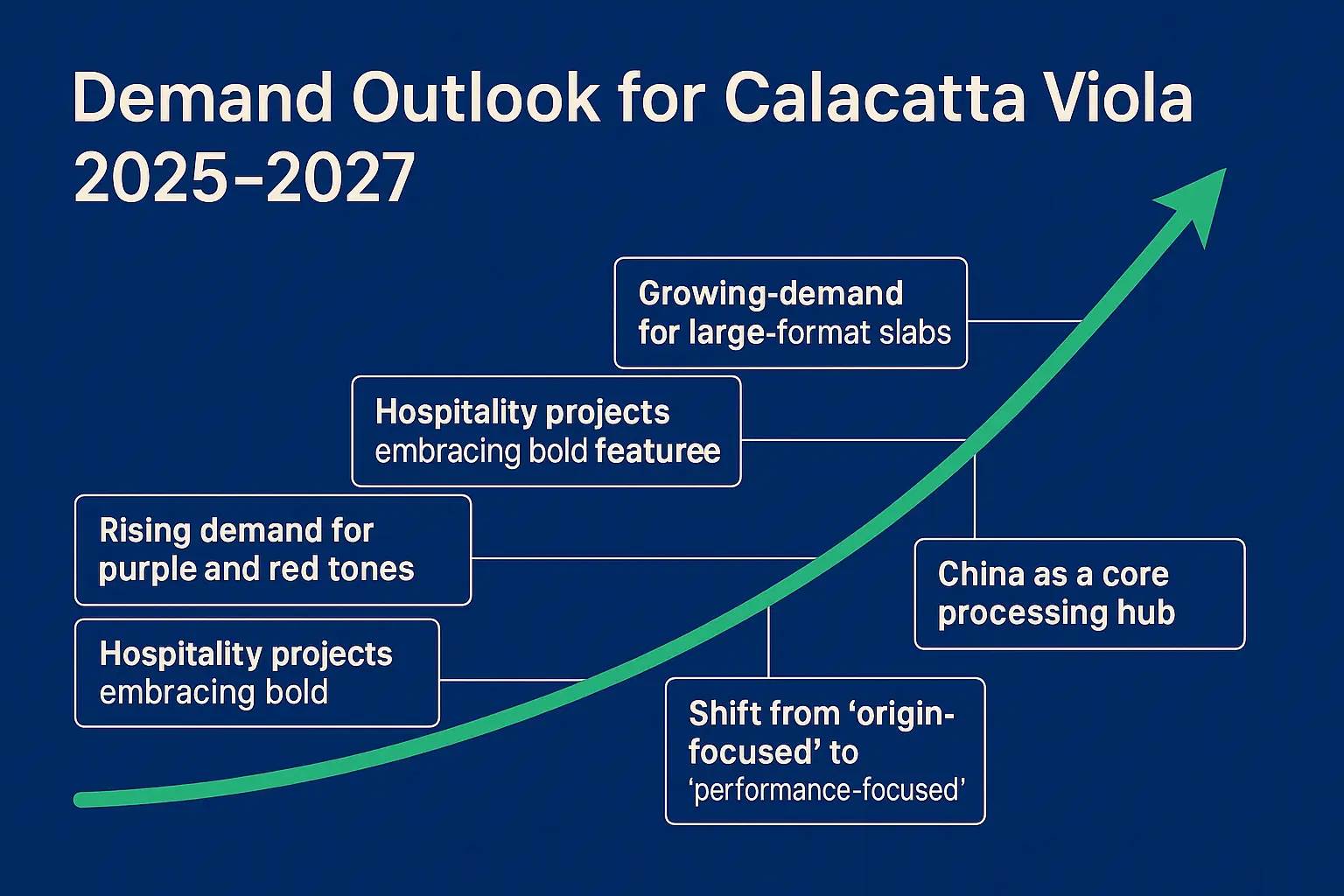
Why interest in Calacatta Viola is accelerating:
-
Rising demand for purple and red tones
Architects are moving away from pure beige/grey minimalism toward more expressive, warmer palettes. -
Hospitality projects embracing bold feature walls
Hotels, spas, and boutique retail increasingly use dramatic book-matched marble for lobbies and backdrops. -
Growing demand for large-format slabs
Designers prefer using fewer but larger slabs to cover entire walls or islands. -
Shift from “origin-focused” to “performance-focused”
Buyers now care more about consistency, reinforcement, and long-term behavior than romantic stories about the quarry. -
China as a core processing hub
The origin may be Italian or elsewhere, but processing precision, finishing quality, and export readiness are frequently handled in Chinese factories.
9. Where Calacatta Viola Works Best (Application Scenarios)
In real projects, Calacatta Viola is especially effective in:
-
kitchen islands and waterfall countertops
-
restaurant and bar counters
-
hotel lobby reception walls and backdrops
-
bathroom feature walls and vanity tops
-
luxury retail display tables and podiums
-
boutique residential flooring accents and stair details
When the right batch and finish are chosen, this stone can become the visual anchor of an entire interior.
10. Global Brands vs Chinese Suppliers — My Real Observations
Here is a neutral, experience-based comparison:
| Key Area | International Brands | Chinese Suppliers |
|---|---|---|
| Visual Presentation | Highly standardized | Varies (some are excellent) |
| Slab Size | Always large-format slabs | Medium–large, must confirm per batch |
| Thickness | Standard 2 cm | 18 / 20 / 30 mm available |
| Variation Control | Strict quarry selection | Must verify batch photos |
| Packaging | Premium crates as standard | Must request reinforced crates |
| Project Adaptability | Less custom, more catalog-based | Very high customization |
| Speed | Slower but predictable | Fast and flexible |
| Pricing Structure | Includes logistics & showrooms | Mainly FOB-based manufacturing |
| Custom Fabrication | Limited | Strong |
| Communication Style | Formal | Fast and practical |
11. What I Learned Personally
These were the insights that truly changed my sourcing approach:
-
name similarity does not mean stone similarity
-
batch photos are more important than any catalog brochure
-
resin and finishing quality decide long-term stability
-
packaging is not an extra cost — it is insurance
-
the “best” supplier depends on the project type and batch, not on brand fame
-
fast, transparent communication eliminates many hidden risks
Reinforced wooden crates significantly reduce slab damage during long-distance shipping. Many issues buyers describe as “quality problems” are actually packaging problems. Asking for detailed packaging photos before loading can prevent most avoidable losses.
12. FAQ – The Questions I Now Ask (and Answer) Every Time
Q1. Is color variation normal in Calacatta Viola?
Yes. Variation is an inherent part of this marble. You should always review lot-specific batch photos and, if possible, videos of the slabs under natural and artificial light.
Q2. Do I really need book-matched slabs?
For projects with large, visible surfaces (lobby walls, kitchen islands, feature panels), book-matching dramatically improves the final effect. For small pieces or furniture, it’s optional but still valuable when strong veins are present.
Q3. Should slabs be reinforced with back mesh?
Back mesh is strongly recommended for:
-
long-distance export shipments
-
large-format slabs
-
installations with complex cutting or openings
It improves handling safety and reduces breakage risk.
Q4. How many slabs should I order for a consistent look?
For medium-sized projects, 3–6 slabs from the same batch are usually needed to ensure visual continuity. For very large projects, you should plan by square meters and confirm how many slabs can be taken from one block or set of blocks.
Q5. Is Calacatta Viola suitable for commercial spaces?
Yes—especially for walls, counters, and reception areas. For very high-traffic floors or heavy-use bar tops, you should pay extra attention to:
-
density and porosity
-
resin and sealant system
-
cleaning and maintenance guidelines
Q6. Are Calacatta marbles from different countries structurally different?
Geological origin affects color tone and vein style, but structural performance depends more on:
-
block density
-
micro-crack content
-
reinforcement method
-
fabrication and finishing quality
Well-processed material from different regions can perform similarly if these factors are controlled.
Q7. Does resin reinforcement affect quality?
Yes. High-quality resin systems and proper curing:
-
stabilize micro-cracks
-
reduce chipping
-
improve long-term performance
Poor resin work, on the other hand, can lead to yellowing, surface weakness, and premature failure.
Q8. What thickness should I choose—2 cm or 3 cm?
Both 2 cm and 3 cm are widely used worldwide. The right choice depends on:
-
application (wall vs. countertop vs. flooring)
-
edge profiles
-
structural support under the stone
-
design preferences
2 cm is common for walls and many countertops; 3 cm can provide extra mass and perceived solidity in some designs.
13. My Final Decision — and Why I Won’t Name a Single “Winner”
People often ask me:
“So which supplier did you finally choose?”
Here is my honest answer:
There is no universal best supplier—only the best supplier for a specific project, at a specific time, with a specific batch.
A slab that is perfect for a hotel lobby may not be ideal for a furniture studio.
A supplier who has excellent stock and communication today may have different availability next season.
So instead of naming a single winner, my real conclusion is this:
Choose the right factory for the right batch—not just the right name.
That is how you buy Calacatta Viola wisely.
When you use global brands as visual benchmarks, and evaluate Chinese factories through the same professional lens, your decisions become clearer, your expectations more realistic, and your project outcomes far more predictable.