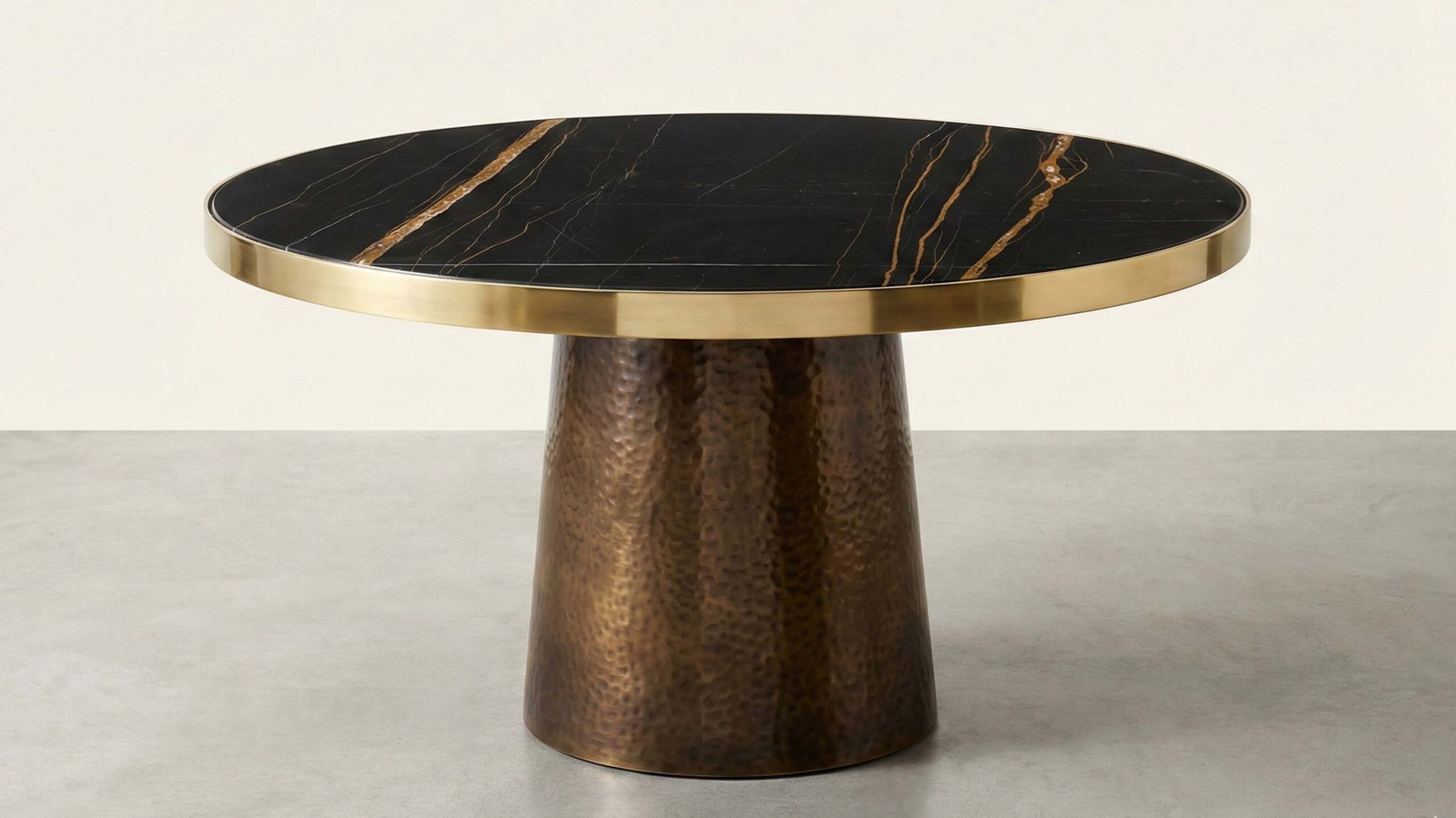
Sahara Noir is a dramatic black marble that performs best as a round marble coffee table when you plan around circulation, lighting, and daily habits. In EU and US living rooms, a round silhouette softens dark stone’s visual weight, improves walkways, and keeps seating layouts feeling open. For the most “designer-correct” result, size the table to your sofa zone (reach + clearance first), balance the black surface with warm woods, textured textiles, and controlled reflections, and rely on trays/coasters to reduce etching risk. If you specify custom fabrication, confirm slab veining direction, edge profile, base stability, and scratch-safe packaging. For future-proof interiors, choose low-odour, compliant finishing products where relevant and work with makers who demonstrate responsible dust-control and process documentation.
Why Sahara Noir Works So Well as a Round Marble Coffee Table
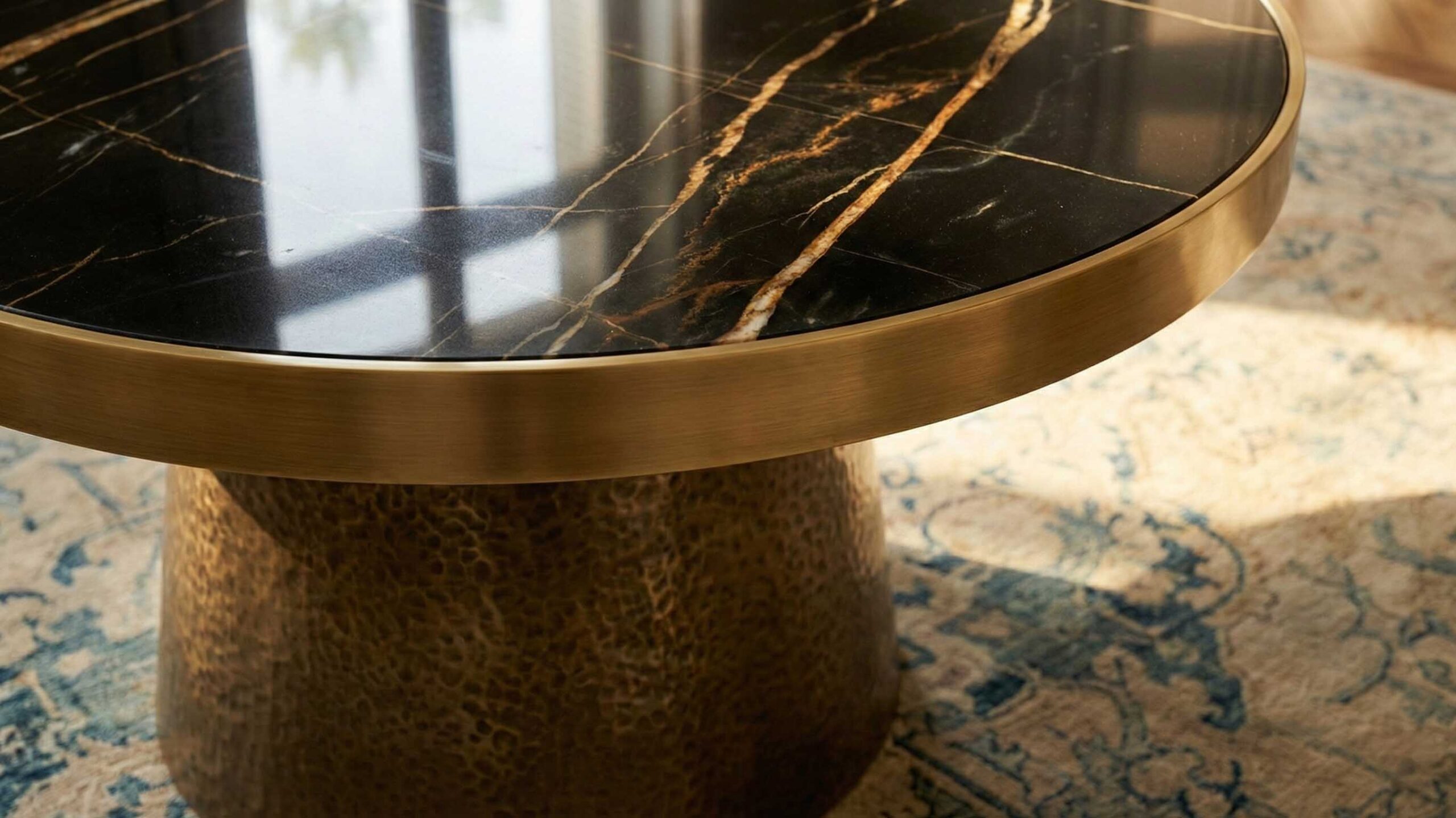
Sahara Noir is one of those stones that behaves like a piece of abstract art: a deep black base interrupted by sharp, high-contrast veining that can read as white, gold, or warm bronze depending on lighting and finish. Designers in Europe and the U.S. keep returning to it for the same reason they return to a black tuxedo: it doesn’t need to “try” to look intentional. It already is.
A round marble coffee table in Sahara Noir has two big advantages over rectangular silhouettes. First, the circle softens the visual weight of dark stone. Second, it solves real-life circulation issues: European apartments often have tighter paths between sofa and dining, and many American open-plan living rooms still rely on clear walking lines between kitchen, living, and patio doors. Round edges reduce “hip-bump” moments and keep a layout feeling calm, even when the stone is visually dramatic.
Sahara Noir is also a strong candidate when you want a black marble coffee table that reads premium without leaning into trendy shapes. The stone is the statement; the geometry stays timeless. That balance is exactly what makes it popular in modern marble coffee table styling today.
If you’re exploring darker marble tones beyond this specific piece, our guide to black marble coffee tables in interior design explains how these dramatic surfaces are styled across modern European and American homes.
The Design Brief Europeans and Americans Actually Use (Even If They Don’t Say It Out Loud)
Before picking any marble coffee table round profile, most people are solving three silent problems:
Comfort and movement
A coffee table should support how people sit, reach, and move. Round shapes help small rooms feel less blocked, especially when seating is compact or when you have a sectional with a narrow clearance path.
Light and contrast
Black stone absorbs light. In northern Europe, the seasonal light is often soft and limited, so you need reflective counterbalances (sheer curtains, warm lamps, pale rugs). In many U.S. homes, big windows mean the table can look different morning vs. evening; a polished finish can amplify daylight highlights while evening lighting needs warmer bulbs and controlled glare.
Maintenance expectations
Marble is not fragile, but it is honest. It records acids, dyes, and time. That means the “best” styling approach is the one that matches your lifestyle: coasters, trays, and a realistic sealer plan.
If you plan around those three, a Sahara Noir round marble coffee table becomes easy to place, not intimidating.
Sizing a Round Coffee Table Marble Piece Like a Designer
The 2/3 rule for sofa relationships
A classic guideline is to size the coffee table at roughly two-thirds the length of the sofa (or the main seating run). This keeps the table visually connected without looking undersized.
H3: Diameter choices that work in real rooms
In many European living rooms, a diameter that keeps pathways open is often more important than making the table huge. In many American layouts, you can go larger, but you still want reach to feel effortless.
Use these practical checks:
-
You should be able to reach the center of the table without leaning forward uncomfortably.
-
Leave enough space so people can pass while someone’s legs are stretched out.
-
If you have a chaise sectional, consider placing the round marble top coffee table slightly toward the “conversation” zone rather than dead center in the overall seating footprint.
H3: Height and visual weight
A black marble coffee table looks heaviest when it’s tall. A slightly lower profile often reads more modern and helps the stone feel “grounded,” not bulky. If your sofa is low-slung (a trend that continues into 2026 living rooms), keep the table height aligned with the seat height or slightly lower for a cohesive line.

Styling Sahara Noir Without Making the Room Feel Dark
Sahara Noir’s veining often carries warmth (gold/bronze tones) even when the base reads near-black. The trick is to echo that warmth elsewhere so the table looks integrated, not like a dramatic object dropped into the room.
H3: Build a three-material palette
A reliable formula for a modern marble coffee table is:
-
One soft material (wool rug, boucle, linen)
-
One warm material (oak, walnut, smoked wood)
-
One reflective accent (brass, aged nickel, glass, lacquer)
This is where the round marble table becomes the “anchor” while everything else keeps the space breathable.
H3: The tray strategy (designers do this for a reason)
Instead of placing items directly on the stone, use a tray as an intentional buffer. It’s not only aesthetic; it reduces contact with potential staining liquids. A tray also gives you permission to change seasonal styling without rethinking the whole table.
H3: Keep contrast intentional, not random
If the room already has black elements (window frames, fireplace surround, picture frames), Sahara Noir becomes part of a controlled contrast plan. If the room has no black at all, add a few small black details so the table doesn’t look like a “one-off.”
Houzz’s design editors have repeatedly noted that a dark stone coffee table can set a sophisticated mood and sharpen surrounding colors by contrast, which is exactly the role Sahara Noir plays when styled well.
Room-by-Room Applications for a Black Marble Coffee Table
Living rooms with open-plan layouts
In open-plan spaces, a stone coffee table helps define the living zone. A round silhouette keeps the space flowing between zones.
H3: Pairing with sectionals
A round marble coffee table round profile works especially well with L-shaped sectionals because it softens the inside corner of the seating arrangement. If your sectional is large, choose a larger diameter or use a nesting side table as support.
Compact European apartments and city flats
A round coffee table marble piece is often more forgiving in compact rooms because corners are what steal circulation. Use a lighter rug and warm ambient lighting to keep Sahara Noir from making the center feel heavy.
Formal sitting rooms and “grown-up” lounges
A polished black marble coffee table reads particularly strong in formal rooms. It reinforces a boutique-hotel vibe without relying on ornate shapes. If you want the room to feel quieter, keep accessories minimal and lean into texture rather than color.
Lighting: The Make-or-Break Factor for Sahara Noir
Lighting determines whether Sahara Noir reads as elegant or simply dark.
H3: Daylight
Near a large window, the veining can become the star. Rotate the table (or align the slab orientation) so the most dynamic veining faces the main entry view. That small decision often changes the perceived “luxury level” of the entire room.
H3: Evening lighting
At night, use layered lighting: a floor lamp, a table lamp, and soft overhead. This prevents the black surface from turning into a visual void. Warm color temperatures tend to flatter the gold-like veins described in many Sahara Noir references.
H3: Glare control
A polished surface can reflect bulbs directly. If you notice glare, adjust lamp positions or choose shades that diffuse light. In highly reflective rooms, a honed finish can reduce harsh reflections while keeping the stone’s character.
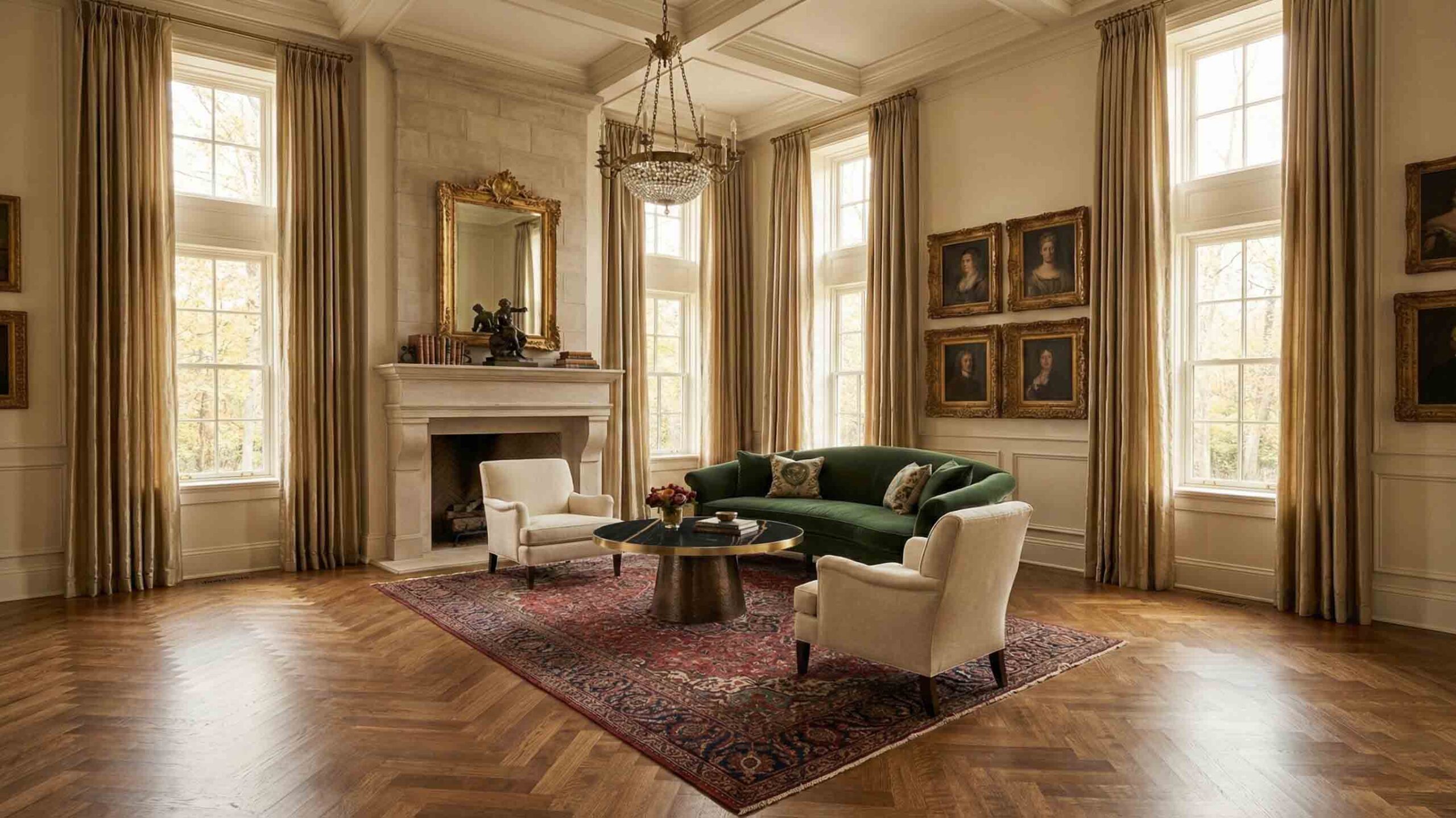
For more layout-driven inspiration, see how to style dark stone in modern European and American homes, especially when pairing bold marble with light upholstery and architectural detailing.
Marble Reality Check: Etching, Staining, and What Matters Most
Sahara Noir is still marble, which means acids can etch and certain pigments can stain. The goal isn’t perfection; it’s predictability.
H3: The difference between etching and staining
Etching is a surface reaction that changes sheen; staining is pigment absorption. Dark marbles can hide some marks but can also show changes in gloss depending on lighting angle.
H3: Daily habits that protect a marble top coffee table
-
Use coasters for citrus drinks, wine, and coffee.
-
Use a tray for candles and oils.
-
Wipe quickly, especially for acidic spills.
H3: Sealing and indoor air quality
Here’s where “design” meets “regulation” in a way that matters in both the EU and U.S. Many homeowners seal stone, use adhesives for felt pads, or apply touch-up coatings on nearby surfaces. These products can fall under VOC rules depending on category and region.
In Europe, the Decopaint Directive limits VOC content in certain paints and varnishes, pushing the market toward lower-VOC formulations.
In parts of the U.S., especially California air districts, coatings and related products can be subject to strict VOC limits (architectural coatings rules are widely referenced by green building programs).
Practical takeaway: when you choose a stone sealer or any finishing product used in the home, look for compliant, low-VOC options if you want the project to align with modern indoor-air expectations and green-building checklists.
The “New Rules” Shaping Furniture and Material Choices in Europe
Even though a coffee table isn’t a regulated “construction product” in the same way as insulation or windows, European policy direction is very clear: products sold in the EU are being pushed toward better durability, reparability, and transparency.
The European Commission’s Ecodesign for Sustainable Products Regulation (ESPR) is designed to improve sustainability of products placed on the EU market by improving circularity, durability, and recyclability, and it supports tools like product information requirements.
What that means for a stone coffee table in practice:
-
Designers increasingly ask for traceability and documentation, not just beauty.
-
Durability becomes a value signal: stone performs well when maintained, and the table can last decades rather than seasons.
-
Replaceable components matter more (for example, bases, pads, and fixings).
If you are working with a black marble coffee table manufacturer or a round marble coffee table factory for custom projects, these expectations are already influencing what specifiers request: better packaging choices, clearer material declarations, and longer-lasting finishes.
Worker Safety and Responsible Fabrication: Why It Belongs in a Design Article
This section isn’t here to lecture; it’s here because the best design decisions are also the most future-proof ones.
Stone fabrication can involve cutting, grinding, and polishing. In the U.S., OSHA’s respirable crystalline silica standard for construction sets a permissible exposure limit of 50 μg/m³ as an 8-hour time-weighted average and requires controls to protect workers.
For buyers, architects, and even homeowners, the implication is simple:
-
Responsible makers invest in dust control, wet cutting, ventilation, and PPE.
-
That tends to correlate with better finish consistency and fewer defects.
-
It’s a quiet marker of professionalism when selecting manufacturing partners for custom stone furniture.

Making Sahara Noir Feel “European Quiet Luxury” vs “American Statement Luxury”
Design language differs across markets, even when the stone is the same.
H3: European approach: restraint and texture
In many European interiors, Sahara Noir looks best when the rest of the palette stays calm: textured neutrals, warm woods, and a few black lines to connect the table to the architecture. Keep accessories minimal and let veining do the talking.
H3: American approach: contrast and scale
In many U.S. living rooms, Sahara Noir shines when paired with a larger rug, bold art, and deeper seating. The table becomes a graphic focal point. “Loud luxury” and bolder pattern play have been discussed as a recent trend direction in interiors, which helps explain why dramatic stones keep getting attention.
If You’re Specifying Custom: What to Ask a Round Marble Coffee Table Factory
This is not about selling. It’s about avoiding the mistakes that make a gorgeous marble coffee tables project look cheap in six months.
H3: Slab selection and veining direction
Ask for photos of the exact slab and confirm how veining will face the primary viewing direction. Sahara Noir varies; two “Sahara Noir” pieces can feel totally different.
H3: Edge detail
Simple edges feel modern; more pronounced profiles can feel classic. With a busy stone pattern, simpler edges often win.
H3: Base and stability
A black marble coffee table is visually heavy. A stable base prevents wobble and protects floors. If the base is metal, ask about finish durability and protective pads.
H3: Packaging and transit logic
Dark polished marble can show micro-scratches if packaging is careless. A serious maker uses surface protection that doesn’t trap grit and includes clear handling instructions.
Conclusion: Sahara Noir as a Practical Design Tool, Not Just a Pretty Stone
A Sahara Noir round marble coffee table is at its best when you treat it like a design tool: it anchors a room, adds graphic contrast, and elevates everyday living without relying on trendy forms. Round geometry makes it friendlier in real layouts, from compact European flats to large American open plans.
If you plan for light, circulation, and maintenance, Sahara Noir becomes surprisingly livable. And if you care about future-proof choices, today’s direction in sustainability policy, VOC expectations, and fabrication safety standards rewards materials that last and makers who document how they work. That combination—timeless design plus responsible execution—is exactly why black marble coffee tables keep showing up in the homes people save, share, and copy.
[PILLAR LINK ANCHOR: black marble coffee tables in interior design]
FAQ
1) Is a round marble coffee table practical for everyday family use?
Yes, especially because the round edge improves circulation and reduces sharp-corner bumps. Use a tray and coasters to reduce etching and staining risk, and keep the finish consistent with your lifestyle.
2) Does black marble stain more easily than lighter marble?
Black marble doesn’t necessarily stain more, but it can show changes in sheen under angled light. Some marks may be less visible, while others (like dull etched areas) can stand out depending on lighting.
3) What is the best rug color under a black marble coffee table?
Light and mid-tone rugs usually work best because they prevent the table from visually “disappearing” into a dark floor. Warm neutrals, textured creams, or muted greys help Sahara Noir look intentional and balanced.
4) Do I need to seal a Sahara Noir marble coffee table top?
Many homeowners choose to seal marble to reduce absorption risk. If you do, select low-odor, low-VOC products when possible to align with modern indoor air expectations and regional VOC limits.
5) How big should a round coffee table be for a standard sofa?
A common guideline is around two-thirds of the sofa length in visual scale, with enough clearance for comfortable walking paths. The best size is the one that lets seated people reach without leaning too far forward.
References
-
European Commission, Ecodesign for Sustainable Products Regulation (ESPR), European Commission website.
-
European Parliament and Council, Directive 2004/42/EC on VOC limits in certain paints and varnishes, EUR-Lex.
-
South Coast Air Quality Management District, Rule 1113 Architectural Coatings, SCAQMD documentation.
-
U.S. Occupational Safety and Health Administration, 29 CFR 1926.1153 Respirable Crystalline Silica, OSHA.
-
International WELL Building Institute, WELL Tip on VOC requirements in WELL v2, IWBI resources.
-
U.S. Green Building Council, Low-emitting materials guidance referencing SCAQMD rules, USGBC credit library.
-
Houzz Editorial, “10 Reasons to Work With (and Love) Black Marble,” Houzz.
-
Livingetc Editorial, “Living Room Trends for 2026,” Livingetc.
What this piece is really about: Sahara Noir is not “just a black stone.” In interior design terms, it’s a high-contrast visual anchor that can either elevate a room into quiet luxury or overwhelm it—depending on how you manage light, negative space, and supporting materials.
How a round marble coffee table changes a room: Round geometry solves two common EU/US layout problems at once: it improves circulation (no corners blocking paths) and it reduces the “hard stop” effect that dark surfaces can create in the centre of a living zone. When a black marble coffee table feels surprisingly livable, it’s usually because the circle kept the plan fluid.
Why Sahara Noir works specifically: The stone’s signature is its energetic veining over a deep black base. That veining becomes your built-in design “motion,” so the most successful rooms keep the silhouette calm and the palette disciplined. Let the slab be the artwork; keep forms and accessories quiet.
Option thinking (not a shopping list): If the room is bright (large windows, pale walls), a polished Sahara Noir top reads crisp and architectural. If the room is low-light or heavily textured already, a honed finish can feel calmer and more forgiving to glare—without removing the stone’s identity.
Considerations that decide success (the non-obvious ones): The table’s perceived quality is often determined by veining orientation, edge detail restraint, and base stability—not by how “rare” the stone sounds. Confirm the “hero face” view from the entry, keep edge profiles simple when veining is active, and ensure the base doesn’t wobble (dark stone magnifies visual imbalance).
Maintenance reality (in one sentence): Marble doesn’t punish you for using it—it only reacts to acids and pigments—so the winning strategy is predictable habits: coasters, a tray, quick wipes, and a sealing plan that matches your household.
Trend + regulation direction (future-proof framing): EU and US design is moving toward durability, transparency, and healthier indoor environments. That shifts attention toward compliant, low-odour finishing products where applicable, clearer material/process documentation, and responsible fabrication practices—because sustainability is increasingly judged by lifespan and traceability, not just aesthetics.