Why STONEMART Jaipur 2026 Matters More Than Ever
As global construction, architecture, and interior design markets reassess supply chains, sustainability benchmarks, and sourcing resilience, STONEMART Jaipur 2026 arrives at a critical moment. Scheduled from February 5–8, 2026, in Jaipur, Rajasthan, the event is positioned not merely as a regional exhibition, but as a strategic platform where India presents its evolving role in the global natural stone ecosystem.
With participation from domestic and overseas producers, exporters, technology providers, architects, and large-scale buyers, STONEMART Jaipur 2026 reflects a broader shift: India is no longer just a volume supplier—it is actively redefining itself as a value-driven, sustainability-conscious, and processing-capable stone manufacturing hub.
India’s Natural Stone Industry at a Turning Point
India possesses one of the world’s most diverse natural stone reserves, spanning granite, marble, sandstone, limestone, and slate. Rajasthan alone accounts for a significant share of dimensional stone extraction, supported by clusters of quarries and processing facilities.
However, the industry’s current transformation is not driven by reserves alone. Three forces are reshaping India’s stone sector:
-
Tighter global sustainability expectations
-
Rising demand for processed and semi-finished stone products
-
Increased scrutiny on traceability, labor standards, and environmental compliance
STONEMART Jaipur 2026 becomes the convergence point where these shifts are translated into tangible business conversations.

What Makes STONEMART Jaipur 2026 Different from Conventional Stone Fairs
Unlike many trade fairs that focus primarily on product display, STONEMART Jaipur 2026 emphasizes industry alignment—connecting extraction, processing, technology, and market access within a single framework.
A Full-Spectrum Industry Gathering
The exhibition brings together:
-
Quarry owners and natural stone manufacturers
-
Stone processing machinery suppliers
-
Exporters, importers, and wholesale buyers
-
Architects, developers, and project specifiers
-
Government bodies and institutional stakeholders
This multi-layered participation enables discussions that go beyond pricing and aesthetics, extending into long-term supply agreements, processing partnerships, and sustainable sourcing models.
Sustainability as a Core Industry Narrative
The theme “Stone for Sustainability” is not a marketing slogan. It reflects concrete changes underway across India’s stone industry.
Regulatory Alignment and Environmental Standards
Indian stone producers are increasingly aligning with:
-
Environmental clearance norms at state and central levels
-
Water recycling and dust suppression requirements
-
Energy efficiency benchmarks in processing units
These shifts mirror global expectations seen in European and Middle Eastern markets, where sustainability compliance is becoming a prerequisite rather than a differentiator.
STONEMART Jaipur 2026 provides a structured environment for showcasing how Indian manufacturers are adapting operations to meet these requirements—without sacrificing scalability.
Processing Capability: From Raw Blocks to Market-Ready Solutions
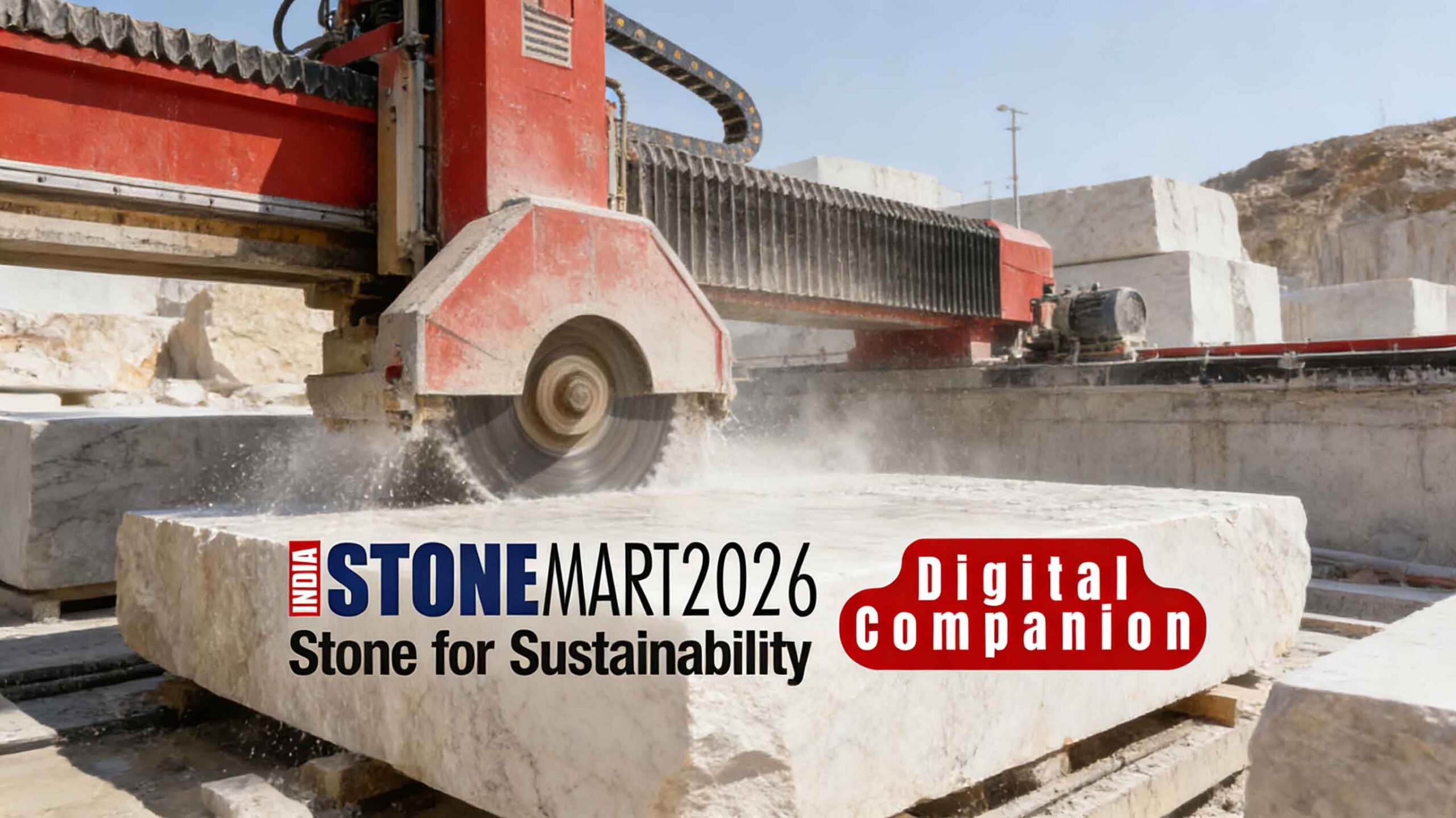
One of the most significant trends highlighted at STONEMART Jaipur 2026 is the industry’s move up the value chain.
Instead of exporting primarily raw blocks, Indian suppliers are increasingly offering:
-
Calibrated slabs
-
Cut-to-size stone
-
Surface-finished architectural elements
-
Project-specific stone solutions
This evolution directly responds to international buyers seeking reduced lead times, consistent quality, and fewer processing steps post-import.
For buyers already building a broader stone sourcing playbook, this move toward higher-value processing mirrors what we’ve seen in STONE INDUSTRY INSIGHT: Eastern Europe’s strategic gateway for stone manufacturers and machinery—where regional hubs compete on reliability, technology, and supply-chain execution, not just quarry access.
Jaipur as a Strategic Location, Not Just a Host City
Jaipur’s role extends beyond geography. Rajasthan’s established quarrying base, combined with improving logistics connectivity, positions the region as a strategic interface between extraction zones and export channels.
Key advantages include:
-
Proximity to major stone quarry clusters
-
Growing processing infrastructure
-
Established export routes through western Indian ports
STONEMART Jaipur 2026 leverages this ecosystem, enabling buyers to engage directly with manufacturers operating within realistic production and logistics frameworks.
Global Buyers: Why STONEMART Jaipur 2026 Deserves Attention
For international buyers, especially those managing large-scale architectural or infrastructure projects, the exhibition offers more than supplier discovery.
Strategic Benefits for Overseas Buyers
-
Direct access to stone manufacturers and factories
-
Insight into India’s regulatory and sustainability trajectory
-
Opportunity to assess processing capabilities on-site
-
Reduced reliance on intermediaries
In contrast to purely design-focused fairs, STONEMART Jaipur 2026 emphasizes supply reliability, production transparency, and long-term collaboration potential.
This positioning complements global exhibition circuits such as GLOBAL TRADE CONTEXT: /xiamen-stone-fair-2026-the-global-sourcing-gateway-for-stone-manufacturers-machinery-and-industry-innovation/, reinforcing India’s role within a diversified sourcing strategy rather than as a standalone alternative.

Technology and Machinery: Quiet but Critical Progress
While not always the headline attraction, machinery and processing technology form a critical backbone of the exhibition.
Advancements showcased include:
-
Automated cutting and polishing systems
-
Waste reduction and slurry management solutions
-
Energy-efficient processing lines
-
Precision tooling for architectural applications
These technologies directly support India’s ambition to deliver higher consistency and lower environmental impact across stone production.
Market Expansion and Business Networking Dynamics
STONEMART Jaipur 2026 is structured to facilitate deal-making rather than passive browsing. The event environment supports:
-
Pre-scheduled buyer-seller meetings
-
Cross-border sourcing discussions
-
OEM and private-label manufacturing inquiries
-
Long-term supply negotiations
With record growth in business visitors projected, the exhibition acts as a springboard for exporters seeking market expansion across Asia, the Middle East, Europe, and emerging African markets.
India’s Position in the Global Stone Supply Chain
India’s strength lies in its ability to balance:
-
Large-scale production capacity
-
Diverse material availability
-
Increasing processing sophistication
-
Competitive cost structures
STONEMART Jaipur 2026 signals that India is actively aligning these strengths with global expectations, positioning itself not just as a supplier, but as a strategic manufacturing partner.
What to Watch After STONEMART Jaipur 2026
The real impact of the exhibition will unfold in the months following the event, as:
-
Supply agreements transition from trial to long-term contracts
-
Sustainability practices become standardized across exporters
-
Processing-led exports gain greater market share
For industry observers, STONEMART Jaipur 2026 offers an early indicator of how Asia’s stone manufacturing landscape is likely to evolve over the next five years.
Conclusion: More Than an Exhibition, a Strategic Signal
STONEMART Jaipur 2026 represents a recalibration moment for the global natural stone industry. It reflects India’s shift from volume-driven exports toward value-oriented, sustainability-aligned manufacturing.
For buyers, manufacturers, and industry professionals, the event is less about discovering stone—and more about understanding where the future of stone sourcing is heading.
FAQ
1. What is STONEMART Jaipur 2026?
STONEMART Jaipur 2026 is an international stone industry exhibition held in Jaipur, India, focusing on natural stone products, processing technology, sustainability, and global trade collaboration.
2. Who should attend STONEMART Jaipur 2026?
The event is designed for stone manufacturers, exporters, importers, architects, developers, machinery suppliers, and international buyers seeking long-term sourcing partnerships.
3. Why is sustainability emphasized at STONEMART Jaipur 2026?
Global regulations and buyer expectations increasingly require stone suppliers to demonstrate environmental responsibility, resource efficiency, and traceable production practices.
4. Does STONEMART Jaipur 2026 focus only on raw stone?
No. The exhibition highlights processed stone, value-added products, and manufacturing capabilities alongside raw material sourcing.
5. How does STONEMART Jaipur 2026 compare to other global stone fairs?
STONEMART Jaipur 2026 emphasizes manufacturing depth, sustainability alignment, and long-term supply collaboration rather than purely aesthetic or design-driven showcases.
References
-
Centre for Development of Stones (CDOS) – Industry Publications
-
Federation of Indian Chambers of Commerce & Industry (FICCI) – Trade Reports
-
Government of Rajasthan – Industrial Development Briefings
-
International Trade Centre – Natural Stone Market Outlook
-
World Stone Association – Sustainability and Supply Chain Reports
-
European Construction Industry Federation – Material Sourcing Trends
-
Global Architecture & Design Market Review – Stone Applications
-
Asian Manufacturing Outlook – Building Materials Sector
What is India Stonemart 2026 really “about” for buyers? Beyond a traditional stone show, it’s a capability checkpoint: buyers can evaluate whether a region can consistently deliver cut-to-size, calibrated thickness, finish accuracy, packing standards, and documentation discipline at export scale—without relying on brochure claims.
Why does sustainability remain the headline topic? Because procurement is being pulled by measurable environmental and chemical expectations: lower dust exposure, safer water management, reduced waste, and clearer disclosure of treatment chemicals. For many projects, “green” is no longer marketing—it’s a tender requirement and a risk-control tool.
How should buyers use the show to reduce sourcing risk? Treat the visit like an audit sprint: verify block selection logic, confirm saw/bridge/line capacity, check finishing consistency across batches, inspect packing and edge protection, and request proof of routine QC (calibration checks, surface defect criteria, shade sorting rules).
Option mapping: what to compare (not just “stone vs stone”)? Compare suppliers by “deliverable outcomes”: lead-time stability, thickness tolerance, finish repeatability, breakage rate control, moisture-safe packing, and the ability to ship mixed SKUs efficiently. The best partner is rarely the one with the most varieties—it’s the one with the most predictable execution.
Considerations that buyers often miss (and later regret): 1) Resin or surface treatment transparency, 2) batch-to-batch shade control, 3) anti-slip performance for public areas, 4) traceability paperwork, and 5) after-sales replacement logic. These “small” details decide whether a project stays on schedule.
Trend signal for 2026: Expect more suppliers to position themselves as “solution manufacturers” rather than raw material sellers—bundling processing, finishing, packaging, documentation, and export readiness into one offer. For buyers, the advantage is simpler: fewer surprises between sampling and container arrival.