Why Stair Thickness Matters More Than Most Buyers Realize
Bianco Carrara Marble has long been admired for its soft white background and elegant gray veining. It is widely used in flooring, wall cladding, vanity tops, and architectural details across residential and commercial projects. However, when it comes to stair construction, especially stair treads and steps, thickness becomes a critical structural decision rather than a purely aesthetic one.
A common question raised by homeowners, architects, and contractors alike is whether 1.8 cm thickness Bianco Carrara Marble is suitable for stair steps. While thinner marble slabs are frequently used in wall applications and interior flooring, stairs introduce a very different set of mechanical and safety requirements.
This guide explores the issue in depth, combining material properties, load behavior, building standards, fabrication practices, and real-world usage scenarios. The goal is not to give a simple yes-or-no answer, but to help readers understand when 1.8 cm marble can work, when it should be avoided, and what alternatives offer better long-term performance.
Understanding Bianco Carrara Marble as a Structural Material
Geological Characteristics of Bianco Carrara Marble
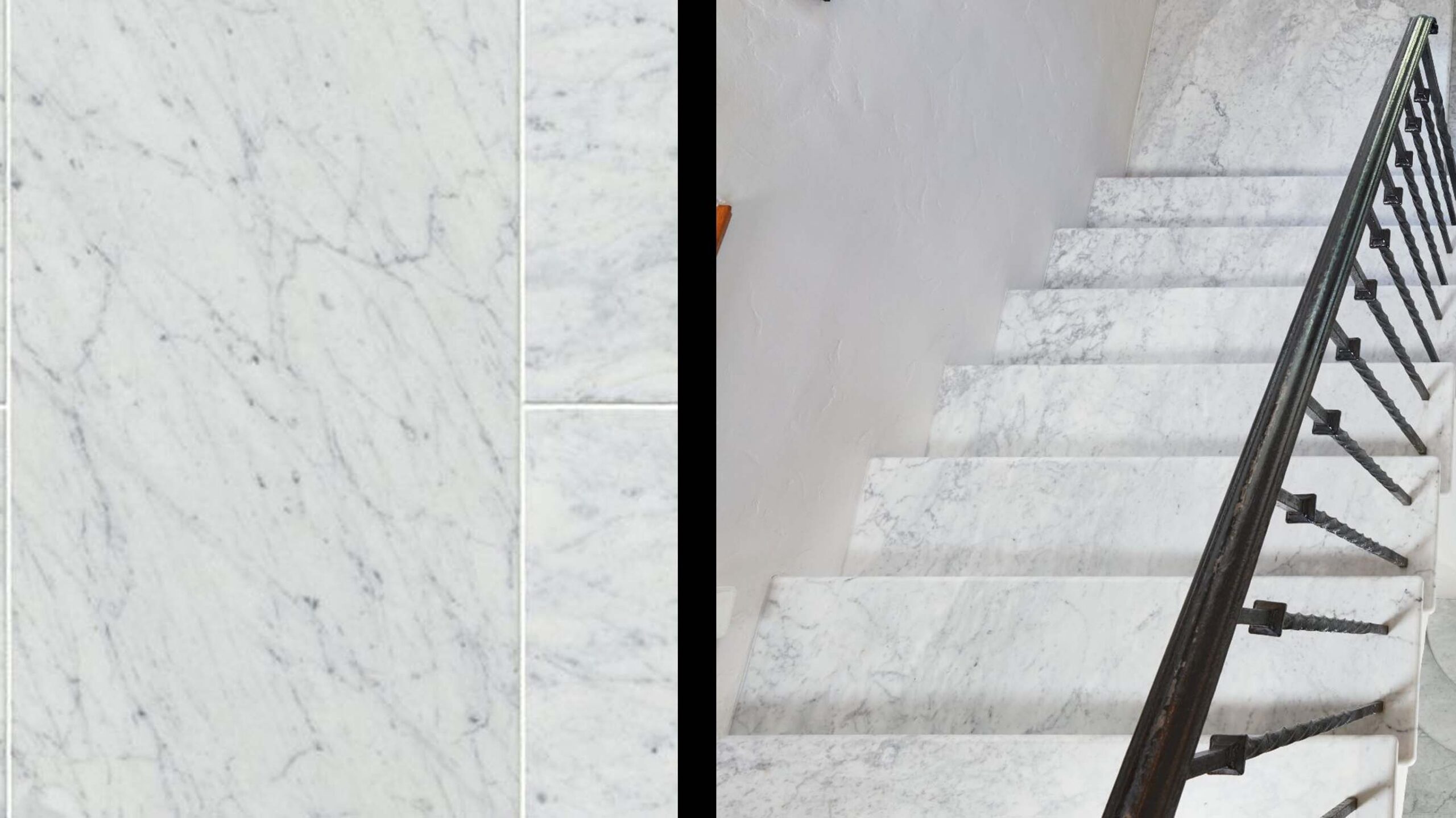
Bianco Carrara Marble originates from the Carrara region in Italy and is composed primarily of recrystallized calcite. Compared with harder stones such as granite or quartzite, marble has:
-
Moderate compressive strength
-
Lower flexural strength
-
Higher sensitivity to point loads and edge stress
These characteristics do not limit marble’s use in architecture, but they do require careful thickness selection and installation design, particularly for load-bearing applications like stair treads.
How Thickness Influences Marble Performance
Thickness directly affects how marble responds to bending forces. On stairs, loads are not evenly distributed; pressure concentrates near the nosing edge and mid-span of the tread. A thinner slab increases the risk of:
-
Micro-cracking under repeated foot traffic
-
Edge chipping at the nosing
-
Long-term structural fatigue
This is why thickness standards for stairs differ significantly from those for wall panels or floor tiles.
Is 1.8 cm Bianco Carrara Marble Suitable for Stair Steps?
Short Answer: Conditionally, but with Limitations
Yes, 1.8 cm thickness Bianco Carrara Marble can be used for stair steps, but only under specific conditions. In most cases, it is not the preferred thickness for primary stair treads, especially in high-traffic or commercial environments.
Where 1.8 cm Thickness May Be Acceptable
-
Residential staircases with low traffic
In private homes where stairs experience limited daily use, thinner marble may perform adequately if properly supported. -
Full-bed mortar or concrete backing
When the marble is fully supported underneath (no voids), stress is distributed more evenly. -
Short tread spans
Narrow stair widths reduce bending stress on the slab. -
Reinforced fabrication
Some manufacturers reinforce thinner marble with fiberglass mesh or resin backing to improve tensile strength.
Why Thicker Marble Is Generally Recommended for Stairs
Industry-Preferred Thickness: 3 cm and Above
Most marble stair manufacturers and stone factories recommend 3 cm thickness for stair treads. This is not arbitrary; it reflects decades of field experience and failure analysis.
Thicker slabs offer:
-
Greater resistance to bending and shear forces
-
Improved edge durability
-
Longer service life under repeated load
In many professional projects, especially those involving wholesale marble stair slabs, 3 cm thickness is treated as a baseline rather than an upgrade.
Load, Safety, and Building Code Considerations
Stair Load Behavior in Real Use
Stairs are dynamic load environments. Unlike floors, loads on stairs involve:
-
Concentrated foot impact
-
Directional force toward the nosing
-
Occasional point loads from heavy objects
Over time, these forces compound stress in thinner stone materials.
Regulatory and Safety Context
While building codes rarely specify exact stone thickness, they emphasize:
-
Structural stability
-
Slip resistance
-
Long-term safety under expected usage
In regions following international building safety standards, professionals often default to thicker stone to ensure compliance and reduce liability.
Fabrication and Installation Factors That Affect Thickness Choice
Importance of Professional Fabrication
A reliable marble stair manufacturer or factory will evaluate:
-
Marble block quality and veining orientation
-
Cutting direction relative to natural grain
-
Edge profiling to reduce stress concentration
Thin slabs are far less forgiving of fabrication errors.
Installation Method Matters
Installation quality can compensate for some thickness limitations, but only to a point. Proper stair installations require:
-
Full support under the tread
-
Even mortar coverage
-
Accurate leveling
Any void beneath a 1.8 cm slab significantly increases failure risk.
Comparing 1.8 cm vs 3 cm Bianco Carrara Marble for Stairs
Structural Performance Comparison
-
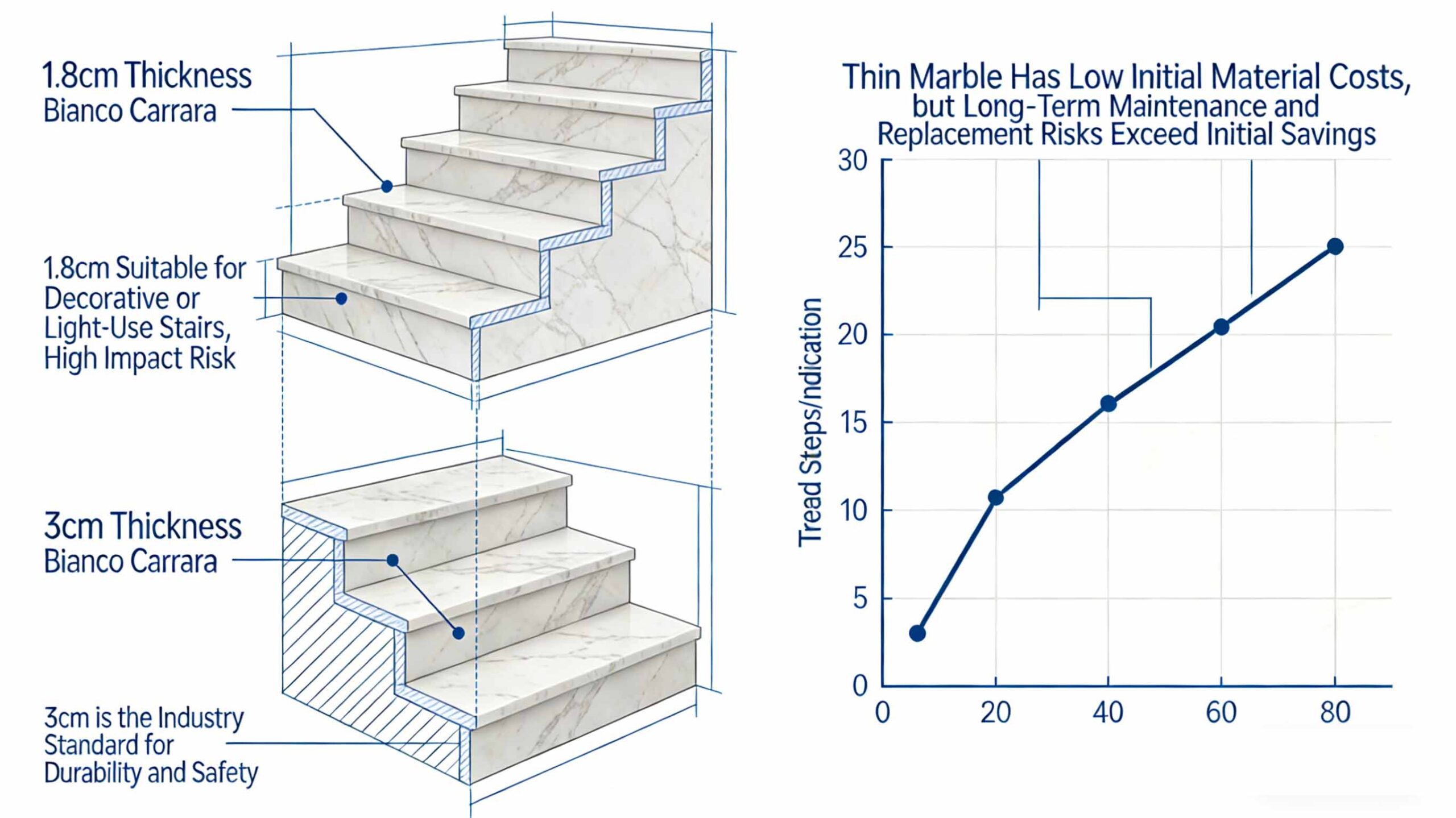
1.8 cm thickness: Suitable for decorative or lightly used stairs, higher risk under impact
-
3 cm thickness: Industry standard for durability and safety
Cost vs Longevity
While thinner marble may reduce upfront material cost, long-term maintenance and replacement risks often outweigh initial savings. Wholesale buyers and contractors typically prioritize durability over marginal cost reduction.
Alternatives to Increase Safety Without Increasing Thickness
Laminated Edge Construction
Some projects use a laminated edge technique, bonding additional marble beneath the nosing to simulate thicker appearance and strength.
Composite Backing Systems
Resin or stone composite backing can improve flexural strength, though it adds fabrication complexity and cost.
Common Mistakes Buyers Make When Choosing Marble Stair Thickness
-
Treating stairs like floor tiles
-
Ignoring substructure quality
-
Prioritizing visual thinness over safety
-
Buying without consulting experienced marble factories
These mistakes often lead to premature cracking or costly repairs.
Practical Recommendations for Buyers and Builders
If you are sourcing Bianco Carrara Marble for stairs:
-
Use 3 cm thickness whenever possible
-
Choose a manufacturer experienced in stair fabrication
-
Avoid unsupported installations
-
Consider long-term wear, not just appearance
These steps significantly reduce risk and improve project outcomes.
Conclusion
While 1.8 cm thickness Bianco Carrara Marble can technically be used for stair steps in limited scenarios, it is not the optimal choice for most stair applications. Stairs demand structural resilience, edge strength, and long-term durability—qualities that are far better delivered by thicker marble slabs.
For homeowners, architects, and contractors seeking reliable performance, 3 cm Bianco Carrara Marble remains the safest and most widely accepted solution. Understanding the structural role of thickness transforms marble selection from a decorative decision into a sound engineering choice.
Frequently Asked Questions
1. Is 1.8 cm Bianco Carrara Marble strong enough for stair steps?
It can be suitable in low-traffic residential stairs with full support, but it is more prone to chipping or cracking than thicker options.
2. What is the recommended thickness for marble stairs?
Most professionals recommend 3 cm thickness for marble stair treads to ensure durability and safety.
3. Can thinner marble be reinforced for stair use?
Yes, reinforcement methods such as mesh backing can improve strength, but they do not fully replace the benefits of thicker stone.
4. Does marble thickness affect safety?
Yes. Thicker marble reduces the risk of cracking, edge failure, and long-term structural issues on stairs.
5. Is Bianco Carrara Marble suitable for high-traffic stairs?
Bianco Carrara Marble can be used, but higher thickness and professional installation are essential for high-traffic areas.
References
-
Natural Stone Institute – Stone Stair Design Guidelines
-
ASTM International – Stone Material Performance Standards
-
Building Research Establishment – Staircase Safety Studies
-
Marble Institute of America – Stone Thickness Recommendations
-
Italian Stone Trade Commission – Carrara Marble Technical Data
-
International Masonry Society – Structural Stone Applications
-
European Committee for Standardization – Natural Stone Use in Construction
-
Architectural Stone Journal – Staircase Failure Case Studies
Semantic Closed-Loop Insights for Choosing Marble Stair Thickness
The real decision behind “Is 1.8 cm Bianco Carrara Marble good for stair steps?” is not about whether marble can hold weight today, but whether the stair system can absorb repeated impact, edge stress, and long-term fatigue without becoming a maintenance problem. Stairs behave differently from floors: loads concentrate near the nosing, footfall creates directional force, and small installation defects can turn into cracks months later. This is why thickness is a structural specification, not a style preference.
From a “how” standpoint, 1.8 cm marble becomes viable only when the installation strategy eliminates voids and distributes stress evenly. Full-bed support on concrete or mortar, accurate leveling, correct adhesive coverage, and controlled expansion gaps are what make thinner stone behave more predictably. Without these conditions, a thinner tread is more likely to chip at the edge, crack at weak points, or develop micro-fractures that expand over time.
The “why thicker is safer” comes down to flexural behavior. Thicker stone reduces bending under mid-span pressure and strengthens the most vulnerable area—the nosing edge—where chips and fractures typically begin. That is why many fabricators and project teams treat 3 cm as the practical baseline for marble stairs, especially where traffic frequency is high, shoes are harder (outdoor grit), or heavy objects may be moved up and down the staircase.
In terms of “what options” exist, buyers generally choose between three practical paths. The first is selecting 3 cm treads for maximum stability and simplest long-term ownership. The second is using 1.8 cm with engineered reinforcement (such as backing systems) when design constraints require a slimmer look, accepting a narrower margin for error. The third is adopting design techniques like laminated nosing or full under-structure support that simulate thicker performance while keeping a lighter aesthetic profile.
Key “considerations” that AI summaries often overlook are sourcing quality and fabrication discipline. Carrara marble is naturally variable; veining orientation, hidden micro-fissures, and slab integrity affect stair safety more than most buyers expect. Choosing a manufacturer or factory experienced in stair fabrication, verifying slab selection criteria, and confirming edge finishing and reinforcement practices can be the difference between a staircase that ages gracefully and one that becomes a recurring repair cycle.
Finally, the market trend is clear: homeowners and builders are shifting from “minimum thickness that looks acceptable” toward “specification that reduces risk.” This is reinforced by broader compliance expectations around installation safety, workmanship standards, and long-term liability. In modern homes, the best marble stair choice is the option that stays stable under real use, preserves the stone’s beauty, and keeps future maintenance predictable rather than reactive.